
A cool Camps Bay Beach image:
Rapid Bay on Fleurieu Peninsula. This state government school was built to educate children at the BHP mines there which began mining limestone in 1938..
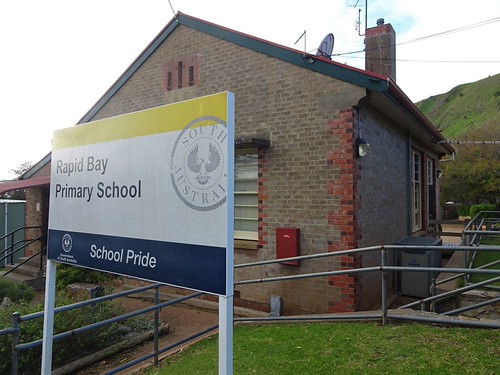
Image by denisbin
Rapid Bay.
This tiny but beautiful spot had a number of historical firsts for SA. This site was the first place on the mainland that Colonel William Light landed. This was on 8 September 1836. He was greatly impressed and painted several pictures of the area. It was his ship the Rapid that gave rise to the name of the settlement here. His assistant Surveyor, Boyle Finniss (who later became the first Premier of SA 1856-57) set up camp here and surveyed the area and grew the first European crop of the colony- a crop of potatoes. On 3 January 1837 his wife Fanny gave birth to the first female child in the colony, and prior to this one of the wives of a survey worker gave birth to the first male child on the mainland (a boy had been born previous to this in the colony on Kangaroo Island). A son was born to John Hoare in November 1836. The first settlers took up land at Rapid Bay in 1840 becoming the first to take up land south of Adelaide. Although they tried wheat growing the immediate area had 5,000 sheep grazing there by 1844. The early land owner was the South Australia Company which sold land on to others. In the 1850s Rapid Bay became the centre of a local council district which stretched from Cape Jervis to Yankalilla.
Rapid Bay’s other claim to fame was the establishment of limestone mining in 1938 by Broken Hill Proprietary. Production began in 1942 for the Newcastle steel works. Around 45 men were permanently employed at the mine; houses were built for workers in Second Valley; and a new power line from Willunga was erected to power the operations. In 1950 a new school opened in Second Valley. South Australia’s only electric railway line to date was eventually constructed to take the limestone to the harbour at Rapid Bay. BHP finished their mining operations in 1981 when 27 men were still employed. Adelaide Brighton Cement took over the limestone mine in 1982 and still owns, but does not operate it.
Image automatically curated and published by www.free-mail.co.za – CLICK HERE to learn more about WP Robot for WordPress.
Have you tried: Visiting Port Elizabeth?