
A cool Paternoster image:
Image from page 157 of “The animal kingdom : arranged after its organization, forming a natural history of animals, and an introduction to comparative anatomy” (1849)
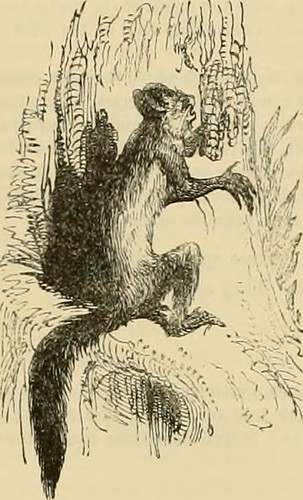
Image by Internet Archive Book Images
Identifier: animalkingdomar00cuvi
Title: The animal kingdom : arranged after its organization, forming a natural history of animals, and an introduction to comparative anatomy
Year: 1849 (1840s)
Authors: Cuvier, Georges, baron, 1769-1832 Metcalf Collection (North Carolina State University) NCRS Blyth, Edward, 1810-1873 Mudie, Robert, 1777-1842 Johnston, George, 1797-1855 Westwood, J. O. (John Obadiah), 1805-1893 Carpenter, William Benjamin, 1813-1885
Subjects: Animals
Publisher: London : Wm. S. Orr and Co., Amen Corner, Paternoster Row
Contributing Library: NCSU Libraries
Digitizing Sponsor: NCSU Libraries
View Book Page: Book Viewer
About This Book: Catalog Entry
View All Images: All Images From Book
Click here to view book online to see this illustration in context in a browseable online version of this book.
Text Appearing Before Image:
e, and Jerboas; but we carry their subdivision much further, from considerations founded on the form of their grinders. The Marmots {Arctomys, Gm.)— Have, it is true, the inferior incisors pointed, as in the greater number of animals comprised in thegreat genus of Rats; but, as in the Squirrels [to which superior group they indubitably appertain],they have five molars on each side above, and four below, all of them sharply tuberculated; accord-ingly, some of the species are inclined to eat flesh, and feed upon insects as well as vegetables. Theyhave four toes, and a tubercle in place of a thumb, to their fore-feet; and five toes to their hind feet.In other respects, these animals are nearly the direct reverse of the Squirrels; being heavy, with shortlimbs, a hairy tail of middle length or short, a large flat head, and they pass the winter in a state of • The Opossums were arrwiged among the Car^arin ill the iiuthots , t The iVoml).it presents the only inst.^nce ninoiigst the M,IT-
Text Appearing After Image:
Fig 45.—The Ays aye. RODENTIA. 111 lethargy in deep holes, the entrance of which they close with a quantity of grass.* They live in society,ami are easily rendered tame. Two species are known in the Eastern continent. The Alpine Iklarmot (.Vim. nipiinu, Lin.), as large a.s a liabbit,with a short tail, and yellowish-grey fur, more nsh-coloured towards the head, which inhabits lofty mountainsimmeiliately below the pen^etual snow line: and the Polish Marmot, or Uobac {M. bobac^ Lin.), the same size asthe other, and yellowish-grey, with a russet tint about the head ; it inhabits the lesser mountains ami hills fromIoland to Kamtschatka, and often burrows in the hardest g-roimd. Russian travellers in Ducharia mention someothers, as Aret. futviu, leptodactulm, and miuogariciu, which are perhaps not sufficiently determined. Americalikewise produces several Marmots. Under the name of SousLiKS {Spermophitm, F. Cuv.),— May be distinguished several Marmots which have check-ponches. Their supe
Note About Images
Please note that these images are extracted from scanned page images that may have been digitally enhanced for readability – coloration and appearance of these illustrations may not perfectly resemble the original work.
Image automatically curated and published by www.free-mail.co.za – CLICK HERE to learn more about WP Robot for WordPress.
Have you tried: Travelling to South Africa?