
A nice South African City image:
Gabbronorite (“Impala Black Granite”) (Bushveld Complex, 2.054-2.061 Ga, Paleoproterozoic; north of Rustenburg, North West Province, South Africa)
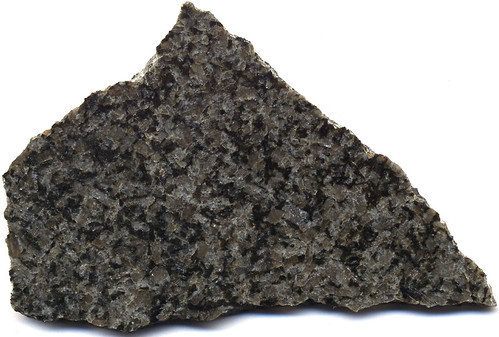
Image by James St. John
Igneous rocks form by the cooling & crystallization of hot, molten rock (magma & lava). If this happens at or near the land surface, or on the seafloor, they are extrusive igneous rocks. If this happens deep underground, they are intrusive igneous rocks. Most igneous rocks have a crystalline texture, but some are clastic, vesicular, frothy, or glassy.
Gabbronorite is an intrusive igneous rock. It is similar to gabbro in that it has a mafic chemistry and a phaneritic texture. Mafic igneous rocks are generally dark-colored, have 45-52% silica (= SiO2 chemistry) (mafic has also been defined as 45 to 55% silica), are rich in iron (Fe), magnesium (Mg), & calcium (Ca), and are dominated by the minerals plagioclase feldspar and pyroxene. Phaneritic-textured igneous rocks are coarsely-crystalline, with all or almost all crystals between 1 mm and 1 cm in size each, the result of relatively slow cooling of magma deep underground. Gabbro is dominated by the minerals plagioclase feldspar and clinopyroxene (= calcium-bearing pyroxene). The similar rock norite has plagioclase feldspar and orthopyroxene (= non-calcium-bearing pyroxene). Gabbronorite (see above photo) has plagioclase feldspar and both clinopyroxene and orthopyroxene.
The sample shown above is a commercial decorative stone called "Impala Black Granite", an attractive, 2 billion year old gabbronorite from South Africa. It is composed principally of grayish plagioclase feldspar and black pyroxene. It comes from the famous Bushveld Complex, a world-class example of an LLI (large layered igneous province). LLIs often have economic concentrations of valuable metals, such as platinum and chromium. North America has one economically significant LLI – the Stillwater Complex of Montana.
The Bushveld has a thick stratigraphy that is well documented. The gabbronorite sample shown above comes from the upper Main Zone of the Rustenburg Layered Suite. It dates to the mid-Paleoproterozoic (2054-2061 million years). “Impala Black Granite” is quarried north of the town of Rustenburg in northeastern North West Province (= northwest of the city of Johannesburg), northeastern South Africa.
Image automatically curated and published by www.free-mail.co.za – CLICK HERE to learn more about WP Robot for WordPress.
Have you tried: Diving with Sharks?