
Nearly 60% of young children are social justice activists – a future full of Elin Erssons:
Since 21-year-old Swedish student Elin Ersson live streamed her protest against the deportation of an Afghan asylum seeker, the video has been viewed more than 11m times on Facebook. The young woman refused to sit down until the man was removed, announcing to the camera and her fellow passengers: “I’m doing what I can to save a person’s life.”
At one point in the video, a man with a British accent is heard telling Ersson:
I don’t care what you think. What about all these children that you, you, are frightening?
His point seems to be that Ersson’s message – about asylum seekers, the refugee crisis and activism – is not for children. According to this argument, children need to be insulated from distressing political and social issues.
This isn’t an unusual opinion, though it is somewhat outdated. People used to think of children as not-yet-adults – “becomings”. But this argument was long ago dismantled by academics in childhood studies, youth workers and the United Nations back in the late 1980s. Children began to be thought of instead as “beings”, respected members of society in their own right.
Article 13 of the United Nations Convention on the Rights of the Child states that children “have the right to freedom of expression; this right shall include freedom to seek, receive and impart information and ideas of all kinds”.
It was this idea that formed the formal citizenship education in the UK at least as it was originally conceived. The 1998 Crick report, which recommended making citizenship part of the national curriculum for England, Wales and Northern Ireland, advised that “many controversial topics are major issues of the day: moral, economic, political and religious issues which young people ought to know about”.
Getting involved
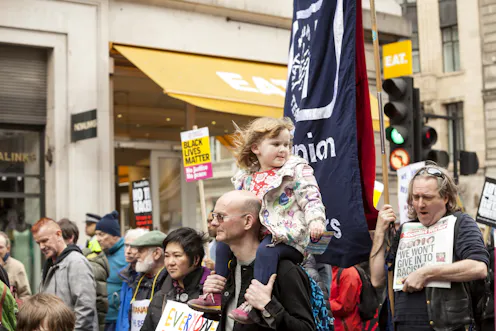
Recent events suggest that children are not only capable of understanding these “major issues of the day” – they’re also able to do something about them. For example, children participated in the recent protests during Trump’s visit to London. Either with their schools or families, children made placards and marched against the US president’s separation of migrant families and his response to school shootings.
And this was not just a one-off: a 2017 UK-wide survey found that 58% of 10-20 year olds took part in some kind of social action – defined by the #iwill campaign as “practical action in the service of others to create positive change”. This can include activities such as volunteering, campaigning and fundraising.
Most found social action to be meaningful, too – 39% of the young people surveyed recognised the benefits which participating social action brought to themselves and others and took part regularly throughout the year. Around 19% felt their participation was not meaningful, while a further 15% felt it was meaningful but didn’t participate regularly. And the 10 to 15-year-olds were actually more likely to participate than the 16 to 20-year-olds.

There’s also interest in social action among children who said they hadn’t actually taken part in any activities during the past year: 20% said that they’d be interested in taking action to fight social inequality in the future. So there’s an appetite here for children to learn about important issues and take action on them.
Making it normal
What we really need to be doing is making it easier, not harder, for children to take action on social issues. One way is to make social action “normal” and visible, so that children see others doing too.
Research has found that 10 to 20-year-olds with family and friends who are involved in social action were more likely to take part than those whose friends and family weren’t involved. The more we normalise standing up for what we believe in, as Ersson did, the easier it might be for children to take action.
In Ersson’s case the protest was successful. The Afghan man being deported was removed from the plane and, at least temporarily, returned to Swedish land. Student activism is nothing new, but social media now makes it possible for protests like Ersson’s to reach unprecedented numbers in a short space of time. If this means more Elin Erssons in future, all the better. The children will be fine.

Emma Taylor-Collins previously worked for Step Up To Serve, the charity coordinating the #iwill campaign.
: The Conversation – Articles (UK)
Have you tried: Diving with Sharks?