
 As a water stressed country, South Africa is expected to reach a 17% deficit of water by 2030. The country has a history of building dams to address water security needs and to provide essential bulk water supply to its population. However, the construction of dams does come with disadvantages. Sedimentation rates in South Africa are extremely high and pose a serious threat, alongside increased water demands in the region. In the last year, some of the country’s dams have experienced up to 90% sedimentation, leading to storage capacity losses of between 10% and 30%.
To assist in addressing these challenges, the South African Department of Water and Sanitation (DWS) has appointed the Water Research Commission (WRC) to develop the National Siltation Management Strategy for Large Dams in South Africa, more commonly known as the NatSilt Programme. The programme represents a collaborative, transdisciplinary approach to tackle the wide spectrum of dam sedimentation and storage capacity challenges in South Africa.
It was launched officially during a two-day virtual WRC NatSilt Symposium, held on Wednesday, 19 and Thursday, 20 May 2021 under the theme “Protecting our Source Water Systems”. The event brought together stakeholders across the sectors of water and sanitation and environmental management.
Leonardo Manus, Acting Deputy Director General: Infrastructure Operations & Maintenance at the Department of Water & Sanitation, said, “We have established our whole economy and livelihood around these majestic dam structures, but we can so easily lose them if you don’t apply proper management procedures to keep them in that state.
Striving for efficiency, effectiveness and sustainability
“The NatSilt Programme will provide the department with tools and intelligence to make appropriate, site-specific decisions regarding each dam instead of having a blanket approach,” he said. “Where sedimentation occurs to such an extent that it has to be dealt with, we will create a business model that will not be to the detriment of those who are dependent on the dam. To minimise costs to the downstream users in that specific catchment, we need to find alternatives to expensive methodologies and dredging models deployed to keep any dam operating,” he added.
The NatSilt Programme thus aims to ensure that bulk water resource infrastructure is managed in an efficient, effective and sustainable manner to ensure economic growth, social development and poverty eradication.
It is initiated and funded by the DWS through its Infrastructure Build Operate and Maintenance (IBOM) branch, which has responsibility for asset management and infrastructure maintenance of 276 government water schemes in the country, including 321 large state dams that make up more than 90% of the country’s total storage capacity.
Dr Shafick Adams, Executive Manager: Water Resource and Ecosystem at the WRC, said some of the pressing water challenges requiring mitigation and adaptation include those related to climate change, extreme weather variability, dealing with vandalism of infrastructure, operation and maintenance issues and user behavior, among others. Managing and prolonging storage availability of dams by limiting silting of dams is one of the strategies to ensure water security into the future.
“These challenges require an institutional and governance response that is not only focused on getting more water to people, but also protects and manages our dam assets effectively. That includes considering land use planning. In most cases the dam is the symptom of the problem, rather than the problem itself. Upstream behaviour, coupled with poor land use, is usually responsible for the unnatural release of sediment into a dam,” he said.
The key deliverables of the NatSilt Programme are to develop:
- A Dam Basin SiItation Management Operations Model
- A Sustainable Dredging Business Model/s
- A Dam Basin Classification Decision-Making Tool
- Capacity Building
- A step-by-step comprehensive Implementation Plan and Piloting of the draft Strategy, Models and Tools
- A Pilot Plan potentially rolled out in 3 Government Water Schemes – Welbedacht Dam in the Free State, Hazelmere Dam in Kwazulu-Natal, and Darlington Dam / Orange-Fish GWS in the Eastern Cape
There are four sub projects that will synchronise across the NatSilt Programme. Sub Project 1 will focus on Development of a Siltation Management Strategy. Sub Project 2 will focus on Dam engineering and socio-ecological systems (SES). Sub Project 3 will explore Sustainable Dredging of Dams, while Sub Project 4 will investigate and implement Training and Capacity Development.
The NatSilt Programme will be undertaken over three phases within three years and is expected to be concluded in 2023. The first phase will involve conceptual and strategic development, and research and assessments, followed by practical piloting of the decision-making tools, models and concepts in Phase 2. Phase 3 will see the culmination of the programme and application of learnings to revise the strategy and adapt the models and tools.
Watch a video summary of the NatSilt Programme here: https://www.youtube.com/watch?v=7BOtiQlMm6o
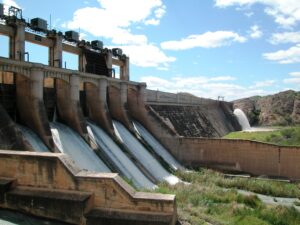
Darlington Dam in the Eastern Cape is one of 3 Government Water Schemes that will potentially serve as a pilot site for the NatSilt Programme execution. The others are Welbedacht Dam in the Free State and Hazelmere Dam in Kwazulu-Natal. Photo: Addo Elephant National Park
CLICK HERE to submit your press release to MyPR.co.za.
Submit your Press Release for free to MyPR here: MyPR Free Press Release Submission.