
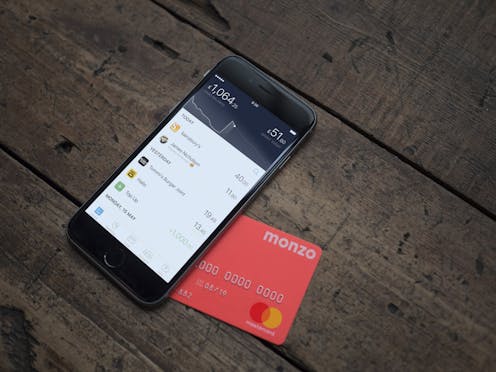
Monzo, Revolut and other challenger banks are shaking up the industry:
Digital technology has transformed the established ways of doing business across industries – and banking is no exception. New start ups are challenging traditional service providers with a more personalised and innovative service. Traditional banks have been slow to adapt but they haven’t – yet – lost too much of their business.
Challenger banks like Starling, Monzo, Revolut, Atom and Tandem are all digital banks without high street branches. They are more flexible, quicker to adapt to user needs, more user friendly and more personal than traditional banks. Their biggest advantage is that they have started fresh with a digital offering and the use of the latest technology available. Traditional banks, meanwhile, are typically slower to respond to market demands and keep up-to-date with technological developments.
In contrast, challenger banks are able to incorporate new products much more quickly and with less friction through their platform business model, which can easily connect customers with new products developed by third parties. This greatly increases customer choice.
For instance, the account opening procedure is a lot easier and quicker with challenger banks, often only involving taking a picture of your ID and a video of yourself. Plus, they offer novel features such as making recommendations based on your transaction data for saving money, making payments to nearby friends via bluetooth, or even blocking gambling transactions from customer accounts.

They can also be better at security and preventing fraudulent behaviour thanks to their more intelligent analytic capabilities. Monzo, for example, recently noticed a data breach of the ticketing platform Ticketmaster more than a month before Ticketmaster did and took action to replace all cards that had used Ticketmaster, without waiting to receive customer requests.
The trend of these new providers has been accelerated by recent regulatory changes in the UK (Open banking) and across Europe (PSD2). Taking effect in early 2018, these reforms force banks to share their customers’ data with third parties that can provide financial services if their customers request this. The change aims to boost competition and also challenges the powerful position of the traditional banks in the market by forcing them to share customers with new players.
What most challenger banks have in common is their ability to offer lower fees to their customers due to their lean set up and lower cost structure. Challenger banks (and fintech start ups in general) capitalise on the perception that they are looking after the customers’ best interests, rather than doing what is best or most profitable for themselves (at least not in the short term).
But this benefit to the customer makes it difficult to make profits. This is the norm for most UK challenger banks, as their focus is on accelerated growth and winning over new customers, while trying to work out their business model and how they will turn profits in the long term. Revolut marked itself out as an exception when it reported breaking even in December 2017.
Trust issues
Part of the issue is that, although challenger banks bring obvious benefits to users, we do not see a large number of customers leaving their traditional banks for these new players. While challenger banks increase their customer base and market presence, the number of customers using these banks as their main bank and having their payroll registered to them is low.
The main reason for this is trust. Trust is of paramount importance when it comes to where customers put their money, and here established banks seem to have the upper hand. The common view is that even though the customers do not trust traditional banks for giving them the best deals, they trust these banks for keeping their money safe.
The system failures that new players might face can also cause hesitation among potential customers and make gaining their trust more difficult. For instance, app-only banks including Monzo, Revolut and Starling ran into problems and went down briefly last year due to issues with one of their technology suppliers. In June of this year, Starling and Revolut both experienced weekend-long outages. Even though the companies announced that the issue was caused by their partner for payment processing, users were quick to declare the event “the end for open banking”.
The overall picture we see so far in our research into challenger banks is that people stick with their traditional banks for keeping their savings and salaries and prefer making frequent, small payments into their challenger bank accounts to use in their daily lives.
The pessimists say that the challengers will not necessarily win out. Although they are growing their users every day, they will not be able to grow beyond a certain size and will need to be acquired by established players. On the other hand, stats show that millennials are much more willing to switch financial providers in order to get better, more customised services.
Plus, despite the uncertainty around the future of challenger banks, there are hints – including new regulations and tech firms getting into financial services – that show there will be no return to banking as we have known it.

Pinar Ozcan receives funding from the Strategic Management Society Research in Organisations Program.
Dize Dinçkol receives funding from Strategic Management Society Research in Organisations Program.
Markos Zachariadis receives funding from Strategic Management Society Research in Organisations Program.
: The Conversation – Articles (UK)
Have you tried: Diving with Sharks?