
Mikhail Gorbachev: southern Africans have a special reason to thank him:
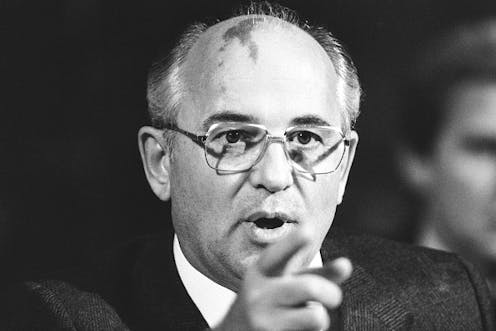
The whole world has much to thank Mikhail Gorbachev for. As many have pointed out since his death in Moscow earlier this week, Gorbachev – the last leader of the Soviet Union – did more than anyone to bring the Cold War to an end peacefully, reducing the threat that nuclear weapons might be used.
He allowed the countries of Eastern Europe to move out of the Soviet orbit and towards democracy in 1989. And he tried to set Russia on the path to a more democratic society. His actions led to the break-up of the Soviet Union in 1991.
Though Vladimir Putin views that break-up as a very negative development, most have welcomed it.
Southern Africans have a special reason to thank Gorbachev. He helped bring apartheid to an end. He did this both directly and indirectly.
Pivotal interventions
The assistance that the Soviet Union provided to both the People’s Liberation Army of Namibia and Umkhonto we Sizwe was essential in enabling them to fight armed struggles against the South African regime. Without that assistance the South West Africa People’s Organisation and the African National Congress might not have survived in exile, or ultimately come to power.
But it was not those armed struggles that brought them to power. That was made possible in part by the fact that from 1988 the balance of forces in the region changed. In that Gorbachev played a major role.
Soon after taking over as general secretary of the central committee of the Communist Party of the Soviet Union in 1985, he decided that the Soviet Union should withdraw from regional wars in which it was engaged, most notably in Afghanistan and Angola.
He then authorised his diplomats to engage with the Americans to help mediate a negotiated settlement for Angola. They assisted in that process, which led to an agreement being reached in December 1988 that provided for the withdrawal of the Cuban military from Angola and the independence of Namibia.
The Soviet Union then participated in the joint commission that was set up as a result of that agreement to ensure it was implemented. When a crisis in April 1989 threatened its implementation, the Soviets again worked with the Americans to help defuse the crisis, after which Namibia moved towards independence with the assistance of the United Nations.
By then the Soviet Union had made it clear that it was in favour of a negotiated settlement in South Africa. At the same time, the communist ideology that had underpinned the Soviet Union and its satellite countries was crumbling.
The success of the Namibian transition helped make possible the South African one that followed. But it was also the collapse of the communist regimes of Eastern Europe, and the removal of what South Africa’s National Party government had seen as a communist threat, that made it possible for the new President of South Africa, FW de Klerk, to take his party with him when he agreed to open the door to a negotiated settlement.
The collapse of communism in Eastern Europe and the Soviet Union destroyed what remaining credibility the idea of a “total onslaught” still had in National Party circles and reduced fears, both in those circles and in Western capitals, that the South African Communist Party would control the ANC if it were to come to power.
Though de Klerk initially hoped for a power-sharing arrangement, even such a settlement, which turned out not to be possible, meant the end of apartheid and white minority rule.
Unexpected outcomes
Like Gorbachev, De Klerk was a reformer whose domestic reforms led to unexpected consequences.
When De Klerk made his breakthrough speech in February 1990, unbanning the ANC and announcing that Nelson Mandela would be released from prison unconditionally, he made much of what had happened in Eastern Europe and the Soviet Union in late 1989. He said that events there had weakened “the capacity of organisations which were previously supported strongly from those quarters”.
Without Gorbachev those changes would not have taken place, and without them it is unlikely that De Klerk would have moved as he did at that time.
By the end of the 1980s, internal pressures, most particularly from mass resistance, and a variety of external pressures from the west, including sanctions, were undermining the apartheid regime.
But of all the external factors that helped lead to the ending of apartheid in 1994, the collapse of the communist regimes of Eastern Europe and the process leading to the end of the Soviet Union must count among the most important.
And we have Gorbachev to thank for that.

Chris Saunders does not work for, consult, own shares in or receive funding from any company or organisation that would benefit from this article, and has disclosed no relevant affiliations beyond their academic appointment.
: The Conversation – Articles (AFRICA)
Have you tried: Farking?