
Macbeth at the National: powerful domestic tragedy spoiled by needless clutter:
On the train to the National Theatre recently to see Rufus Norris’s production of Macbeth I was concerned to read a comment about the play in the London Evening Standard by Charlotte Edwardes, who was wondering what to do with her tickets: “As each day goes by the reviews get more terrible. Do I sell them or do I still go?” My response would be to reassure her. This is, in both senses, a grim show – but it contains two wonderful performances.
Of Shakespeare’s tragedies, Hamlet and King Lear are huge plays – the former wrestles with the agonies of life and death and the latter addresses the metaphysics which surround them. By contrast, Othello is a domestic tragedy, about infidelity and the groundless jealousies which more properly belong to a cuckolding comedy. Macbeth can go either way. It is a grand lament for the collapse of civilisation following an almost blasphemous act of regicide. But it is also about a marriage ruined by infant death and spiteful recriminations about masculine impotence. It is either a supernatural epic or an everyday study of the banality of evil.
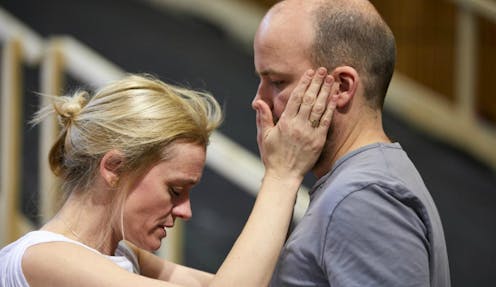
Norris’s miscalculation was to make his production try to do both and the result was a sprawling mess punctuated by several fine, claustrophobic and intense exchanges between the Macbeths, played here by Rory Kinnear (surely the finest Shakespearean of his generation) and Anne-Marie Duff. As he flattered her on her “undaunted mettle [which] should compose / Nothing but males”, she winced at the memory of their dead child. A flicker of shame shot across his face as he registered his tactlessness, but it was too late.
Following the interrupted feast, at which Macbeth has just seen the blood-drenched ghost of Banquo, assassinated on his orders, Lady Macbeth urged him to rest as she attempted to caress his face: “You lack the season of all natures, sleep.” With aggressive petulance he shot back at her: “Come, we’ll to sleep” in the most sarcastic tone, as though to suggest the triviality of her suggestion in the teeth of their murderous offences. Yet later, as he cradled her dead and bloodied body in a woeful pieta, he was heartbroken at her loss.
The Macbeths were to each other, by turns, loving, cruel, gentle and reproachful – a knowing portrayal of any ordinary couple, but one who here (almost accidentally) found themselves up to their necks in blood.
Such a portrayal would have made complete sense and, indeed, Warwick University’s Paul Prescott has judiciously trimmed the text to ensure that the domestic setting takes centre stage. Gone were Duncan’s second (and largely redundant) son, Donalbain, the witches’ hocus-pocus around the cauldron and Malcolm’s unmotivated and incomprehensible u-turn in England scene towards the end which stretches an already overlong scene almost to the crack of doom. The Porter’s gobbledegook was also thankfully edited.

But Norris would not let go of the play’s supernatural features which left us with three quite normal looking young women – although draped in limbs of plastic dolls – climbing up and down poles and standing around amid puffs of smoke. Kinnear was capable of driving his own Macbeth into action without recourse to these witches who felt as though they’d wandered in from an alternative production.
Apocalyptic setting
Perhaps the most conspicuous way in which this Macbeth aspired to some sort of elemental stature was its (over)designed gloominess. Set designer Rae Smith has positioned an enormous convex ramp from upstage centre down to the footlights. This could be hinged across the width of the stage (though not without some intrusive shoving).
Upstage, huge curtains – made of torn black bin-liners – were randomly flown in and out. The Macbeths occupied a concrete bunker which revolved to reveal piles of dirty laundry, a bucket, crappy furniture and other domestic detritus. The banquet was served on a couple of trestle tables, food scooped from billy cans and “wine” poured from grubby plastic containers which might more usually have contained antifreeze. There was a hole in the wall surrounded by scorch marks as though the room had narrowly survived a missile hit. Duncan’s seat of power was an orange plastic chair propped against a transparent plastic sheet supported on two builder’s tripods.
Costumes were tramp coats and dirty t-shirts. Hands and faces were grimy and unwashed and Macbeth’s armour, lacking buckles, was stuck to him with packing tape. This was an apocalyptic setting out of all scale to the detailed intensity of its central performances and aurally ruined by the intrusive witterings, whispers and echoes of voices, ominous parps of “new wind instruments”, clarinets and horns.
Macbeth is a short, tightly focused play – the only one of Shakespeare’s tragedies without subplot – and its simplicity is its devastating strength. Norris had managed to find this strength in the compelling detail of Kinnear and Duff’s central performances. What a shame he has had to overload them with so much conceptual and extraneous clutter.

Peter J Smith does not work for, consult, own shares in or receive funding from any company or organization that would benefit from this article, and has disclosed no relevant affiliations beyond their academic appointment.
: The Conversation – Articles (UK)
Have you tried: Visiting Port Elizabeth?