
Leopold Mannes – The co-inventor of Kodachrome on ‘The Theory of Color and its Application to Photography and Art’
- Unconditionally guaranteed authentic without time limit to the original purchaser.
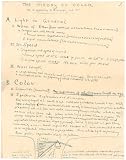
MANNES, LEOPOLD. (1899-1964). Co-inventor of Kodachrome, the first color photographic film. AMsS. (“Leopold Mannes”). 3pp. 4to. N.p., N.d. A highly interesting manuscript entitled The Theory of Color, and its Application to Photography and Art, which includes a small drawing. Written on three separate sheets of paper. After a disappointing viewing of the 1917 film Our Navy in Prizma Color, a successor of Kinemacolor, Mannes and his friend Leopold Godowsky, Jr. began experimenting with the use of colored filters and film, patenting a new process even before their high school graduation. They continued their experimentation and research while Mannes was studying physics and piano at Harvard and Godowsky violin at UCLA. Eventually, with backing from an investor, the pair were able to convince Kodak of the value of their discoveries. In 1930, they moved to Kodak’s Rochester headquarters and within three years had developed the technique of three-color emulsion which made Kodachrome film possible. Commercial sale of Kodachrome began in 1935 and continued until 2010. After the perfection of Kodachrome, both Mannes and Godowsky returned to the world of music. Our long and meticulous outline explains in detail how various colors and their wavelengths respond to various processes including those used by French landscape painter Claude Monet (1840-1926), French manufacturer of photographic equipment and inventor of an early motion-picture camera August Lumière (1862-1954), the Paget process invented by G.S. Whitfield in 1912, and the Hess-Ives process. With small fold tears along the center horizontal fold. In very good condition. A fine, technical paper, written by a largely forgotten polymath of the 20th-century.

Price: [wpramaprice asin=”B0096SAR28″]
[wpramareviews asin=”B0096SAR28″]
[wprebay kw=”applications” num=”0″ ebcat=”-1″]