
#JeSuisCharlie was one of the most viral hashtags in history – here’s why it wouldn’t happen today:
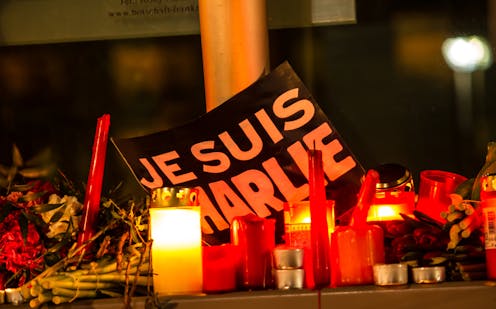
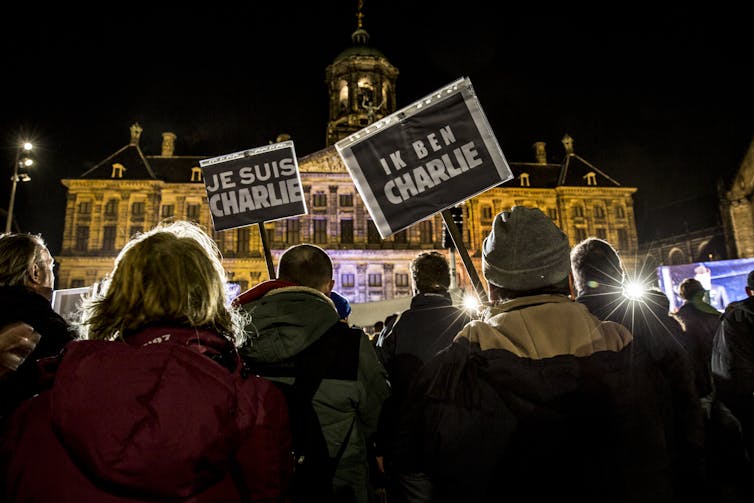
It will be nine years on January 7 since a shooting at French weekly satirical magazine Charlie Hebdo killed 12 and injured 11 of its employees. The attack led to an immediate and unprecedented outpouring of solidarity around the world. Much of this support was organised online, using the hashtag #JeSuisCharlie (I am Charlie).
In my PhD research, I am exploring the role of social media in commemoration, specifically when it comes to terror attacks. The immense popularity of #JeSuisCharlie is a prime example of how the technology available to us can shape our understanding of shared experiences.
The designer Joachim Roncin is credited with the first use of the phrase, which he posted to Twitter less than an hour after the attack started. It was immediately turned into a hashtag and within a week it had been used about six million times, becoming one of the most retweeted hashtags in history.
When the attack took place in early 2015, Twitter use was hitting its peak, with hashtags well established as key drivers of content. Successful hashtags shared a number of characteristics: they were emotional, polarising, easy to adapt and made use of a catchy slogan to tell a bigger story.
The hashtag #JeSuisCharlie capitalised on all of these. It was widely adopted by those defending free expression, but a flurry of counter-narratives quickly emerged providing alternative perspectives on the attack. Another hashtag, #JeNeSuisPasCharlie, (I am not Charlie) was used by those who were against the attacks but also disagreed with the offensive content of the publication. Meanwhile, #JeSuisAhmed paid tribute to Ahmed Merabet, the French Muslim policeman killed in the attack.
The story of Charlie was complex, but the structure of the hashtag demanded that people pick a side. To be or not to be Charlie was something beyond the attack on Charlie Hebdo’s offices. It represented historical and cultural debates deeply embedded in French society around freedom of expression, human rights, the role of cartooning and laïcité (the separation of religion from the state).
Lasting power
The hashtag #JeSuisCharlie had a global reach, with Spanish and English translations also becoming popular.
It has had an enduring legacy which is unusual for social media. After a knifeman wounded two at the former site of Charlie HQ in 2020, the hashtag reemerged in various forms. In reviewing tweets from recent years, I’ve found that engagement with #JeSuisToujoursCharlie (always Charlie), #PlusQueJamaisCharlie (more than ever Charlie), and #JamaisCharlie (never Charlie) has continued the narrative in new and nuanced ways.
The viral phenomenon of #JeSuisCharlie (and its other versions) shows how Twitter and the hashtag enabled a global movement of solidarity and collective remembrance unlike anything seen before.
Nine years later, our interactions with social media platforms have evolved. We have not experienced a viral hashtag on the scale of #JeSuisCharlie in many years, and it seems unlikely to be replicated again.
What would #JeSuisCharlie look like today?
We engage with social media differently than we did in 2015. Twitter is now X, and Elon Musk’s takeover has driven users toward other platforms like Mastodon and Instagram’s Threads. Younger users in particular are choosing sites such as TikTok and Instagram over X and Facebook.
The hashtag remains as an organising feature of social media, but it is now used regularly across platforms. We could expect Charlie today to be even more polarising, as the message is dispersed into different, fragmented communities on Facebook, X, Instagram and TikTok.
These days, social media users create shared memories by connecting their individual experiences rather than expressing genuine collective solidarity as seen in #JeSuisCharlie. In other words, people are more likely to share their own personal narratives as part of a bigger story, rather than repeating or retweeting one unifying message.
Viral content today spreads in unpredictable and intense pockets of activity, bubbling up and dying down almost immediately, with cycles sometimes lasting as little as two or three hours. Because of this, it’s often difficult to trace a single point of emergence for a particular phrase or idea. And platforms such as TikTok make it easier to respond, adapt or remix content instead of just sharing it.
The use of algorithms to influence user behaviour on social media means shared memories are now often circulated in echo chambers. This makes it less likely that a user would come across even a popular hashtag organically.
Today’s viral movements burn brightly but are short-lived, and often lost in the sea of content – which now includes AI-generated material. We can still expect practices of shared remembering, such #JeSuisCharlie, to emerge in some form. But nearly ten years from now, will we still remember the popular hashtags of today? Almost certainly not.

Emma Connolly does not work for, consult, own shares in or receive funding from any company or organisation that would benefit from this article, and has disclosed no relevant affiliations beyond their academic appointment.
: The Conversation – Articles (UK)
Have you tried: Diving with Sharks?