
Jellyfish: our complex relationship with the oceans’ anti-heroes:
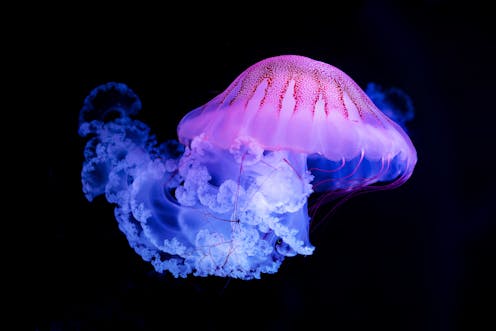
Ding! The courier hands me an unassuming brown box with “live animals” plastered on the side. I begin carefully unboxing. The cardboard exterior gives way to a white polystyrene clamshell, cloistering a pearly sphere-shaped, water-filled bag. Lightly pulsing, I spot them: three cannonball jellyfish (Stomolophus meleagris). Each the size of a 50-pence coin.
After months of waiting, my first gelatinous companions had arrived and I was finally ready to begin my research on human connections with jellyfish.
Cannonball jellyfish are an unusual pet choice. Whether stinging beachgoers, clogging power station intake pipes, or outcompeting more popular ocean wildlife, jellyfish are often labelled nuisances.
Despite their poor press, they have a growing community of admirers. Thousands of people drift to aquariums each year to admire jellyfish. Darting around and bumping into one another, tentacles circling or gently pulsing they inspire delight in their guests. The Californian Monterey Bay Aquarium’s Jellyfish: Living Art was the organisation’s most popular and long-running exhibit since opening in 1984.
Jellyfish not only have the ability to captivate us. It may also benefit our health. A study has shown eating cannonball jellyfish, for example, can reduce the effects of arthritis – albeit so far only in a small group of rats.
A biological wonder
Perhaps more importantly, however, we can learn a lot from studying the incredible biology of jellyfish. For example, immortal jellyfish (Turritopsis dohrnii) sidestep the ageing process by reverting to their polyp stage.
Crystal jellies’ (Aequorea victoria) green fluorescent protein (GFP), found in organs within the animal’s bell, allows scientists to study gene expression. Gene expression is the instruction manual DNA follows, for example, to become proteins. This process can be quite complex and difficult to follow. But the GFP lights up under ultraviolet light, which helps scientists map the different processes a cell goes through as it follows DNA instructions.
Jellyfish deserve more of the public’s attention. They are a major player in the marine food web and have complex relationships with other wildlife. For example, cannonball jellyfish have a fascinating relationship with young spider crabs (Libinia spp.) that live inside their bells. This gives the crabs security and research suggests jellyfish hosting crabs grow larger than those without, but it’s not clear why.
Some scientists say jellyfish are climate-change survivors, which they don’t mean as a compliment. Despite rising temperatures, they sometimes “jellify” the ocean because of their sudden population “blooms”. However, they have their own climate-change-related problems.
For example, temperature increases in Palau’s Jellyfish Lake in the South Pacific have been linked to the disappearance of golden jellyfish (Mastigias papua). Jellyfish blooms are also often followed by crashes in their populations, which are caused by several overlapping factors such as food shortage, predation, parasites, disease, weather and getting stranded on beaches.
Sea curiosities
There are so many reasons humans should make an effort to understand jellyfish better. Research suggests ocean literacy is best cultivated through hands-on experience and personal interactions. But the technology aquariums use to bring jellyfish to the masses limit how involved audiences can be with the animals.
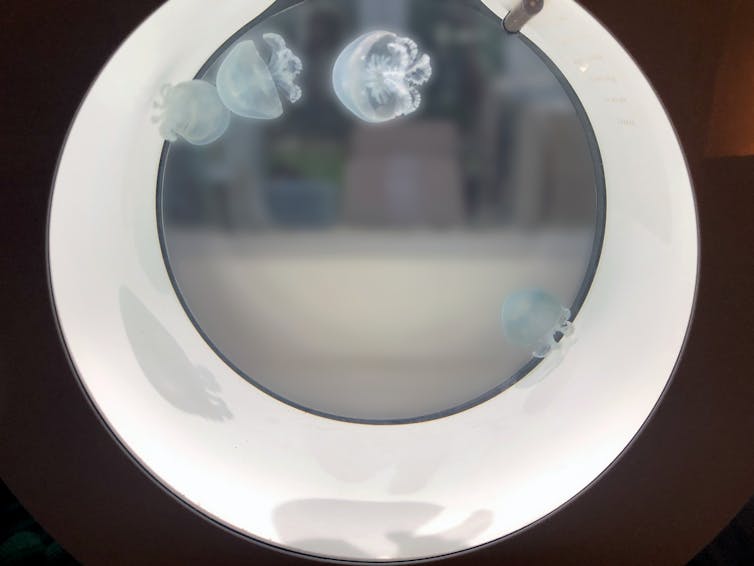
Although scientists have argued technology can damage people’s relationships with other animals, it can help us reconnect with our environment too.
Because jellyfish are 95% water, they are extremely sensitive to their surroundings. Most kit tanks (often referred to as nano aquariums) hold a small water volume, which makes it difficult to maintain the right conditions such as pH, ammonia levels and temperature.
Bacteria must be introduced into the tank to control jellyfish waste (ammonia) by converting it into nitrite and then nitrate. These bacteria are similar to the oxygen-producing microbes in the ocean that form the basis of all ocean food webs, and help maintain the ocean cycle. The nitrate is removed by replacing small amounts of aquarium water with purified salt water.
As I discovered, if these conditions are not maintained, the jellyfish can suffer from bell holes (small circular tears in jellyfishes’ bells) and eversion (when the outer portion of the bell inverts). When aquarium jellyfish suffer eversion, high water temperature is often the culprit. Learning how to care for jellyfish in these kits is learning about their complex relationships to our oceans.
The closer we feel to our environment, the more likely we are to fight to protect it. So next time you visit the seaside or your local aquarium, try to slow down, absorb the experience and see if you can learn something new about jellyfish and wider ocean wildlife.

Matthew Beach receives funding from Queen Mary, University of London. He has also previously received funding from the Royal Geographical Society (with the Institute of British Geographers).
: The Conversation – Articles (UK)
Have you tried: Diving with Sharks?