
India to Africa to the UK: Diasporas don’t influence politics in predictable ways:
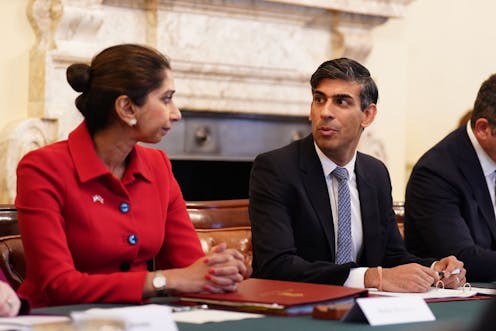
Leading politicians in the UK, including the prime minister, Rishi Sunak, are of African Indian descent. Other high profile examples include the country’s two most recent home secretaries – Priti Patel, who served from 2019 to 2022, and her successor Suella Braverman, whose tenure ended abruptly on 13 November when she was fired by Sunak.
The home secretary is responsible for law enforcement in England and Wales, national security and immigration.
Sunak’s grandparents left the Punjab in northern India for east Africa in the 1930s. His mother was born in Tanzania and his father in Kenya.
Patel’s parents were immigrants from Uganda; she was born in the UK and cherishes her “deeply held British values.”
Braverman, too, was born in Britain. Her mother grew up in Mauritius, a former French colony, and her father is of Kenyan Indian origin. Braverman calls herself “a child of the British Empire”.
All three are part of the African Indian diaspora. Do they tell us anything about the cohort of people who have had the same experiences as the children of migrants and as part of a diaspora?
I have researched the Indian and African diasporas and found that, in fact, members of diasporas have supple and dynamic political positions. Sunak, Braverman and Patel, among others, provide real life examples of how diasporic people exhibit a wide range of political affiliations, outlooks and opinions.
Some researchers used to believe that diasporic and immigrant communities would function as a “unified polity” – they might all vote the same way. This thinking holds true for many whose work focuses on diasporas and politics – but for those, like me, who research diasporas and migration, there’s been a shift in the last decade or so towards more complex understandings. My research is qualitative, allowing me to delve more deeply into the complexity and idiosyncrasy of diasporic communities.
Diasporas on the move
An African Indian is a member of the Indian diaspora whose family is or has recently been Africa-based.
In the early 1970s, former Ugandan president Idi Amin implemented several hostile, xenophobic policies. In 1972 he ordered all Indian Ugandans to leave the country. Many East African Indians, including those from Tanzania and Kenya, emigrated because of open discrimination against them, heading to countries like Canada and the UK in greater numbers.
It wasn’t just Amin who drove those of Indian descent from the continent. Throughout the 20th century, and especially after the second world war, Britain’s colonial subjects started arriving in the UK. In prior centuries, British imperialism and settler colonialism also spurred many waves of migration, including some of those of the African Indian diaspora.
A diasporic group lives in a geographical location other than their original homeland. Researchers have long been interested in whether members of ethnic or religious diasporas would act as a bloc of unified political actors in influencing their homeland politics or the political climate in their new adoptive countries.
Dynamic, discursive identity
Researchers have highlighted how diasporas can “rediasporise” as children, grandchildren and great-grandchildren move to new locations. Members of diasporas may choose to identify with multiple homelands and host countries over time.
But they may choose to identify with one more than the other or do something else entirely. Take Braverman: although a member of the Indian and African diasporas, she has been outspoken about tightening the UK’s immigration policy. She’s on record as having said:
Look at migration in this country – the largest group of people who overstay are Indian migrants.
Expecting her to have an automatic affiliation with her past isn’t reasonable. Recent scholarly work on diasporic identity has sought to understand identity not as static and “essentialist” but dynamic and discursive. It is also co-constructed, created as an interplay between the individual and the structures – of race, ethnicity, religion, national context and so on – in which she finds herself.
Read more: Idi Amin’s ‘economic war’ victimised Uganda’s Africans and Asians alike
Real-life examples like those of Patel, Braverman and Sunak can help diaspora scholars like myself sharpen our analysis of diasporic communities. As scholars, we cannot presume to know how members of diasporas will identify themselves and what their politics will be without doing extensive research. This will build a better understanding of the complex ways that diasporic communities will contribute to society in their new homes.
All we can say for sure is that diasporic identities and identifications are fluid, mobile and creative. Diasporic people cannot be pigeon-holed or put in a box.

Melissa Tandiwe Myambo does not work for, consult, own shares in or receive funding from any company or organisation that would benefit from this article, and has disclosed no relevant affiliations beyond their academic appointment.
: The Conversation – Articles (AFRICA)
Have you tried: Travelling to South Africa?