
A nice Paternoster image:
Image from page 782 of “The animal kingdom : arranged after its organization, forming a natural history of animals, and an introduction to comparative anatomy” (1849)
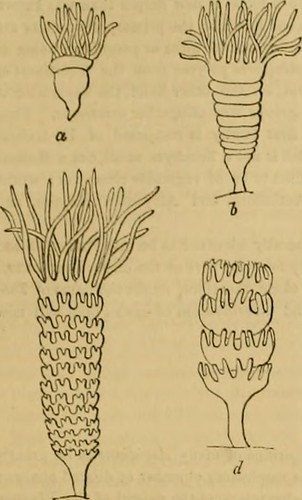
Image by Internet Archive Book Images
Identifier: animalkingdomar00cuvi
Title: The animal kingdom : arranged after its organization, forming a natural history of animals, and an introduction to comparative anatomy
Year: 1849 (1840s)
Authors: Cuvier, Georges, baron, 1769-1832 Metcalf Collection (North Carolina State University) NCRS Blyth, Edward, 1810-1873 Mudie, Robert, 1777-1842 Johnston, George, 1797-1855 Westwood, J. O. (John Obadiah), 1805-1893 Carpenter, William Benjamin, 1813-1885
Subjects: Animals
Publisher: London : Wm. S. Orr and Co., Amen Corner, Paternoster Row
Contributing Library: NCSU Libraries
Digitizing Sponsor: NCSU Libraries
View Book Page: Book Viewer
About This Book: Catalog Entry
View All Images: All Images From Book
Click here to view book online to see this illustration in context in a browseable online version of this book.
Text Appearing Before Image:
Fio. 7.—Dev OFMkDIia; a, h,e,tpolypiiid growth. view of the stage j. Now in this condition, the animal is in every essential particular, a true Polype; and hasbeen repeatedly so described. It remains attached by its base to one spot, draws its food into its mouth bymeans of its arms, and these contract when the stomach is distended, and cannot then be irritated to movement.Not only docs it live as a Polype, but it also reproduces itself as a polype ; for polype-buds are not unfrequentlyseen to issue from its sides (Fig. 7,1); these become detached and form new individuals, just as in the Hydra. Thusfrom a single individual, a whole colony may be produced ; and these may all continue in the polypoid conditionfor many months, or even years. But under some peculiar circumstances, whose nature has not yet been deter-mined, an entirely new series of changes at last takes place. The body assumes a more elongated cylindrical form RADIATA. 697
Text Appearing After Image:
than it previously possessed ; and a constriction or indentation is seen around tliis cylinder, Just below tne rin)*tluit surrounds the mouth and gives origin to the tentncula (Kig. 8, a.) Similar constrictions are soon rt-puutvdaround the lower parts of tlie cylinder, so as to give to tlio wholebomewhat the appearance of a rouleau of coins (b). Still, how-ever, a sort of fleshy bulb,—somewhat in the form of the originalpolype, is left at the base. The number of tlie circles is indcH.nite, and all are not formed at once ; now constrictions appear-ing below, after the upper portions have been detached. Asmany as twenty-seven disks Iiavo thus been progressively sepa-rated in one animal. The constrictlunfi then gradually deepen,so as almost to divide the cylinder Into a pile of distinct saucer-liko bodies ; the divisions being most complete above, and theupper disks often presenting a considerable increase in tlieirdiameter. As the disks thus become more distinct from eachother, anil o
Note About Images
Please note that these images are extracted from scanned page images that may have been digitally enhanced for readability – coloration and appearance of these illustrations may not perfectly resemble the original work.
Image automatically curated and published by www.free-mail.co.za – CLICK HERE to learn more about WP Robot for WordPress.
Have you tried: Travelling to South Africa?