
A cool Paternoster image:
Image from page 274 of “The animal kingdom : arranged after its organization, forming a natural history of animals, and an introduction to comparative anatomy” (1849)
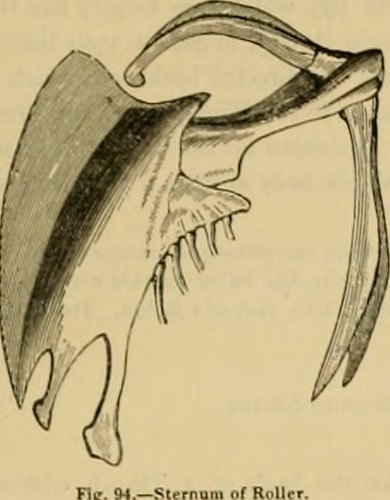
Image by Internet Archive Book Images
Identifier: animalkingdomar00cuvi
Title: The animal kingdom : arranged after its organization, forming a natural history of animals, and an introduction to comparative anatomy
Year: 1849 (1840s)
Authors: Cuvier, Georges, baron, 1769-1832 Metcalf Collection (North Carolina State University) NCRS Blyth, Edward, 1810-1873 Mudie, Robert, 1777-1842 Johnston, George, 1797-1855 Westwood, J. O. (John Obadiah), 1805-1893 Carpenter, William Benjamin, 1813-1885
Subjects: Animals
Publisher: London : Wm. S. Orr and Co., Amen Corner, Paternoster Row
Contributing Library: NCSU Libraries
Digitizing Sponsor: NCSU Libraries
View Book Page: Book Viewer
About This Book: Catalog Entry
View All Images: All Images From Book
Click here to view book online to see this illustration in context in a browseable online version of this book.
Text Appearing Before Image:
elvety feathers, nearly as in the Birds of Paradise. The first-known species {Corv. vanans, Latham), is of a bronzed green colour. These birds are found in Africaand India. The Glaucopis, Forster,—A similar beak and front, but two fleshy caruncles at the base of the bill. The known species (Gl. cinerea, Lath.), inhabits New Holland, and is the size of a Magpie, blackish, with agraduated tail; it lives on insects and beiTles, seldom perches, and is esteemed good eating. The Rollers {Coracias, Lin.)—Have a strong beak, compressed towards the tip, with the point of the upper mandible a little hooked ;oblong nostrils placed at a slight distance from the plumage, and not covered by incumbent feathers;the feet short aud stout [with their outer and middle toes free to the articulation]. They are peculiarto the eastern hemisphere, and bear some resemblance to the Jays in their manners, and in their laxfrontal feathers; are vividly coloured, but in general not harmoniously. PASSERINiE. 205
Text Appearing After Image:
Their anatomy offers some peculiarities which connect them with the Kingfishers and Wood-peckers ; tlie sternum (tig. 94) is douhly cmarginated, they liave but one pair of lar}iigeal muscles,and tlic stomach is membranous; [they liave also no cccca to the intestine. In every essential par-ticular they thus accord with the Kingfishers and Hec-catcrs, with which they form a special naturalgroup, all the mcnihers of which take their food commonly on the wing, lay numerous polishedwhite eggs, of an ahuost spherical shape, in holes of some description, collecting no nest, the youngretaining their first plumage, which is little less bright than thatof the adult, until the second autumn ; the whole of them subsistexclusively on animal diet]. The Rollers, properly so called,—Have a straight beak, higher than broad, [and comparativelyelongated]. Tliere is one in Europe (C. garrula, Lin.).—Vivid sea-green, with red-dishtulvous back and scapularies; some pure blue at the bend of thewinj^; an
Note About Images
Please note that these images are extracted from scanned page images that may have been digitally enhanced for readability – coloration and appearance of these illustrations may not perfectly resemble the original work.
Image automatically curated and published by www.free-mail.co.za – CLICK HERE to learn more about WP Robot for WordPress.
Have you tried: Sailing in Africa ?