
A nice Paternoster image:
Image from page 123 of “The animal kingdom : arranged after its organization, forming a natural history of animals, and an introduction to comparative anatomy” (1849)
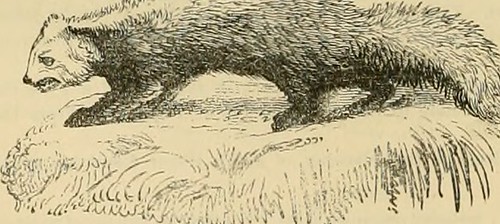
Image by Internet Archive Book Images
Identifier: animalkingdomar00cuvi
Title: The animal kingdom : arranged after its organization, forming a natural history of animals, and an introduction to comparative anatomy
Year: 1849 (1840s)
Authors: Cuvier, Georges, baron, 1769-1832 Metcalf Collection (North Carolina State University) NCRS Blyth, Edward, 1810-1873 Mudie, Robert, 1777-1842 Johnston, George, 1797-1855 Westwood, J. O. (John Obadiah), 1805-1893 Carpenter, William Benjamin, 1813-1885
Subjects: Animals
Publisher: London : Wm. S. Orr and Co., Amen Corner, Paternoster Row
Contributing Library: NCSU Libraries
Digitizing Sponsor: NCSU Libraries
View Book Page: Book Viewer
About This Book: Catalog Entry
View All Images: All Images From Book
Click here to view book online to see this illustration in context in a browseable online version of this book.
Text Appearing Before Image:
(A. refulgcns, F. Cuv.)—Size of a large Cat; the fur soft and thickly set:above of the richest cinnamon-red; behind more fulvous, and deep black beneath. The head is whitish, and the tail annulated with brown. This beautiful species, one ofthe handsomest of known quadrupeds, from the moun-tains of the north of India, was sent to Europe by mylate son-in-law, M. Alfred du Vaucel. [It frequentsthe vicinity of rivers and mountain torrents, passesmuch of its time upon trees, and feeds on birds andthe smaller quadrupeds. Is generally discovered bymeans of its loud cry or call, which resembles the soundwha, often repeated. The soles of its feet are hairy.] J^ THEBiNTnRONGs(/e<!&s,VaIenc.;^rc<ic<is,Teni.) Are also related to the Raccoons by their rienti- Fi i-vdumsfui-i-ns tion ; but the three superior back molars are c jnsitlerably smaller, and le.ss tuberculous, the last one of each jaw more particularly, which is very small and almost simple. These animals are ,.-^i^^«^^^.
Text Appearing After Image:
CARNAKIA. 85 covered with long hair, and have a tuft at eacli ear. The tail is long, hairy, and has a propensity tocurl, as if prehensile; [which it really is : their whiskers arc long and conspicuous]. Thpy are also natives of India, for the first knowledge of which we are indebted to M. du Vaucel. One species(Id. al/ji/rons, F. Cuv.) is erey, with the tail and siiles of the muzzle black; of the size of a larpfe Cat; fruuiUoutan. Another {let. aler, F. Cuv.) is black, with a whitish muzzle, and as large as a stout Dop; from Malni in.[The latter is merely the male, and the other the female of the same species, which is rather a slow-movini;animal, allied to the last in habit, of a timid disposition, and easily tamed. The Ictiile itor/e, F. Cuv., is iisiwcies of Musanj (Paradoxurtis). ] The Coatimondis {Nasua, Storr),—To the dentition, tail [which however is longer], noctuniiil life, and slow dragging gait of theRaccoons, add a singularly elongated and moveable snout. Their feet are
Note About Images
Please note that these images are extracted from scanned page images that may have been digitally enhanced for readability – coloration and appearance of these illustrations may not perfectly resemble the original work.
Image automatically curated and published by www.free-mail.co.za – CLICK HERE to learn more about WP Robot for WordPress.
Have you tried: Farking?