
A nice Paternoster image:
Image from page 110 of “The animal kingdom : arranged after its organization, forming a natural history of animals, and an introduction to comparative anatomy” (1849)
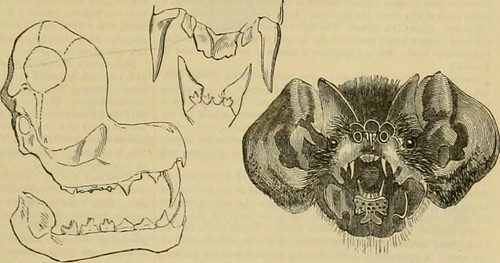
Image by Internet Archive Book Images
Identifier: animalkingdomar00cuvi
Title: The animal kingdom : arranged after its organization, forming a natural history of animals, and an introduction to comparative anatomy
Year: 1849 (1840s)
Authors: Cuvier, Georges, baron, 1769-1832 Metcalf Collection (North Carolina State University) NCRS Blyth, Edward, 1810-1873 Mudie, Robert, 1777-1842 Johnston, George, 1797-1855 Westwood, J. O. (John Obadiah), 1805-1893 Carpenter, William Benjamin, 1813-1885
Subjects: Animals
Publisher: London : Wm. S. Orr and Co., Amen Corner, Paternoster Row
Contributing Library: NCSU Libraries
Digitizing Sponsor: NCSU Libraries
View Book Page: Book Viewer
About This Book: Catalog Entry
View All Images: All Images From Book
Click here to view book online to see this illustration in context in a browseable online version of this book.
Text Appearing Before Image:
ession less marked; the nostrils at the end of the muzzle, with a little laminaabove, forming a kind of snout; the ears are joined; and the tail [which is very slender] extendsfar beyond the interfcmoral membrane. [.\ few species occur on both continents, one of which is figured in the great French work on Ejrypt, under thename Taphien filet.] The Taphiens {Taphozotts, Geof.)—Have also a small rounded indenture on the forehead; but their nostrils have no raistd lamina: thehead is pyramidal, and there are only two incisors above, very often none, and four tiilobate incisorsbelow; their ears arewidely separated, and [thetipof ] their tail free abovethe membrane. The maleshave a transverse cavityimder the throat. A littleprolongation of the mem-brane of their wings formsa sort of pouch near thecarpus.* One species was discover-ed in the catacombs ofKo-pt by M. GeofiVoy [andIt IS probable that the othersare peculiar to the old con-tinent, though one (Vetp.marsupialif, Muller) is said to
Text Appearing After Image:
. T. rufiis, Harlan (Wils. Am. Orn., vol. I AattivjJ/rr^j, Mp|>lied iii lliis ^.emw by Illigcr. . pi. 50) is most likely 74 MAMMALIA. Vc.spertiiio, The E^jjTJtian species is represented to have smiill eyes; but that figured by Gen. Hardwicke (Lin.Trans., vol. xiv. p. 525) possesses eyes proportionally as large as in a Squirrel, and we have examined skins ofanother species (chinchilla-grey above, pure white beneath), in which the same character must have been con-spicuous.] The Mormopes {Mormoops, Leacli)—Have four incisors to each jaw, the superior rather large; the inferior trilobate: their skull (fig. 17) issingularly raised like a pyramid above the muzzle; and on each side of the nose is a triangularmembrane, which extends to the ear. Tlie species M. Blaiiwillii, Leach, is from Java. [It has since been received, together with two others of thesame form (but considered by Gray as separable), from Jamaica; so that the former locality may be presumed tobe wrongly assi£;;ned.] Th
Note About Images
Please note that these images are extracted from scanned page images that may have been digitally enhanced for readability – coloration and appearance of these illustrations may not perfectly resemble the original work.
Image automatically curated and published by www.free-mail.co.za – CLICK HERE to learn more about WP Robot for WordPress.
Have you tried: Farking?