
How we used ancient coins to show a ‘fake’ Roman emperor was real:

All that was previously known about the supposed Roman emperor Sponsian was gleaned from a handful of gold coins that have been regarded as forgeries for over 150 years.
Accordingly, Sponsian has been dismissed as someone who never existed. But new research by my team suggests the coins are authentic products of antiquity. This raises the questions: who was Sponsian, and where and when did he rule?
A third century crisis
Although my main discipline is Earth sciences, I have always been fascinated by ancient history. During the COVID lockdowns, I decided to write a new book on Rome’s third century crisis. It was a time of viral pandemic, economic downturn, inflation and war – and so seemed grimly appropriate.
Rome celebrated its millennium in AD248, but in the wake of the pandemic, the empire suffered escalating disasters, and by AD260 it had disintegrated into warring chunks. Against the odds, a series of successful rulers managed to stitch it together, ushering in a period known as late antiquity.

While researching, I came across the story of the supposedly “fake emperor” Sponsian. Only grainy black and white images of his controversial coins were available, so I emailed Jesper Ericsson, curator of numismatics (coin studies) at the Hunterian museum in Glasgow, requesting a colour photograph.
Zooming in, we were surprised to see that the surface of the coin appeared deeply worn, and there were patches of what looked like soil in the crevices among the lettering. We set about assembling a team of researchers to determine if the coins really were fake.
A crock of gold
In March 1713, Carl Gustav Heraeus, inspector of antiquities and medals in Vienna, received a visit from Johann von Palm, senior finance minister to the Habsburg court.
Palm had taken possession of some coins that had allegedly been unearthed in Transylvania. Heraeus selected eight pieces for the imperial collection and – fortunately for posterity – scribbled a note recording these brief particulars.
He then seems to have authorised the rest to be sold on the thriving antiquities market of the day. About 15 of these have since appeared in published works and auction catalogues.
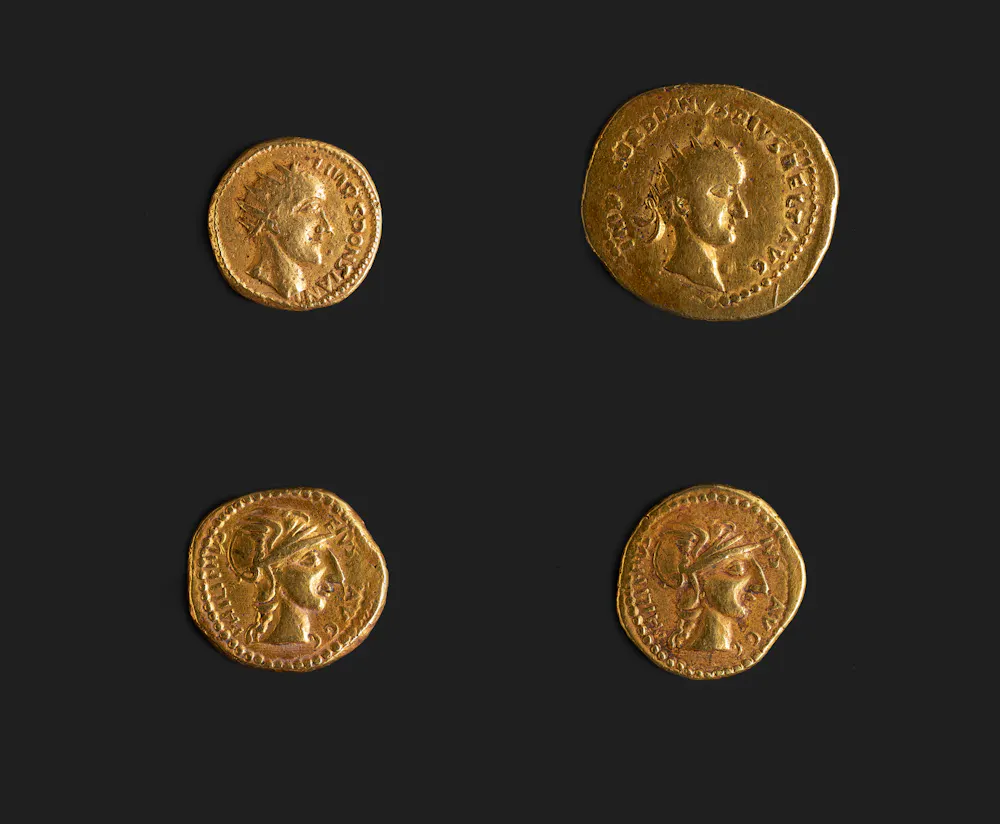
Heraeus and other early specialists recognised immediately that the coins were not official products from Rome. They have a distinctly homemade appearance, with a peculiar mixture of motifs and bungled lettering. Because some feature known emperors Gordian III (reigned AD238-244) and Philip I (reigned AD244-249), Sponsian came to be regarded as a rebel or “usurper” who made a bid for supreme power in the civil war that marked the end of Philip’s rule.
In the 19th century the great numismatist Henry Cohen dismissed the coins as poorly made modern fakes, and that is how they have been regarded until now.
Dirt and scratches
Four of the coins made their way into a large collection bequeathed to the University of Glasgow. One features Gordian III, two Philip and one Sponsian.
We subjected them to a battery of imaging and spectroscopic tests alongside two undoubtedly genuine gold aurei of Gordian III and Philip.
We found that the pattern of wear, scratches and cratering was essentially identical on all the coins. That is not proof of authenticity, however, because known historical fakers sometimes used cunning means to simulate wear.

More convincing was the dirt evidence. It became clear that it was cemented in place with silica (an active component of soil that tends to get dissolved and re-precipitated, helping bind soils together), just as occurs during prolonged burial.
We also found a thin layer of gypsum on the surface of the earthen deposits, indicating oxidation on exposure to air. We concluded that the coins had been buried for a long period before being dug up, and hence are authentic products of antiquity.
The historical Sponsian
Sponsian’s coins give him the title “imperator” (supreme military commander), and he wears a radiate crown, part of imperial regalia. It is reasonable, therefore, to describe him as a Roman emperor, although he certainly never ruled in Rome. The empire threw up a long list of local rebels with imperial pretensions, especially during the third century crisis.
The Sponsian coins are very worn, which indicates that they circulated for some time. From this we deduce that they were part of an active monetary economy. Normal commerce spread coins across the empire, but this seems not to have happened with Sponsian coins. They are extremely rare and no examples have been found in modern times. How can we resolve these puzzles?
Roman Dacia
The coins were found in Transylvania. This mountainous area was once part of the Roman province of Dacia where gold and silver were mined. It was heavily militarised, with two legions protecting the mining operation and civil population.
Historical sources say Roman Dacia was lost during the reign of Emperor Gallienus (AD260-268), but also that it was abandoned by Emperor Aurelian (AD270-275). Our hypothesis is that a secessionist regime held power in Dacia during the intervening period.

At that time the empire was in civil war and the borderlands along the Danube were devastated by invaders. The obvious thing for the Dacian legions to do was to look to their own resources. They had access to gold from the mines which they could turn to coin.
First, perhaps, they made coins featuring previous emperors, and then depicting their own commander Sponsian. Then, when Aurelian finally restored order along the Danube, all this irregular money would have been recalled for melting down. That could explain why the coins are so worn, and yet so rare and localised.
We hope that someday more information about Sponsian will emerge to solve these puzzles. Should a coin turn up in a secure archaeological context, we could study it in more detail, and use fingerprinting to answer our theories on the coins local production.

Paul Pearson receives funding from Royal Numismatic Society (small grant <£1K)
: The Conversation – Articles (UK)
Have you tried: Travelling to South Africa?