
How the age of mammals could end:
Throughout the past 500 million years, our planet has experienced a total of five mass extinctions. One of these – the Permo-Triassic mass extinction event – led to the demise of roughly 90% of Earth’s species.
Most of these events have coincided with the formation of a supercontinent, where Earth’s tectonic plates slowly come together and combine.
Scientists predict that Earth’s continents will again merge together in 250 million years to form a supercontinent called “Pangea Ultima”. It will be centred over the equator and it will be hot. According to new research that I carried out with several colleagues, conditions on Pangea Ultima will be too inhospitable for most mammals to survive.
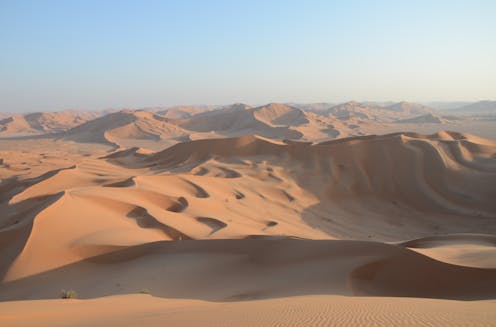
The formation of this supercontinent will drive more volcanic activity, and an older sun will emit more radiation to Earth. This will result in exceedingly hot land surface temperatures, transforming much of the continent into a vast, hot desert reminiscent of the desert planet Arrakis from the science-fiction epic Dune.
Read more: Dune: we simulated the desert planet of Arrakis to see if humans could survive there
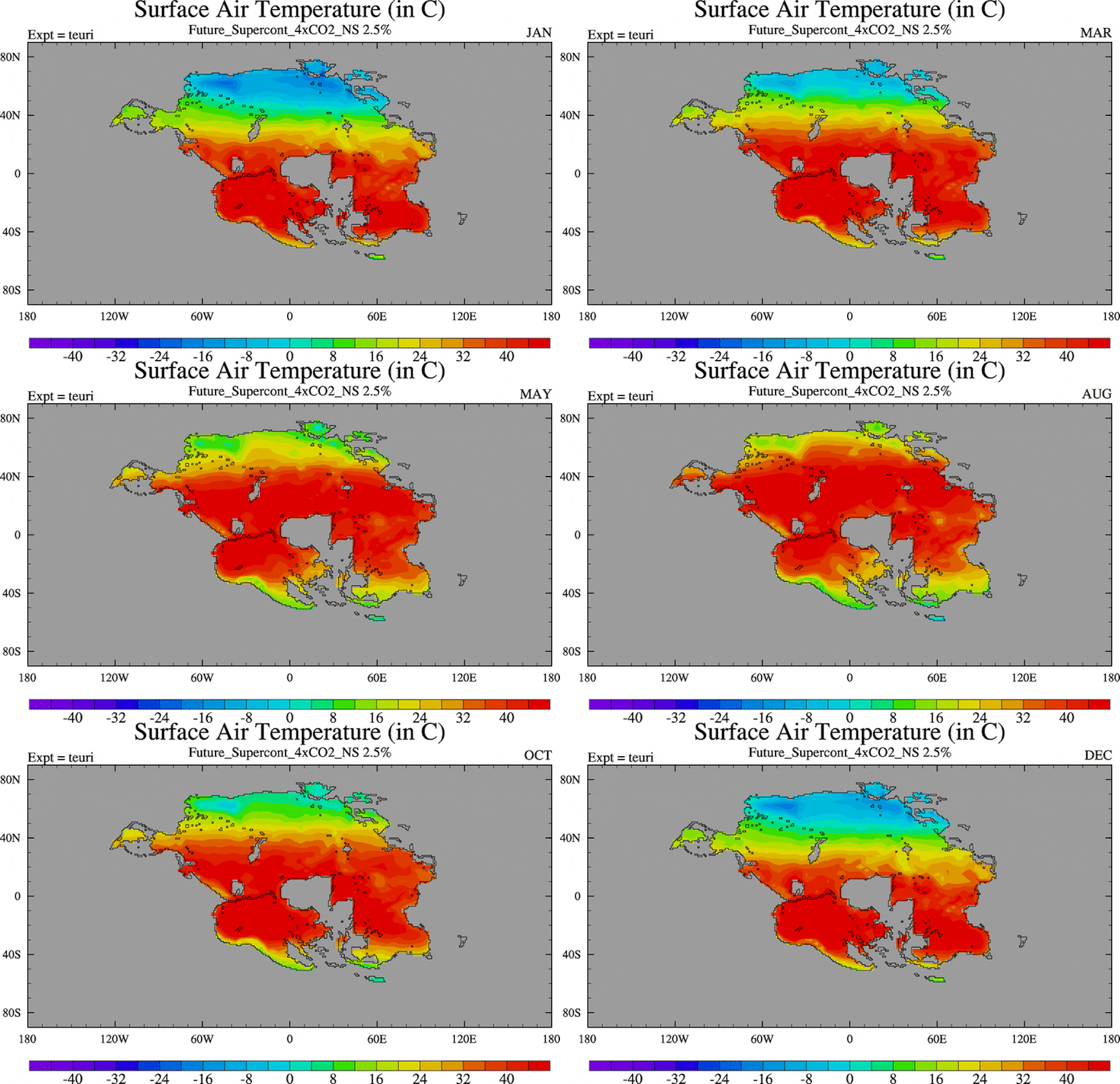
During the hottest months of the year, temperatures could exceed 40? across most of the supercontinent, with many areas experiencing temperatures surpassing 50?.
It’s going to get hot
Currently, mammals are able to survive on roughly two-thirds of Earth’s surface. However, after rearranging the continents without altering other factors, our modelling revealed that the average annual land temperature would increase from the pre-industrial average (about 5?) to approximately 24?. This change would reduce the habitable areas on Earth to just 54%.
The primary reason behind this temperature rise is the projected location of Pangea Ultima, which would be centred on the equator. However, various other factors, such as differences in land elevation (higher ground tends to be cooler), the absence of ice sheets and alterations in vegetation patterns and abundance would also contribute to this warming.
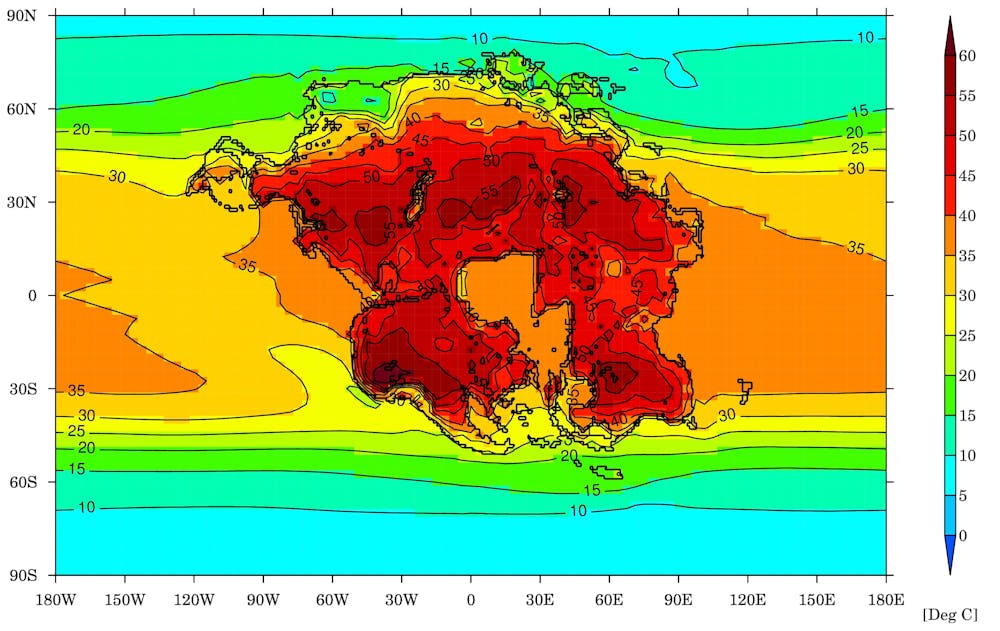
Our estimates also indicate that when Pangea Ultima eventually forms, the Sun will be 2.5% brighter than its present state. This increased solar intensity would further elevate the average land temperature on Earth to around 25?, leaving only a quarter of the planet’s surface habitable.
One uncertainty lies in the atmospheric CO? levels at the time of Pangea Ultima’s formation. Our modelling suggests that CO? concentrations could reach approximately 613 parts per million (ppm), compared to the typical background level of around 420 ppm today. This elevation in CO? levels would result in average land surface temperatures ranging from 30? to 35?, further reducing Earth’s habitability to between 8% and 16%.
If we consider daily maximum temperatures and extreme weather events, then temperatures could potentially be pushed above 60? in some regions.
Inhospitable conditions
The key to the success of mammals since the time of the dinosaurs lies in their adaptability. They possess the ability to regulate their body temperature irrespective of changes in the external environment.
For instance, humans cool themselves down during hot weather by sweating, while dogs rely on panting to dissipate heat. Elephants radiate heat through their large ears.
However, when the surrounding air is hotter than the skin’s temperature, the body struggles to shed heat, leading to overheating. Prolonged exposure to such conditions can result in heatstroke, potentially causing swelling in critical organs like the brain.
Mammals can only endure a specific temperature range. When the dry-bulb temperature (as measured by a standard thermometer) exceeds 40?, or when the wet-bulb temperature surpasses 35? (a lower limit influenced by high humidity), the situation becomes dangerous. Recent research even suggests that the wet-bulb temperature limit for humans and most mammals could be as low as 31.5?. Exposure to such temperatures for just six hours, even when in the shade while wet and with a fan, could result in death.
Some mammals have even lower temperature thresholds. North American moose, for example, have a critical wet-bulb temperature threshold of 17? under calm conditions or 24? if it is windy.
Do mammals stand a chance?
Mammals have endured warm periods in the past, such as the Paleocene-Eocene Thermal Maximum (PETM) approximately 50 million years ago, when Earth’s surface temperature increased by about 5?. But there are some important differences to consider with the formation of Pangea Ultima.
First, the PETM was relatively brief, lasting around 100,000 years. Following this, temperatures gradually dropped to more habitable levels. By contrast, Pangea Ultima is predicted to last for tens of millions of years or longer before breaking up.
Second, during the PETM, the continents were positioned in a way that allowed mammals to move more easily towards cooler regions near the poles to escape extreme heat. In Pangea Ultima, the majority of the planet will be concentrated in the tropics, with vast impassable deserts covering much of the supercontinent. This will make it challenging for mammals to travel long distances in search of cooler areas.
Tectonics play a fundamental role in shaping the evolution of life on our planet and will continue to do so. What life form will become dominant if mammals do perish is anyone’s guess. However, mammals will have had a good run.

Alex Farnsworth receives funding from UK Research and Innovation
: The Conversation – Articles (UK)
Have you tried: Diving with Sharks?