
How King Charles III’s coronation robes — and other historical garments — are conserved:
Ahead of King Charles III’s coronation on May 6 2023, textile conservators based at Historic Royal Palaces are hard at work. For the occasion, the sovereign is set to don historic ceremonial robes, heavy with history and symbolism.
The first piece is the Supertunica, a full-length coat of golden silk, lined with red. It was designed for George V on the occasion of his coronation on June 22 1911 and subsequently worn by George VI in 1937 and Queen Elizabeth II in 1953.
Around his neck, the king will wear the Royal Stole, a thin band of golden silk generously embroidered with heraldry and foliage. And draped over his shoulders will be the Imperial Mantle.

This piece is part of our coverage of King Charles III’s coronation. The first coronation of a British monarch since 1953 comes at a time of reckoning for the monarchy, the royal family and the Commonwealth.
For more royal analysis, revisit our coverage of Queen Elizabeth II’s Platinum jubilee, and her death in September 2022.
Created for George IV’s coronation in 1821 and referencing both priestly garments and Tudor designs, the mantel is an opulent cape, also red-lined, that pools on the floor, fringed with gold. It sports a pattern of embroidered crowns, eagles, roses, thistles, shamrock, fleur-de-lis and other foliage. And it fastens on the chest with an eagle-shaped clasp.
If you have ever travelled from afar to the Tower of London to see royal garments or the V&A to see historic fashions, you might have been frustrated at the low lighting, or the barriers in place which make taking a closer look difficult. Conserving textiles is all the more challenging when the textiles in question are not just to be displayed but also worn, as these coronation robes are. Conservators apply tremendous skill and knowledge to keep such items intact.
Designed to last
Ahead of the big day, the king will have likely done some fittings. A garment designed for a 46-year-old in 1911 won’t necessarily fit a 75-year-old in 2023. So conservators will have suggested alterations to suit the king’s preferences. In concert with textile specialists, they might have applied hidden loops on the inside of the robes so they do not slip when worn.
When the royal coronation garments are not in active use, they are held in the Royal Ceremonial Dress Collection at Historical Royal Palaces and Kensington Palace. This archive offers tangible evidence of dress worn by the royal family since the 18th century.
Conservators there work to identify and protect areas of weakness in the materials the garments are made of. They can be heavy in some areas, which makes the threads more fragile. This can stretch and damage the material, when not supported. Care is taken that elaborate decorations, mostly made with silk and precious-metal thread, like gold and silver, do not snag.
Traditional materials, like the gold silk used to make the coronation robes, are stronger and thus more durable – they can keep their shape and often their colour too. Ensuring this, however, involves thorough environmental monitoring to achieve optimum conditions – regular humidity levels, cool temperatures, low light levels. When transporting or otherwise handling historic textiles, you have to use materials that do not react chemically.
In contrast to these garments designed to last, pop culture treasures like the costumes held among the 80,000-piece collection of Bowie memorabilia the V&A recently acquired, present different challenges.
Conservators at the museum will now be tasked with tending to many of the artist’s memorable costumes: the 1972 Ziggy Stardust ensembles by Freddie Burretti; Kansai Yamamoto’s flamboyant creations for the Aladdin Sane tour in 1973; the Union Jack coat designed by Alexander McQueen for the Earthling album cover in 1997.
The kinds of modern materials used in these creations often degrade sooner rather than later, as amateur trainer collectors and professional trainer conservators alike know. Plastics and rubbers may start to degrade in less than 10 years, depending on when they were made, how they were manufactured and used.
Textile stories
Despite this, fashion conservators do not consider modern fabrics of any less value than costly historic textiles. This is because new materials have often inspired designers to create new things. Polyurethane, polyvinyl chloride and synthetic rubber, developed in the early 20th century, gave artists different surfaces to work with, allowing for both glossy and matt looks. Bowie’s Kabuki jumpsuit, that Yamamoto designed for the 1973 Aladdin Sane tour, is a prime example.
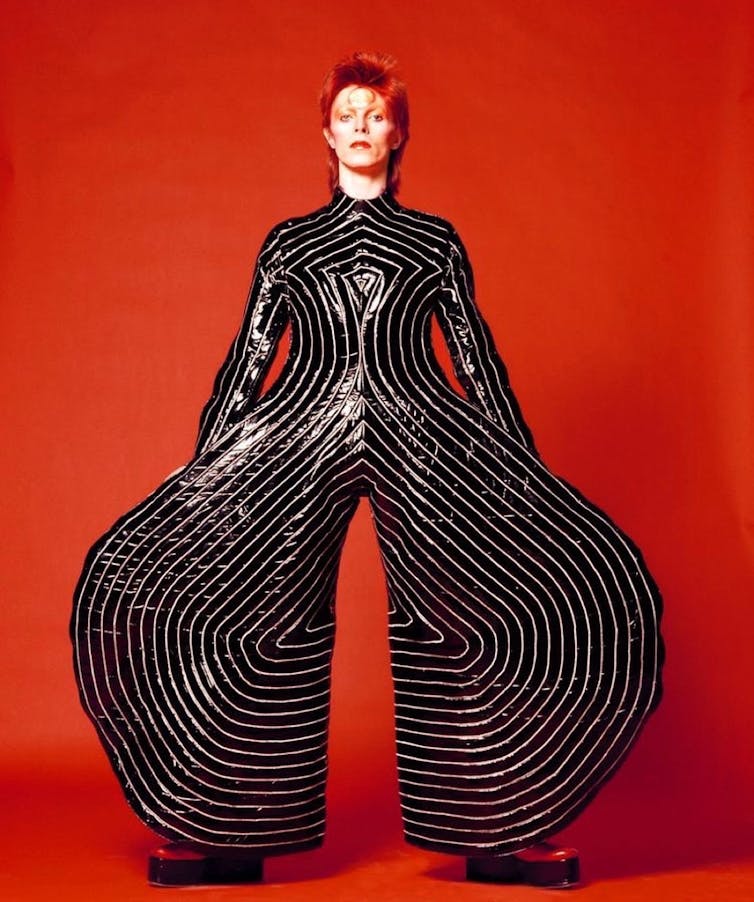
Conserving a garment of historical importance isn’t only about the fabric and design, but the occasions when it was used. Conservators will thus also document, and in some cases preserve evidence that Bowie actually wore these clothes – even stains from his sweat. It’s about keeping the essence of Bowie during those iconic moments of his stage performances.
It is also about recording the link between the person who wore the garment and the designers. Yamamoto materialised Bowie’s vision of being, as curators Victoria Broaches and Geoffrey March once put it, “an alien rock messiah, leader of a band of space invaders”.
Preserving what conservators term “designer intent”, here, is crucial. Each item bears witness to how its creator’s ideas developed, their material choices and their creative engagement.
Similarly, the royal robes can show intended social and political changes through the history of how they have been repaired, adjusted or reworked, to suit the taste of each successive royal wearer.
Ensuring the survival of historic textile and dress artefacts allows stories and histories to be shared from generation to generation. As one curator has put it of Bowie’s many suits:
These were used costumes and they absolutely have lived lives, and they’re continuing to do so.
Bowie’s flowing white cape covered in Japanese kanji, also by Yamamoto, helped to stage his creative output. Similarly, the coronation robes mark, and frame, King Charles III as he embarks on his reign.

Leanne Tonkin does not work for, consult, own shares in or receive funding from any company or organisation that would benefit from this article, and has disclosed no relevant affiliations beyond their academic appointment.
: The Conversation – Articles (UK)
Have you tried: Diving with Sharks?