
How gas keeps the UK’s electricity bills so high – despite lots of cheap wind power:
Gas and electricity bills will rise again for millions of UK households on April 1, when the latest energy price cap takes effect. A typical household will pay £111 more per year.
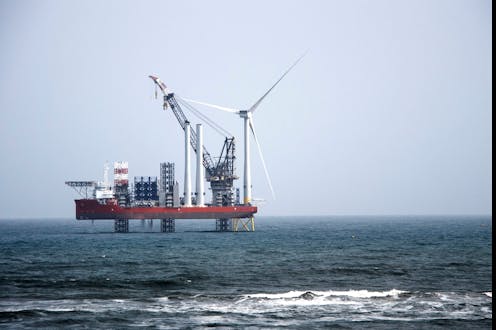
Though prices have fallen somewhat since their peak in 2022, bills are still considerably higher than they have been historically. That’s despite the construction over the past decade of vast wind farms in the North Sea – which, once built, provide electricity for very little extra cost.
So what explains the UK’s pricey gas and electricity?
Since the 1990s, the UK has been dependent on natural gas in more ways than one. In 2023 (the most recent year for which we have full statistics), gas accounted for 33% of the UK’s energy and almost as much of the electricity it generated. That year, wind contributed 29% to generation and solar an additional 5%, which is of some significance.
As nearly all households are connected to mains gas, most energy bills reflect the global price of gas.
The UK has to compete with demand for gas from other markets, especially, but not exclusively, the EU. The higher the demand, the higher the price. Before the Ukrainian crisis, many EU economies, especially Germany, were able to source abundant gas through pipelines from Russia.
The UK, like other big European countries such as Spain, Italy and France, was able to meet some of its gas supply via pipelines (from Norway in the case of the UK), but also in the form of more expensive liquefied natural gas (LNG) from as far afield as Qatar, Algeria, West Africa and, more recently, the US.
Since the Russian invasion of Ukraine in early 2022, the flow of pipeline gas has almost entirely stopped. Germany and western EU countries have to compete with everyone else to source their gas from Norway or international LNG markets. A few countries on the eastern side of the EU, such as Austria and Hungary, are still sourcing their gas from Russia but face western criticism for that continued dependence.
This all matters to UK consumers because most of a household’s average energy bill reflects the vagaries of the international gas market. A relatively harsh winter in Europe means they have purchased more gas and paid more for it. In a global market the UK consumer will have to pay this price as well. Even a harsh winter in Japan means that more LNG is directed there, increasing prices for UK and EU consumers.
We can’t suddenly turn on the wind
Even the growth in renewables, especially wind power, does not offer protection against the vagaries of the global gas markets. It is well known that wind energy is intermittent and therefore difficult to forecast and base generation plans on.
Wind energy is what people in the electricity industry call “non-dispatchable”. Because electricity is a universal good, which we expect to have whenever we ask for it, the national grid needs to be able to balance the randomness of wind generation with the immediate response of a reliable, quick-start, “dispatchable” source of generation. Gas fits the bill.
As a result, expensive gas which is called on to make up for the loss of wind or solar generation, ends up setting the electricity price (called the “system price”) most days. Other countries experience something similar. Germany, for instance, generates just 15% of its electricity from gas (albeit with a further 25% from coal) and gets a higher proportion from renewables (28% wind and 12% solar). Yet it still has to use gas frequently to balance the electrical system, with the same effect as in the UK.
Ultimately, the more variable renewable electricity we inject into the system, the more we need to plan for, and invest in, infrastructure that can support it. That means a smarter grid, fewer grid bottlenecks within the UK, more and bigger interconnections to other European countries and battery solutions which can store electricity both for short periods (minutes and hours) and for days and even weeks.
Putting all these elements in place is a Herculean task. Gas fills the gap, but in a way which is more expensive (for now) and continues emitting greenhouse gases, albeit at half the rate that coal did.
Don’t have time to read about climate change as much as you’d like?
Get a weekly roundup in your inbox instead. Every Wednesday, The Conversation’s environment editor writes Imagine, a short email that goes a little deeper into just one climate issue. Join the 40,000+ readers who’ve subscribed so far.

Michael Tamvakis does not work for, consult, own shares in or receive funding from any company or organisation that would benefit from this article, and has disclosed no relevant affiliations beyond their academic appointment.
: The Conversation – Articles (UK)
Have you tried: Travelling to South Africa?