
How changing blood pressure targets in South Africa could save costs and lives:
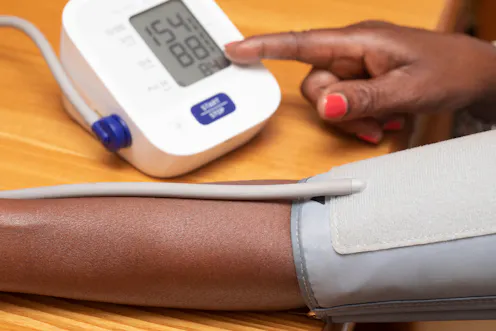
High blood pressure, also known as hypertension, is a serious public health threat globally. If uncontrolled it substantially increases the risk of disability and death from stroke, heart attacks and other cardiovascular conditions. It’s also a huge problem in South Africa – an estimated 35% of people in the country older than 15 have high blood pressure. This is expected to increase as the country’s population rapidly ages over the coming decades.
It is therefore not surprising that the South African government has made blood pressure control a health policy priority.
But improving blood pressure control first requires figuring out what an ideal blood pressure should be. Blood pressure has two components: systolic – the amount of pressure in your arteries during the contraction of your heart muscle – and diastolic blood pressure – blood pressure when your heart muscle is between beats. These two components are written and spoken together as systolic “over” diastolic blood pressure. At the moment in South Africa, people are defined as having high blood pressure if their readings are above 140/90 ?mm Hg – normal blood pressure is a reading below this threshold.
The problem is that this level is determined from information collected in settings like the UK or US which have very different living conditions. This might mean that the targets aren’t ideal for all populations. But there’s little information from settings in Africa with which to determine what ideal blood pressure should be.
In our recent research we set out to determine what blood pressure target makes the most sense for the South African population. We believe that doing this would allow policy makers and public health clinicians to develop treatment guidelines and interventions that are best suited for the population.
Based on our research we concluded that reducing blood pressure to less than 150 mmHg, rather than 140 mmHg, was the most resource-effective way to save lives for people with high systolic blood pressure (the upper reading).
A moving target
In high-income countries, blood pressure targets have been decided by comparing the risk of serious illness in individuals whose blood pressure has been reduced – usually by taking blood pressure reducing medications – to various, lower, targets. Health experts then decide which target best balances health benefits against the side effects of treatment.
For their part South African policymakers and clinicians have decided on treatment targets using guidelines predominantly based on evidence from studies conducted in high-income countries. But the populations living in South Africa may have different underlying conditions and exposure to different environments that affect the relationship between blood pressure and its potential consequences.
So which target makes the most sense for the South African population?
To answer this question, we used the National Income Dynamics Study. To our knowledge, it’s the only population-wide long term data set in South Africa.
We followed 4,993 individuals over a six-year period. The main aim was to compare different blood pressure levels with the risk of death that each level carried. We only considered systolic blood pressure (the upper blood pressure number) since it may be slightly more important for future risk of illness than diastolic blood pressure (the lower number). The four blood pressure targets we looked at were 120, 130, 140, and 150 mmHg.
We compared the future risk of death between people who had each of these blood pressure readings at baseline. We used this information to simulate the number of total deaths that would be avoided and the share of the adult population of South Africa that would require blood pressure care under efforts to scale up blood pressure control to achieve these targets.
We found that the greatest reduction in deaths would come from reducing the upper blood pressure reading to around 150 mmHg. There wasn’t a substantial reduction in deaths if people further achieved the blood pressure targets recommended by the new American College of Cardiology and the American Heart Association guidelines (upper blood pressure reading of less than 130 mmHg).
There was weak evidence in support of the less than 140 mmHg target recommended by the International Society of Hypertension Global Practice guidelines which are currently used in South Africa.
This finding is important for clinical practice. Lower targets place a greater treatment burden on patients in the form of additional and potentially higher doses of medications. Lower targets also require that clinicians provide more effort per patient to help individuals achieve and maintain lower blood pressure levels.
Our findings also have important consequences for policymakers. Lower targets require providing blood pressure management to a substantially larger share of the population.
For example, we found that a hypothetical scale-up effort to treat all people in South Africa whose blood pressure is higher than 150mmHg to levels below this would require providing care to 16% of the adult population. Fifty people would need treatment to avert one death. In contrast, a scale-up effort to treat everyone to a target of 130 mmHg would require providing care to 43% of the adult population. Seventy people would need to be treated to avert one death.
For this reason, the more conservative (higher) targets are also more cost-effective. These require fewer resources per death averted. More conservative targets may also be more realistic to accomplish since they require fewer total resources to meet.
Keep it local
Our results add to a growing concern that exporting clinical guidance from high-income to low- and middle-income country contexts may lead to inefficient decision making.
Ultimately, we believe our findings can be useful for setting treatment targets and planning population-wide blood pressure control efforts throughout the country.
Other researchers who contributed to the research study are Alpha Oumar Diallo, Mohammed K. Ali, Pascal Geldsetzer, Emily W. Gower, Trasias Mukama, Ryan G. Wagner, and Maarten J. Bijlsma.

Nikkil Sudharsanan receives funding from the Alexander von Humboldt Foundation.
Justine Ina Davies receives funding from The UK Academy of Medical Sciences and National Institute for Health Research
: The Conversation – Articles (AFRICA)
Have you tried: Visiting Port Elizabeth?