
How 1920s high society fashion pushed gender boundaries through ‘freaking’ parties:
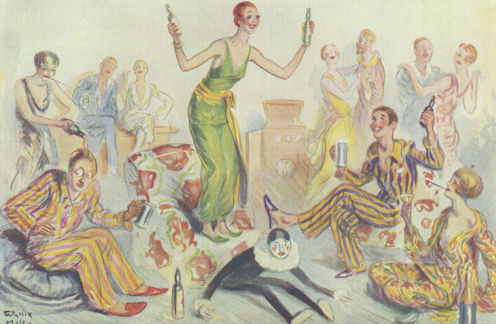
The 1920s brought about a rise in androgynous fashion among a high society set that broke boundaries and caused controversy. This drew on a subculture that had existed for decades, perhaps centuries, but after the first world war gender-bending fashions became front page news.
It was a time of upheaval. Established regimes were toppling across Europe. In Britain, women over 30 had finally been given the vote and there was widespread concern about the new hedonism of their younger “flapper” sisters.
There was also a new market for novels, such as Radcylffe Hall’s banned book The Well of Loneliness (1928) that focused on, rather than merely hinted at, queer lives. Daring male university students started wearing makeup. One of these was Cecil Beaton, the future celebrity photographer, who delighted in cross-dressing both on stage and off.
Beaton became part of a set of high society socialites who were known as the “bright young things”. They were often socially privileged, many of them were queer and their antics were widely followed in the media with a mixture of horror and fascination.
The “things” took partying seriously and paid great attention to their outfits. They dressed to transgress. In 1920, high society magazine The Sketch reported that what it termed “freak parties” were suddenly in vogue with the younger set.
Before the war, articles had appeared condemning unusual styles as “freak fashions”, but suddenly “freaking” was all the rage.
Until this point, menswear had been heavily circumscribed. Black was the default colour for formal occasions and tweed for informal settings. But suddenly there was a circle who were keen to try out new looks, no matter how bizarre – or queer-looking – the results.
Queer parties, queer fashions
These styles were often worn as fancy dress, but they borrowed looks from marginalised queer communities such as feminine-styled queer men, some of whom made a living by selling sexual services.
One such man was Quentin Crisp, whose memoir The Naked Civil Servant (1968) was dramatised as a pioneering TV drama.
Another source of inspiration was the freak show. These displays, horrifying from a 21st century point of view, were a popular element of circuses at the time. They featured such stock characters as the muscled giant and the bearded lady, some of whom became celebrities in their own right.
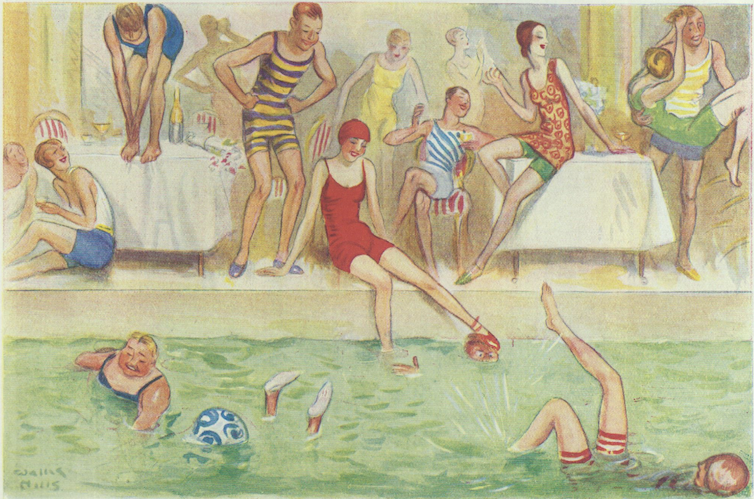
Masquerade and fancy dress parties had long been a feature of urban social life, but the bright young things innovated in that they impressed less through the expense of their outfits and more through their queer implications.
Read more: For diamonds, disguises and bears, the Met Gala has nothing on Georgian masquerade parties
Many such parties were themed, such as a Greek-themed freak party that was hailed as the greatest “Dionysia” of 1929 (Dionysus being the Greek god of sex and pleasure). Androgynous and cross dressing looks were common and men such as Beaton designed their own frocks.
In July 1927, one magazine declared that an event attended by Beaton’s friend Stephen Tennant dressed as the Queen of Sheba and bisexual actress Tallulah Bankhead dressed as a male tennis star was: “one of the queerest of all the ‘freak’ parties ever given in London”.
The party’s over
The Wall Street crash of 1929 led to a rapid shift in public mood. Economic recession led people to favour sobriety over flamboyance. Money for the parties ran out and media attention faltered.

Gender-bending style vanished from the fashionable arena, although it persisted on inner cities streets. Quentin Crisp’s mode of queer dandyism was daring for its time, but it only became extraordinary by virtue of his unwillingness to modernise.
Seemingly he, and pretty much he alone, continued to wear the queer looks of the interwar period into the television age. He duly became a transatlantic celebrity late in life when he became the inspiration for Sting’s song Englishman in New York in 1987.
Cecil Beaton, meanwhile, became a leading photographer for Vogue magazine and was commissioned to take official coronation portraits of Elizabeth II. He also designed the fantastic dresses worn by Audrey Hepburn in the film My Fair Lady (1964), inspired by the gowns he and his compatriots had dreamed up for themselves some 40 years earlier.

Dominic Janes is Professor of Modern History at Keele University and a Professorial Fellow at the University for the Creative Arts. He is a member of the Liberal Democrats.
: The Conversation – Articles (UK)
Have you tried: Diving with Sharks?