
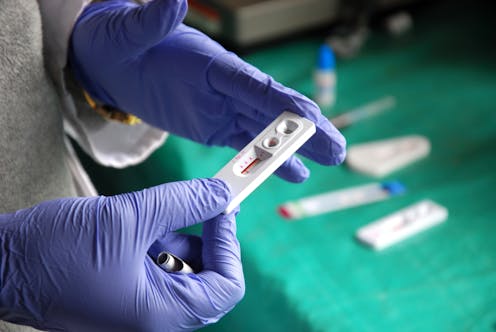
HIV remains a major public health challenge globally. Around 38 million people are estimated to be living with the infection. Sub-Saharan Africa bears the brunt of the HIV epidemic. Close to two thirds of the HIV cases are in the region.
But huge strides have been made in curbing the epidemic. One of the keys to this has been the introduction of antiretroviral therapy (ART). It’s resulted in people with HIV living long, productive lives and reducing the risks of HIV transmission.
HIV has a high mutation rate, however. As a result, there is evidence of HIV variants with resistance to almost all available antiretroviral drugs. The development of variants with drug resistant mutations is a major challenge to the success of ART – and therefore to efforts to achieve the UN goal of ending AIDS by 2030.
In developing countries, screening for HIV drug resistant variants is done only when patients who are on treatment have high viral loads – over 1,000 copies/ml, as per the World Health Organization guidelines. This means drug resistant HIV variants in patients with low viral loads aren’t detected. This is the case in many countries in sub-Saharan Africa – including Botswana.
We set out to establish three things.
Firstly, what percentage of patients on ART had low HIV viral loads. This is data that’s never been collected before. Secondly, we wanted to determine HIV drug resistant mutations in this cohort of patients. The third thing we set to establish is whether there’s a connection between patients with low viral loads and treatment failure. This is known as virologic failure.
Answering these three questions has given us a much deeper understanding of where a country like Botswana stands in its efforts to eliminate HIV. As a result of our research we have a better understanding of how many people with HIV have low viral loads, how serious a threat we face from drug resistant HIV variants and finally how many people with low viral levels are at risk of treatment failure.
We found that people with low viral loads were just as likely to harbour drug resistant HIV variants as people with high viral loads. This matters because it points to the need to change how people with HIV who are on ART are managed in developing countries.
We recommend that patients on ART with detectable viral loads above 50 copies/ml be further investigated to ensure that they don’t harbour drug resistant HIV variants.
What we found
Number of HIV patients on ART with low viral load: Our study looked at a cohort of 6,078 people with HIV from across Botswana who were receiving combination antiretroviral therapy. We narrowed this down to 4,443 people who had been on ART treatment for at least six months.
Only 8% had viral loads of more than 50 copies/ml. Testing for mutations only happens on patients with viral loads of over 1,000 copies/ml, which means that this group isn’t being screened.
The figure of 8% may seem low. But it means that this cohort either has a resistant variant, or their treatment isn’t working.
Prevalence of drug resistant mutations: We sequenced the HIV in the patients with low viral loads as well as those with viral loads above 1,000 copies/ml. We found no difference in the prevalence of HIV drug resistant mutations between the two patient groups. This indicates that patients with low HIV viral loads are just as likely to harbour HIV variants with drug resistance mutations as those with high viral loads.
Treatment failure: A select group of the patients with low HIV viral loads were followed up for at least a year. We found that there was a statistically significant association of low level HIV viral load with subsequent virological (or treatment) failure. Our results show that patients with a low HIV viral load are more likely to experience virological failure.
Current treatment guidelines describe virologic failure as viral loads above 1,000 copies/ml. Our results challenge this.
Going forward
Our results echo the views expressed by others who have looked at this issue. Like them, we recommend that the HIV treatment guidelines in developing countries be improved to ensure that patients with low HIV viral load while on ART get the necessary attention.
In developed countries, screening for drug resistant HIV variants is done when people start ART. Drug resistance screening is also done whenever a patient on treatment has a detectable viral load.
The same approach should be applied in developing countries.
Patients should also have a follow-up viral load test which – if the virus is still detectable – should lead to sequencing of the HIV variants they harbour. If found to have a drug resistant variant, the patient should be switched to an appropriate ART regimen.
If they are found not to harbour HIV drug resistant variants, the patient should undergo intensive adherence counselling because this could point to treatment failure.
Scientists and funders must invest time and resources to develop more sensitive HIV drug resistant assays that can sequence HIV in samples with low viral loads. This is currently a limiting factor as most of the available assays don’t work well with samples with low viral loads.

Simani Gaseitsiwe receives funding from : Wellcome Trust, NIH, EDCTP, Bill and Melinda Gates Foundation.
: The Conversation – Articles (AFRICA)
Have you tried: Travelling to South Africa?