
Glue could be the magic ingredient for cheap and efficient CO? capture:
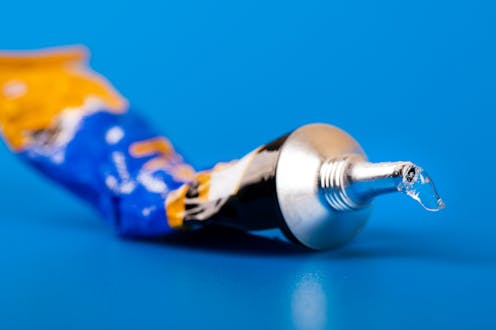
Carbon capture and storage is a hot topic among researchers striving to save the planet from climate change. Scientists are constantly trying to develop and improve materials which can capture carbon dioxide (CO?) from the atmosphere. At the Energy Safety Research Institute (ESRI) at Swansea University, we’ve developed a promising new material from a liquid amine – a chemical which is known for its ability to react with CO?, but in liquid form can’t do so effectively.
By adding just enough glue to make the liquid amine fluff up into a solid, the resulting new material is capable of capturing one-fifth of its own weight in CO?. The glue is a type of epoxy resin – used everywhere in paints, varnishes and flooring. Our work shows that epoxy resins can be a key ingredient in making effective carbon capture materials – and they have been staring us in the face for more than 70 years.

Since huge advances are being made in renewable energy – and the UK’s reliance on fossil fuels has reduced – is carbon capture technology becoming redundant? Unfortunately not. There remains about 1.5 times the concentration of CO? in the atmosphere that there was in pre-industrial times. If we are to limit global warming to 1.5°C to avert the worst consequences of climate change, atmospheric CO? will have to be captured on an industrial scale, and either made into useful new chemicals or buried deep underground in depleted oil reservoirs.
Read more: COP24: here’s what must be agreed to keep warming at 1.5°C
For all the damage it’s causing, CO? actually makes up only 0.04% of the atmosphere by volume, making it very hard to extract directly from the air, which is the ultimate challenge. Our work was focused primarily on capturing CO? before it leaves smoke stacks at power stations where CO? concentrations range from 8-15% and temperatures can be between 40 and 100°C.
Power stations around the world will continue to burn fossil fuels until clean energy technologies are ready to fully replace coal and gas-based energy production, so their emissions have to be reduced as soon as possible.
Industrial processes that carry out CO? capture currently use liquid amines, but this technology comes with problems. It’s very expensive, not very efficient and the chemicals are highly corrosive and toxic to the environment. This is why we need something better which can match the scale of this problem.

The next generation of carbon capture
So what’s special about this new glue-assisted CO? sponge? It’s a polymer made mostly from liquid amines which bind CO?, and epoxy resin glue. We showed that the glue molecules stick the liquid amine molecules together into one solid mass. Being a solid makes it easier and safer to handle and much cheaper to reuse, compared to the current carbon capture materials which are liquid. The epoxy resin is also cheap and widely produced. When this and the liquid amine are combined, the solid material that forms is very effective at capturing CO?. One variant was found capable of capturing almost 20% of its weight in pure CO? at 90°C.
This was a good indication that we had made a material that could suck up a lot of CO?. But in the conditions of a smoke stack, the material would be exposed to a mixture of gases and would have to exclusively capture CO?. We ran an experiment to see if it would take up nitrogen (N?) – the most abundant gas in Earth’s atmosphere – but it didn’t, confirming that the material selectively binds CO?.
We next wanted to test the material’s ability to capture CO? under the replicated conditions of the smoke stack. We tested the material with a stream of gas that was 10% CO? and 90% N? at 90°C. Once CO? was captured, the temperature was increased to 155°C to remove the captured CO? and regenerate the material so that it could be used again.

The material captured 9.5% of its weight in CO? over 29 successive cycles – a pretty good performance for a material that would have to work constantly to capture and release CO? within a smoke stack.
The next test of this material’s performance was its ability to capture CO? under humid conditions as water is present in gas from a smoke stack. Humidity often causes solid CO? capture materials to perform badly as they suck up water instead of CO?. But rather than hinder uptake, water actually helped this material capture more CO?. Under humid conditions and at only 25°C, the CO? uptake from pure CO? was a huge 23.5%. This bodes well for one day capturing CO? directly from air.
This material could be the next generation in solid carbon capture materials. Glue: common, cheap and abundant, could yet find a new and valuable role in the fight against climate change.


Louise Hamdy is funded by the Flexible Integrated Energy Systems (FLEXIS) research operation. This research was also funded by the Reducing Industrial Carbon Emissions (RICE) research operation, both of which are funded by the Welsh European Funding Office (WEFO) through the Welsh Government. Louise Hamdy is a member of UK Carbon Capture and Storage Research Centre (UKCCSRC).
: The Conversation – Articles (UK)
Have you tried: Sailing in Africa ?