
Ghana’s economic crisis: expert insights into how things got so bad – and what to do to fix it:
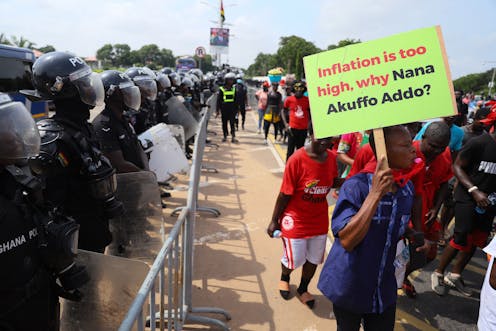
Ghana is grappling with runaway inflation as prices of basic commodities have spiralled. Government finances are also at their weakest in years. Ghana’s local currency, the cedi, is now the world’s worst performer against the US dollar – a signal of the depth of the country’s economic crisis.
Over the past few months, various scholars have written important articles for The Conversation Africa on the state of Ghana’s economy, how it got into this situation and on the International Monetary Fund’s involvement. Here are four essential reads.
1. How Ghana got here
By the year 2000, the government of Ghana had borrowed so much that the country was in debt distress. It then subscribed to the Heavily Indebted Poor Countries initiative of the International Monetary Fund and the World Bank. By the time the initiative ended in 2006, Ghana’s total public debt stock was US$ 780 million (25% of GDP).
However, the debt stock has since risen by 7000% to US$ 54 billion, which is 78% of GDP. In this article, economist Adu Owusu Sarkodie explains why, between 2017 and 2019, Ghana’s debt stock grew astronomically. He argues that, beyond the normal drivers, there were three main reasons: the country’s energy sector debt, the financial sector clean-up exercise undertaken by the country’s central bank and the impact of the COVID pandemic.
Read more: Ghana’s debt makes development impossible: here are some solutions
2. Demystifying IMF visits
This year, Ghana began talks with the International Monetary Fund (IMF) for a bailout programme that would restore economic stability. The idea is that it would enable the country to meet its payments to the rest of the world and restore the health of government finances. Ghana is hoping to receive as much as US$ 3 billion.
But when the IMF announces a visit to a country in Africa, the news can cause concern. This is because IMF policies can have a direct impact on the lives of people living in those countries. It can also cause concern because the public gets little information about the purpose of the IMF’s visit – or its likely outcomes. In this article, law professor Danny Bradlow removes some of the mystery surrounding IMF visits to a country. He unpacks the reasons why the IMF sends its staff on “missions” to a country and what can be expected in each case.
Read more: When the IMF comes to town: why they visit and what to watch out for
3. Ghana’s recurrent failure
This is the second time in the past three years – and 17th since independence in 1957 – that Ghana has turned to the IMF for help. Economist and political risk analyst Theophilus Acheampong argues that Ghana’s approaches to the IMF tell a story of recurrent failure of government to build the economy to withstand internal and external shocks. He says that Ghana’s lack of fiscal discipline and its recent history of dependence on foreign financing leave the country vulnerable to swings in investor sentiment and accompanying portfolio investment selloffs.
Read more: Ghana’s return to the IMF within three years underscores its deeper economic problems
4. Debt restructuring
In this article, Acheampong explains how Ghana’s engagement with the IMF will require a decision to restructure the country’s massive debt. The Fund states that it won’t lend to countries that have unsustainable debts unless the member takes steps to restore debt sustainability, which can include debt restructuring.
He says that while debt restructuring is inevitable, the government must improve its management of the funds that are available to it. Steps include limiting borrowing from the domestic market and respecting the law on fiscal responsibility.
Read more: Ghana and the IMF: debt restructuring must go hand-in-hand with managing finances better
 : The Conversation – Articles (AFRICA)
Have you tried: Visiting Port Elizabeth?