
GE’s big bet on digital has floundered – future now hinges on second attempt:
John Flannery, General Electric’s chairman and chief executive, has had a tough ride since taking over in 2017. Having already warned the market a couple of months ago that there would be no profits this year, there was more gloom in response to the company’s recent first-half earnings announcement.
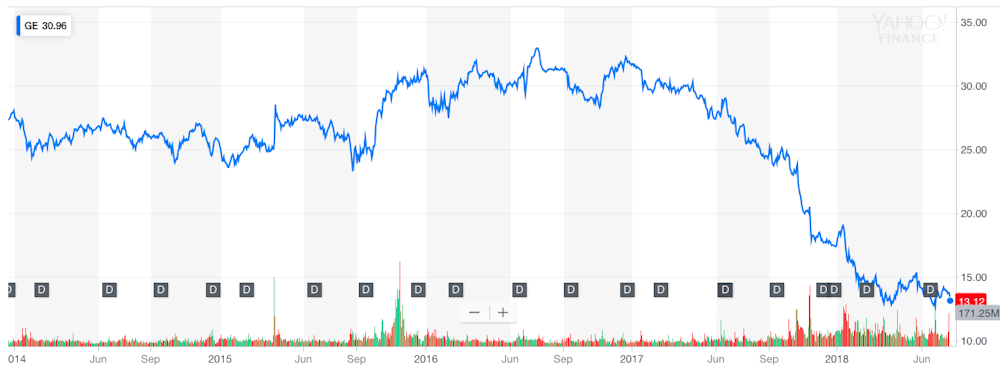
The company achieved a 3% increase in revenues to US$ 30 billion (£23 billion) in the quarter, while a 30% drop in net earnings was less bad than feared, but shares still dived another 4%. After disappointing cash flow numbers, the market decided there could be more bad news about profits on the way. Shares have now roughly halved on Flannery’s watch.

GE, famously founded by Thomas Edison, was the most valuable company in the world at the start of this century. It is a sprawling conglomerate with interests in everything from making aircraft engines, power turbines and medical imaging equipment to financial services and industrial software.
GE’s problems are primarily in power and financial services. Financial services, originally a shift away from the company’s traditional core business, has struggled since the global financial crisis ten years ago. The power business is having to deal with more global competition and less demand for its products and services, plus the rocky progress of two big-ticket acquisitions – French power manufacturer Alstom and US oilfield services group Baker Hughes.
GE divisions by revenue, 2017

GE divisions by operating profit, 2017
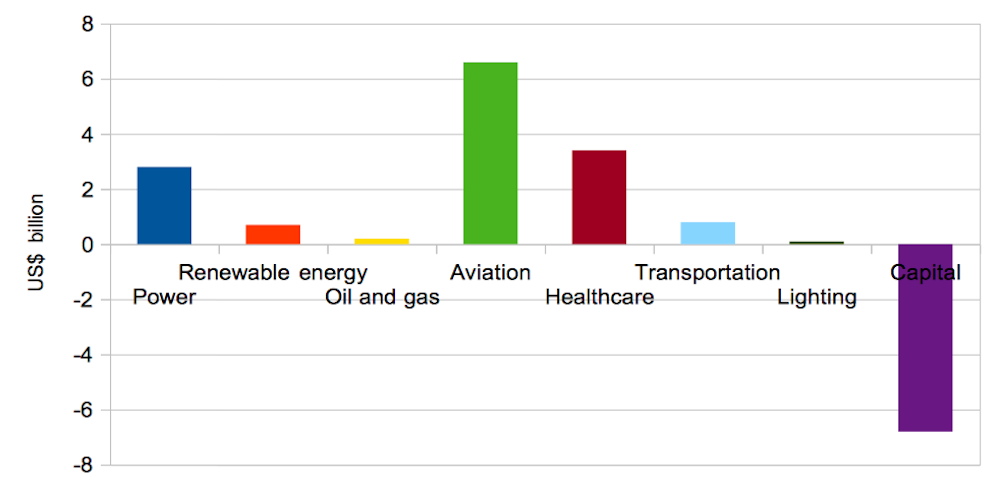
Flannery unveiled a vision for turnaround in autumn 2017 which involved focusing on “jet engines, electric power generators and wind turbines” – the three businesses account for about 60% of the company’s revenues. This involves spinning off healthcare and oil and gas business (part of Baker Hughes), plus selling interests in making industrial gas engines and railway engines.
There is also hefty cost-cutting and cutbacks, including GE Power laying off over 12,000 workers. Bad surprises have included GE Capital writing off in excess of US$ 21 billion in extra costs from a legacy business in healthcare insurance that badly misjudged payouts to customers.
Far less has been written, however, about GE’s waning attempts to become a major player in industrial software services. This still amounts to less than 10% of the overall pie, but unless GE gets it right, it could arguably make or break the entire business.
Betting on digital
GE has long had a reputation both for transformative chief executives and its leadership and management programmes. It was quite a surprise when Flannery’s more realistic forecasts exposed a previous culture of overoptimism that was behind the mess he inherited, not least the insurance announcement.
To the tendency of predecessor Jeffrey R Immelt (chief executive, 2001 to 2017) to be overly optimistic, many would add his overarching theme: the digital future. Immelt created the GE Digital unit in 2015 to become a “top ten software company” by 2020 – four years after headhunting Bill Ruh from Cisco Systems.
The vision was an industrial version of the Internet of Things – sensors and software for GE customers’ industrial equipment to gather data and analyse all the numbers. This would help customers to in turn offer a better service to their own customers and make everyone more profitable. Immelt also saw the whole strategy as an opportunity to use the data in-house to change the engineering culture at GE itself.
In 2015 the company launched the GE Predix Cloud – the “first and only cloud solution for industrial data and analytics” – as the backbone to the offering. It received hefty financial backing from the company – over US$ 4 billion in 2016 for example. Under Flannery, however, the unit is shrinking and under more pressure to perform. It is nowhere close to Emmelt’s prediction that in 2020 it would be grossing over US$ 14 billion a year.
GE share price 2015-18
GE had the vision, but misjudged how the market would play out. It foresaw competition from other cloud software players like Microsoft or Amazon or industrial software specialists like Siemens or Honeywell, but is struggling to compete with their specialised knowledge and integrated offerings. And it didn’t realise that incorporating sensors into much of its equipment would open the door to a host of start ups selling analytics packages on top, including Uptake, C3 IoT, FogHorn Systems and Flutura. Many GE customers are preferring their flexibility and niche expertise to Predix.
Future days
Flannery’s response is to ditch GE’s cloud offering, announcing that Microsoft Azure’s solution will be used instead. GE will concentrate purely on selling the analytics software. Doing this while focusing only on GE’s core divisions should help it to develop apps that might deliver unique insights into, say, the jet engines of the future or making power stations more efficient. GE should learn from its mistakes, however, and involve start ups in reimagining what is required.
GE can’t avoid the fact that it will now face more competition in its traditional safe core markets: GE customers will store their product data with Microsoft, use third-party apps to maintain their equipment, and collect performance insights to benchmark their GE products against those of rivals. If customer purchasing decisions become more influenced by digital applications and software content suppliers gain influence and power, this could be particularly challenging.
Better this than trying to retain too much control, however. Established companies often underestimate market trends – Nokia and Research in Motion learned the hard way that not surrendering control on a software platform can be a bad idea. GE can still be part of optimising the industrial products of the future. The challenge for Flannery and Ruh is to learn from past mistakes to secure what is available.

Ferran receives funding from Innovation Growth Lab – NESTA (UK). He is also a long-term shareholder in GE.
: The Conversation – Articles (UK)
Have you tried: Travelling to South Africa?