
GCSE results: why bright, poor students fail to achieve top grades:
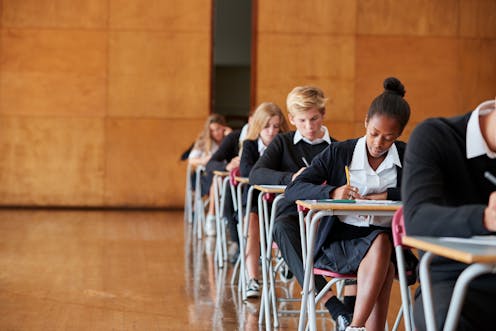
The fourth Thursday in August is a day that is anticipated with equal measures of hope and trepidation by hundreds of thousands of young people across England, Wales and Northern Ireland.
This is when the results of GCSE examinations are released. These exams quite often determine the path these young people will follow – perhaps through upper secondary education, further education, or higher education. Small wonder people get nervous.
Like other exams, GCSEs act as a kind of sieve. Those who do well are presented with opportunities, while those who don’t do so well can often be left wondering what to do next.
The doors that are opened by a good showing at GCSE allow young people to invest further in their own skills, and ultimately this makes them more productive once they enter the workforce. Improving productivity for the country, as well as for individuals, requires that as many young people as possible can access these opportunities. That requires a level playing field – but as our new research shows, that playing field is now anything but level.
Indeed, recent findings from social mobility charity, The Sutton Trust, show that almost half of able but disadvantaged students fail to achieve top GCSE grades. These are students who did well in primary school, but by the time they reached GCSE year, have fallen behind their academic peers.
Social disadvantage
Along with my co-authors, Chiara Masci and Tommaso Agasisti, I have used recently developed machine learning methods to analyse the determinants of pupils’ educational performance across a variety of advanced countries. Our analysis makes use of data from the OECD’s PISA data set – this is useful because it allows comparisons to be made across the numerous countries in our study.
The results for the UK are particularly striking. They show that for here, educational performance is very much driven by social factors. So while tweaking educational policy may help or hinder at the margin, it is social policy that really has the power to secure large gains in educational attainment.

Looking at the proportion of the variation in schools’ test performance that can be explained by our model, we found that around a half is due to the percentage of students coming from disadvantaged homes. As soon as the proportion of disadvantaged students in a school passes through 20% – as it does in almost a half of all schools – the performance of students in that school falls off a cliff. A further fifth of the inter-school variation is due to students having special educational needs.
Only a tiny fraction of the variation is due to school-related factors – such as the number of computers per student, the number of staff per student, the size of the school, or school policies about communication with parents – or even government funding. It’s clear that it’s the social stuff that matters.
How to fix it
The PISA data set defines a student’s family as being disadvantaged if its socioeconomic status is in the bottom 25%. In turn, socioeconomic status is measured as a combination of variables that capture the educational attainment of the parents. This includes their wealth and the educational and cultural possessions – books and the like – that the family has in the home.
Of course, it stands to reason that students who have better educated, wealthier parents and more access to books and resources within the home, should find education easier to access. But our findings also suggest that promoting adult education for parents, and providing students with access to books in the home could go some way to make a difference.
It is clear then that schools can only do so much to solve society’s problems. More needs to be done to help all students maximise the potential that education has to make a difference. Because it’s only right that everyone has the ability to achieve their full potential – not just those students who were born into easier circumstances.

Geraint Johnes is an associate of the Work Foundation.
: The Conversation – Articles (UK)
Have you tried: Travelling to South Africa?