
France in the Sahel: a case of the reluctant multilateralist?:
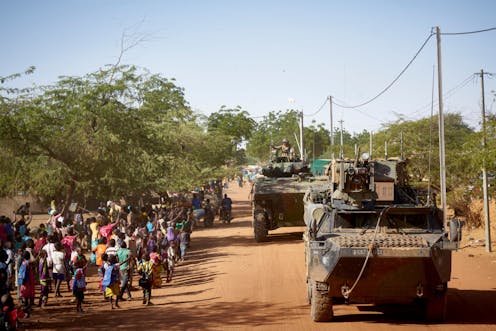
France is presenting its current involvement in the Sahel as a new, and more multilateral, form of intervention.
But is it? Does it mark a clean break with France’s early postcolonial past, characterised by unilateral intervention practices? Or does it, thanks to a process called ‘layering’, superimpose and meld together old unilateral intervention practices with the ‘newer’ multilateral approach?
In looking for answers to these questions, we are reminded of the quotation by management consultant Peter Drucker, namely that
If you want to do something new, you have to stop doing something old.
This observation seems to be the key to understanding the novelty or otherwise of France’s actions in the Sahel. Thus, before searching for the ‘new’, we need to look back and identify the ‘old’.
France of old
France traditionally sees itself as the self-appointed ‘gendarme of Africa’. It has intervened militarily on the continent at least 30 times over the early postcolonial decades. This was possible thanks to its pre-positioned troops based in Africa and French readiness to intervene. Bilateral military and defence agreements signed with a number of former French colonies in Africa after independence provided the legal basis for intervention.
Until the 1990s, French military interventions were mostly unilateral and accompanied by the practice of self-legitimation. In other words, interventions were conducted according to French interpretations of security. They aimed to defend imperilled African heads of state at the discretion of the French president against any threat to the regime. The rules of engagement and levels of force deployed were determined by France without reference to external legitimating authorities. France alone decided on the remit of its operations, which almost always took place within the borders of sovereign African states.
The end of the Cold War and France’s role in Rwanda marked a major turning point for French military policy in Africa. Paris, as the key international supporter of the Juvenal Habyarimana regime that was responsible for the 1994 Rwandan genocide, was widely criticised for its role in the run-up to the genocide, during which up to a million Rwandans, mainly Tutsis, were slaughtered by the Hutu majority. It was also criticised for Operation Turquoise in the immediate aftermath of the genocide. Many critics believed that this ‘humanitarian’ operation was less about saving lives than providing those who had been involved in the genocide with an escape route into eastern Zaire.
As a result, France shifted from a policy of unilateral intervention to a multilateral approach. Partly this was because of the need to share the political risks of intervention following international criticism of the military’s role in Rwanda. But it was also partly driven by resource considerations. France no longer had either the money or the personnel to sustain its old unilateral approach and so needed to share the burden.
‘New interventionism’
Twenty years later, how real is multilateral France’s ‘new interventionism’?
To be sure there has been a shift away from self-legitimation. France has come to accept that interventions need to be mandated by international bodies such as the UN Security Council. And that ideally there should also be approval from regional bodies such as the European Union or the Economic Community of West African States.
It has also come to accept rules set by bodies such as the UN Security Council and by troop contributing countries on a range of fronts. These include the conduct of missions, length of operations and use of violence.
Yet older style unilateral interventionism has never been too far from the surface. One example was French actions in Côte d’Ivoire between 1999 and 2011.
And today France is unquestionably the pivotal actor within the assemblage of external interveners in the Sahel. Its Operation Barkhane involves the deployment of over 5,000 troops to fight terrorism in five francophone countries of the western Sahel – Mauritania, Mali, Burkina Faso, Niger and Chad – and in the Lake Chad Basin. The new elements are the efforts to obtain international approval, the cross-regional approach and the coalition-building focus.
Within this coalition each player has adopted a primary role. France’s Operation Barkhane focuses on active and potentially lethal, on-the-ground counterterrorism operations. For its part, the United Nations Multidimensional Integrated Stabilisation Mission in Mali supports political processes and reconciliation. And the European Union Training Mission Mali and the European Union Capacity Building Mission Sahel Mali focus on training the Malian army and reform of the country’s security sector. Finally, the G5 Sahel joint force, actively promoted and supported by France, undertakes counterterrorism operations in cooperation with French forces.
France’s new approach continues to attract support. But one can raise questions over the extent to which its efforts in the Sahel can genuinely be considered multilateral.
Interventions have not always received prior authorisation by the UN. Also, France has played a dominant role as the lead nation, thanks to its influential position within – or in relation to – all the various bodies involved.
There remain question marks, therefore, surrounding the extent of the newness of the French interventions in the Sahel. Although the ‘new’ interventionism contains elements of multilateralism, it also involves practices that hark back to the old, pre-Rwanda unilateralism.
Perhaps the clearest example of the resurgence of such old-style neocolonial practices was Barkhane’s bombardment, in February 2019, of Chadian forces opposed to President Deby’s regime. The rebels were advancing on the capital N’Djamena with the aim of overthrowing the regime of France’s old ally Idriss Deby.
In the end, it was perhaps never realistic to assume that France would fully embrace the tenets of the ‘new interventionism’. Even the threat of US withdrawal, the relentless attacks by jihadist extremists and the onslaught of COVID-19 might not be enough to make France anything more than a reluctant multilateralist.

Tony Chafer received funding from the Leverhulme Trust to undertake the research on which this article is based.
Gordon D. Cumming received funding from the Leverhulme Trust and support from the Collegium in Lyons.
: The Conversation – Articles (AFRICA)
Have you tried: Sailing in Africa ?