
Four reasons why children need to be more active in school playgrounds, and what’s stopping them:
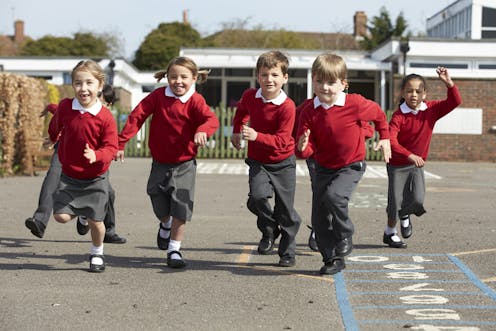
School breaktimes might be assumed to be the most active period in a child’s school day. The fanciful notion that when the school “bell” rings children flood the playground, running, jumping and actively playing with friends may be based on school stories and older people’s experiences.
While some children are physically active at breaktimes, for others there are a number of barriers preventing them from doing anything energetic, recent research has highlighted.
There has also been a marked reduction in the amount of time outside provided by schools provided in the last 27 years. The youngest primary school children now have an average of 45 minutes less breaktime per week, and secondary schoolchildren 65 minutes less, than in 1995. Exercise outside school hours has also declined.
It is essential that schools understand the benefits of these moments in the school day in encouraging every child to run, skip or play games outside, research shows.
Here’s why:
1. It’s important to start young
Skills such as hopping, jumping and throwing combine with other skills such as cycling and scooting and act as a foundation to develop more complex skills such as serving in tennis, and tackling in football. School playgrounds should offer equipment, space and coaching for these basic activities so children are able to develop the skills needed to be active throughout life.
It’s important to do exercise from an early age. Physical activity levels have been found to decrease from as early as seven years of age and continue declining throughout childhood.
Schools need to redesign playground spaces to include equipment that is appropriate for the ability of the children, and to encourage them to have a go. For example, providing two-wheel scooters to younger key stage one children (five-year-olds) without also providing the space needed or any coaching is counterproductive. Schools need to provide a range of equipment from scooters to bikes, balls and rackets that develop a range of basic movement skills (squatting, throwing, catching and cycling) and consider the resources needed such as staff training, and available space to increase children’s chances to do exercise or play games at breaktime.
2. Making friends
Within a school day, children say breaktimes are their favourite times to “catch up” with their friends.
The strongest reason children give for choosing activities and play spaces at breaktimes is “because my friends play here” and “this is where my friends are”. The desire for friendship is so strong that children will often give up on their preferred breaktime activity to take part in games their friends are playing.
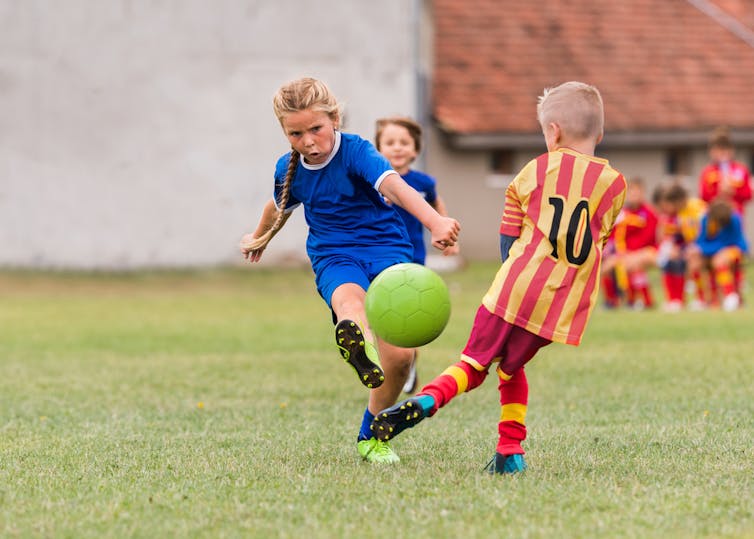
The desire for children to engage in social games (games requiring more than two people) will increase the quality of their friendships. Children will often take part in activities their friends do, despite initially demonstrating lower ability levels. This highlights the importance of friendship as a driver for developing skills and getting children to do more exercise.
3. Improving mental health
One in six children between the ages of five and 16 years of age are identified as having a mental health disorder. An increase in physical activity levels, and time spent outdoors is positively associated with reduced depression and anxiety, and increases in self-esteem.
Some evidence suggests playing games or sport leads to improvements in thinking and problem solving in young people.
Due to the strong positive associations between time spent outdoors with physical activity levels, cardio-respiratory fitness and flourishing mental health, it is essential that schools address both the reduction in breaktimes and the lack of wet weather play space.
Read more: Daily exercise can boost children’s exam grades – new research
4. Getting better results
The pressure of hitting curriculum targets, and the management of poor behaviour are the main factors leading to reduced school breaktimes. However, evidence suggests this is counter intuitive, as an increase in physical activity can have beneficial effects on academic achievement, largely as a result of improvements in memory, flexible thinking and self control.
Irrespective of exercise levels, children who interact more with other children rather than teachers, at breaktime also have better academic results. So headteachers must rethink removing breaktimes as a punishment for misbehaving children.
While breaktimes are often perceived as unimportant by school teachers and policy makers, children disagree. They are important opportunities for children to develop essential social skills and to get more active. We should listen to children on this one.

Michael Graham does not work for, consult, own shares in or receive funding from any company or organisation that would benefit from this article, and has disclosed no relevant affiliations beyond their academic appointment.
: The Conversation – Articles (UK)
Have you tried: Farking?