
Erdo?an has wrecked Turkey’s economy – so what next?:
Turkey’s 2023 election is one of the most significant in its hundred-year history. After years of currency crashes, vanishing foreign currency reserves and surging inflation, rethinking economic policy will be a top priority for whoever is sworn in after the vote on May 14.
President Recep Tayyip Erdo?an and his ruling AKP (Justice and Development Party) came to power in 2002 not long after the previous incumbents’ economic mismanagement had caused a major crisis that sent the lira and stock market plunging. In exchange for an IMF rescue, the outgoing government had introduced reforms such as an independent central bank, banking and finance regulators, taking steps to reduce public deficits and debt, and proper public procurement rules.
The AKP wisely stuck to these reforms, which paid handsome dividends. Inflation fell from above 50% in 2001 to single digits within three years.
Foreign investment improved significantly, allowing annual economic growth to average 7% from 2002-07. This produced sizeable productivity gains, and benefited large parts of society, significantly reducing inequality.
The global financial crisis of 2007-09 caused Turkish exports to collapse, but the country recovered relatively quickly after advanced economies cut their interest rates to almost zero. This encouraged investors to borrow cheaply and put money into emerging markets like Turkey in search of decent returns.
Choppy waters
The turning point, both politically and economically, came in 2013. Demonstrations in Istanbul against construction activity in Gezi Park, one of the last remaining green areas in the city, quickly turned into a nationwide movement against the government’s growing authoritarianism.
Erdo?an responded with a crackdown, deploying riot police and detaining hundreds of protesters. This would become a defining characteristic of his regime, permeating through to all other aspects of governance.
Around the same time, international investors began pulling back from emerging markets as the US Federal Reserve started tightening monetary policy. There have been several cycles of loosening and tightening since then, but the money hasn’t returned to Turkey.
Foreign ownership of Turkish government bonds has fallen from 25% in May 2013 to below 1% in 2023. Similarly, investors have pulled out more than US$ 7 billion (£5.6 billion) from the Turkish stock market.
Investor concerns grew worse after a referendum in 2017 created an executive presidency that bestowed enormous powers on Erdo?an. He has used this to the full, effectively reducing most institutions to independent entities only on paper.
The central bank of Turkey is a case in point. As inflationary pressures started to mount in 2021, and unlike almost every other central bank, it cut interest rates sharply – from 19% to 8.5% today. This pushed inflation to a 24-year high of 84% in August 2022.
Erdo?an’s insistence on low interest rates to promote growth has also severely weakened the lira, which is down 80% against the US dollar in the last five years. To add to the problem, Turkey’s imports are much higher than its exports, causing a current account deficit of 6% of GDP.
Turkey’s tragic lira:
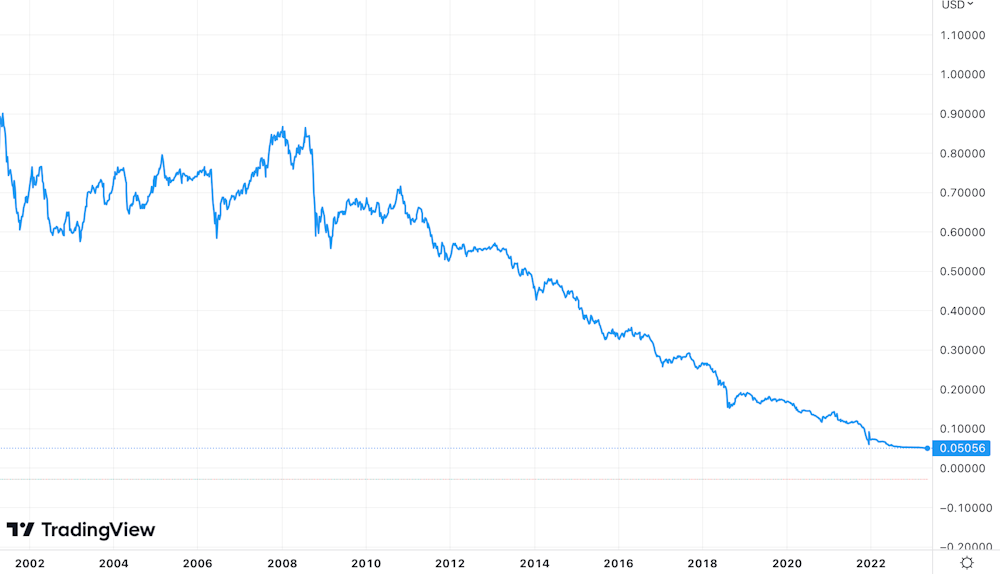
To prop up the lira, the authorities have squandered a huge amount of foreign exchange reserves. They have also resorted to swapping agreements with friendly Gulf nations like the United Arab Emirates, in which Turkey has borrowed Emirati dirhams in exchange for lira. But this doesn’t address the underlying problems. As of April 2023, Turkey’s net foreign currency reserves are down to negative US$ 67 billion.
The authorities have been forced to introduce unconventional measures to keep the wheels turning. These have included protecting lira bank deposits against dollar depreciation by promising to make up any losses, requiring exporters to relinquish 40% of their foreign currency earnings, and barring banks from lending to companies with significant foreign currency holdings.
What next?
A rethink is inevitable after this election, though two very different scenarios are foreseeable. If Erdo?an wins, one would expect some normalisation with the west.
Turkey has been difficult over major issues such as Sweden and Finland joining Nato, recently yielding on Finland but continuing to object to Sweden. With the EU the major destination for Turkey’s exports and hence source of hard cash, Ankara’s approach to the west could potentially soften under Erdo?an after the election.
On the other hand, the AKP’s election manifesto has not offered any novelty on the economic policy front. It seems very unlikely that Erdo?an would change his stance on low interest rates, in which case the lira is likely to plunge further.
Opposition leader Kemal Kilicdaroglu has consistently been ahead in the polls in the run-up to the election, and has just been boosted by the withdrawal of one of the other main candidates. An opposition victory, especially if decisive, would allow for a proper reset, most obviously starting with raising interest rates to deal with high inflation. This would maximise foreign investment, boosting economic growth while alleviating the pressure on the lira.
This is easier said than done, however. Interest rates might need to rise to 30% to break inflation, which would likely cause a nasty recession. As if that wouldn’t put enough pressure on the government’s finances, there have been various electoral giveaways and costly promises from both sides.
Much other spending is also required. The US$ 50 billion cost of building new homes in regions hit by the two recent earthquakes is just one example.
Meanwhile, there has been a significant deterioration in the rule of law, press freedoms and civil liberties. The AKP has relied overly on construction for growth, which has come at the expense of farming, turning a country that was once self-sufficient in food into a major importer.
Education and procurement have suffered from endless reforms. Success in any business in Turkey now requires access to the ruling party elite.
But if undoing all this damage is going to be arduous, it still matters greatly for the rest of the world. Turkey is a key part of international community, not only as a member of Nato and the G20 but at the crossroads of trade between Asia and Europe.
It still has enormous potential, with a young population and dynamic business culture. The results of this election are therefore likely to have ramifications far beyond Turkey’s borders.

Gulcin Ozkan does not work for, consult, own shares in or receive funding from any company or organisation that would benefit from this article, and has disclosed no relevant affiliations beyond their academic appointment.
: The Conversation – Articles (UK)
Have you tried: Diving with Sharks?