
 |
| Photo: Dale Baskin |
If you’re like most enthusiast photographers, your camera equipment represents a sizable investment. It’s natural to want to protect that gear, but just how careful do you need to be?
There’s no single answer. Everyone has their own risk tolerance. What’s acceptable to one might be reckless to another. Of course, it also depends on your gear; professional-grade equipment tolerates more extreme use than entry-level. However, in my experience as a professional photographer, workshop leader, and over a decade of reviewing gear, most people are more careful than they need to be.
I’m not suggesting you throw caution to the wind, but let’s look at common dangers to your camera equipment and how careful you truly need to be.
Impact damage
You’re right to be concerned about drops, bumps, or other impact damage. Cameras and lenses are well-made, but they’re not military grade. You don’t want to scuff, bend, or break things.
 |
|
I often hike with a pack designed for minimal camera gear. If I need to take more, I’ll sometimes wrap a lens in a fleece jacket and stuff it in the top of the pack. Photo: Dale Baskin |
It makes sense to protect your gear, but you don’t need to baby it. I’ve seen people who won’t go anywhere without a padded bag or protective case. Those are great, but often unnecessary. Wrapping your camera in a t-shirt in a daypack for a hike, or rolling it up in a towel for travel, will likely suffice.
In my experience, most impact damage happens when cameras are outside their bags, often due to a lapse of attention. For example, I’ve seen people trip over their own tripod leg, knocking the camera to the ground, or bend over, forgetting a camera around their neck, only to have it swing wildly and hit something. Sometimes, the best protection is old-fashioned situational awareness.
Rain or inclement weather
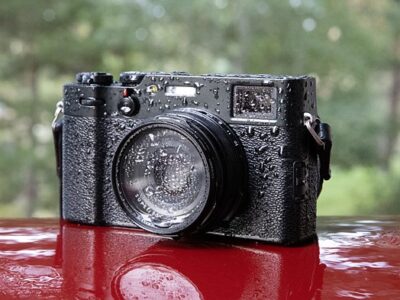
One of the most common fears I encounter is concern about water or moisture. Water is a danger to electronics and optics, but many camera users are more concerned than they need to be.
I’ve seen people travel thousands of miles for a workshop, only to pack up their camera at the first sign of a minor drizzle. They don’t want the camera to get wet, but in most cases, they’re not giving their camera enough credit.
 |
|
Don’t put your camera away just because it starts raining. Most cameras, particularly models with weather sealing, handle rain pretty well. Just be reasonable about it. Photo: Dale Baskin |
Many modern cameras include some level of weather protection, often with ambiguous descriptions like “splash-proof” or “dust-resistant.” Even without these claims, your camera will almost certainly be fine for a little while in a light drizzle. My advice? If your camera advertises any weather protection, you’re probably fine using it in the rain, and even if it doesn’t, your camera isn’t going to melt if it gets a few raindrops on it. Just be reasonable about it.
One luxury I’ve had as a DPReview editor is the opportunity to use many mid-range cameras in absolutely terrible, wet conditions, sometimes with water dripping off them for extended periods. Every single camera I’ve done this to kept working. I’m not suggesting carelessness, or that water will never cause a problem – just that gear may tolerate more than many imagine.
Sensor damage
We all agree on the need to keep a camera’s sensor clean. But what if you’re out shooting and notice a dust speck? What do you do?
I’ve seen it too many times: a workshop participant discovers a horrendous dust spot but is afraid to do anything in the field for fear of damaging the sensor. They end up with hundreds of photos, all with the same dust spot.
 |
|
We’ve all been taught to treat camera sensors very carefully, but don’t let sensor dust ruin your day. Photo: Mitchell Clark |
Conventional wisdom says to be cautious when cleaning sensors, and I won’t argue that. But they’re not made of unobtanium. I know the user manual probably recommends removing dust in a clean room with a specialized swab, but be pragmatic. In most cases, it’s okay to use your Rocket Blower to shoot some air on the sensor to remove it.
Just don’t use compressed air in a can, which might spray chemicals onto the sensor.
Extreme temperatures
Extreme temperatures are worthy of caution. If you’re shooting in cold conditions, there’s not much to worry about other than getting cold yourself. I’ve worked outside for extended periods at -20°C (-4°F), usually giving up before the camera. However, if something feels stiff or frozen, don’t force it.
 |
| Graphic: CDC |
Hot weather is another matter. Heat can damage sensors, electronics, and warp plastics. While it’s unlikely you’ll be shooting in conditions hot enough to vaporize lens lubricants, the most common heat damage is storing or transporting gear in places that get extremely hot, like a car trunk. Take precautions to protect your gear in extreme heat.
Dust, sand or other debris
Small particles like dust and sand can be a nightmare. Beyond sensor dust, sand can get into lens mounts and gears, or scratch surfaces like viewfinders and lenses. You’ll obviously want to avoid this, but don’t let it prevent you from enjoying your camera.
 |
|
Occasional use in sandy or dusty environments is OK as long as you’re careful and clean your equipment at the end of the day. Photo: Dale Baskin |
Using your camera at the beach or in sand dunes is fine, but use common sense: don’t change lenses on a windy, sandy beach, and wipe down your gear at the end of the day with a damp microfiber cloth. With a little precaution, occasionally using your gear in dusty, sandy environments is generally not a problem for most gear.
The take-home message
I’m never going to judge anyone for taking care of expensive gear. We all have our own risk tolerances, and I appreciate that people have different motivations for owning gear – sometimes it’s a tool; other times, it’s just something they enjoy using.
However, my observation over the years is that many camera owners don’t trust their gear enough, and many are more protective than necessary. And if you’re so protective of your gear that you can’t enjoy using it, what’s the point?

Our DPREVIEW Tribute:
After nearly 25 years of operation, DPReview closed on 10 April 2023. This difficult decision was part of the annual operating plan review that parent company, Amazon, shared earlier this year.
Over the course of 25 years, DP Review built up a reputation as being one of the most informative places to go for information about that new camera or lens you’re after. DP Review began as an independent reviews site based in the UK in 1998, the brainchild of Philip and Joanna Askey, but it was eventually purchased by Amazon in 2007 and relocated over to Seattle in the USA in 2010.
Cheers DPReview – thanks for the great work and content that guided photographers, videographers and techno junkies the world over!