
Johannesburg: College Africa Group | Executive Question of the Week
Every month, finance departments across South Africa face a familiar challenge. They must collect, reconcile, check, and present financial information to management. Deadlines approach, spreadsheets multiply, and experienced finance professionals spend valuable hours preparing reports.
By the time the reports are completed, there is often little time left to analyse the results, identify trends or provide meaningful recommendations.
The problem is not necessarily a shortage of employees or inadequate software. In many organisations, the underlying issue is how financial reporting processes have developed over time and whether employees have the Microsoft Excel skills needed to work efficiently.
CAG Executive Question of the Week:
How much of your finance team’s working week is spent preparing financial information rather than helping management understand what it means?
The Hidden Cost of Manual Financial Reporting
Consider a finance department responsible for producing monthly management accounts.
Information arrives from different departments, accounting systems and operational spreadsheets. Employees copy figures between workbooks, reconcile transactions, update formulas, correct formatting and check whether the final totals agree.
Employees may have repeated much of this work every month for years.
The financial cost is not limited to the hours spent preparing reports. There is also an opportunity cost when qualified finance professionals have less time to investigate variances, evaluate financial performance and advise management.
A report that takes two days to prepare instead of four hours represents a potential productivity opportunity. The actual improvement must, however, be demonstrated through a review of the existing reporting process.
Microsoft Excel Is Often Underutilised
Microsoft Excel remains an important business tool for financial reporting, budgeting, forecasting and analysis.
Yet there is a considerable difference between knowing how to enter information into Excel and knowing how to use it efficiently.
Many employees have developed their Excel knowledge informally. They may be comfortable with basic formulas and formatting but unfamiliar with capabilities that could simplify recurring reporting activities.
For example:
- Excel Tables help organise source data and accommodate additional records without constantly adjusting reporting ranges.
- PivotTables allow finance teams to summarise and analyse large datasets without repeatedly rebuilding reports.
- Power Query can import, clean and transform recurring data, reducing repetitive preparation work.
- SUMIFS, XLOOKUP and other formulas can improve the efficiency of financial comparisons, reconciliations and reporting.
- What-If Analysis helps finance teams examine different financial assumptions and business scenarios.
These capabilities are not simply advanced technical features. When applied correctly, they can change how financial information is prepared and used.
Better Excel Skills Alone Will Not Fix a Poor Reporting Process
Training employees in advanced Excel functions is valuable, but it should not be the only consideration.
A complicated spreadsheet does not automatically become a better reporting system because it contains more sophisticated formulas.
Before investing in training or redesigning a workbook, management should understand where the reporting process is losing time.
Is information being entered more than once? Are employees manually repeating tasks that could be standardised? Do reports contain unnecessary calculations? Are multiple versions of the same workbook circulating between departments?
These questions help distinguish between an Excel skills problem, a spreadsheet design problem and a broader business process problem.
The appropriate solution may involve better data structures, simplified reporting procedures, targeted Excel training or a combination of these improvements.
From Report Preparation to Financial Analysis
The real business opportunity is to shift the finance team’s attention from producing numbers to understanding them.
Consider an illustrative monthly reporting process involving three employees, each spending six hours preparing recurring information.
If improved Excel skills and reporting procedures reduce that work to two hours per employee, the department releases twelve working hours every month.
That represents 144 hours of potential productive capacity annually.
This is an illustration, not a claim about actual client results. The time saved must be measured, and the accuracy of the reports must be maintained or improved.
Those additional hours could be redirected towards investigating financial variances, monitoring costs, improving forecasts and supporting management decisions.
The value is not simply completing the same work faster. It is enabling finance professionals to contribute more meaningfully to business performance.
What Should Business Leaders Measure?
College Africa Group recommends establishing a baseline before changing a recurring reporting process.
Management should examine the time required to prepare reports, the number of manual interventions, recurring errors, rework and the time between receiving source information and delivering the final report.
After improving the process and strengthening employee skills, the same measures should be reviewed.
This allows businesses to distinguish genuine productivity improvements from simply introducing new techniques or software.
The College Africa Group Perspective
College Africa Group (CAG), a South African corporate training and consulting provider established in 2003, believes that workplace productivity begins with understanding how employees perform their work.
According to Arnold Muscat, Director of College Africa Group, the objective of Excel training should extend beyond teaching employees additional formulas.
“The real value of Excel training is not how many functions an employee can remember. It is whether they can use those skills to produce accurate information more efficiently and give management better insight into the business.”
CAG’s practical approach connects business processes, employee capability, effective Microsoft Excel usage and measurable workplace improvements.
For finance departments, this means identifying the reporting activities consuming the most time, strengthening the skills required to improve those activities and measuring the results.
The ultimate objective is straightforward: finance professionals should spend less time preparing information and more time helping businesses make informed decisions.
Improve Your Finance Team’s Excel Productivity
College Africa Group provides practical, corporate-focused Advanced Excel Training in South Africa, helping finance teams and business professionals strengthen their reporting, data analysis and spreadsheet skills.
Businesses seeking to reduce repetitive financial reporting work and improve employee productivity can contact College Africa Group to discuss appropriate Excel training and skills development programmes.
College Africa Group — Better Processes. Stronger Skills. Smarter AI.
Website: https://collegeafricagroup.com
Email: sales@collegeafricagroup.com
Images:
Video:
https://www.youtube.com/@collegeafricaexcelvideotip1434
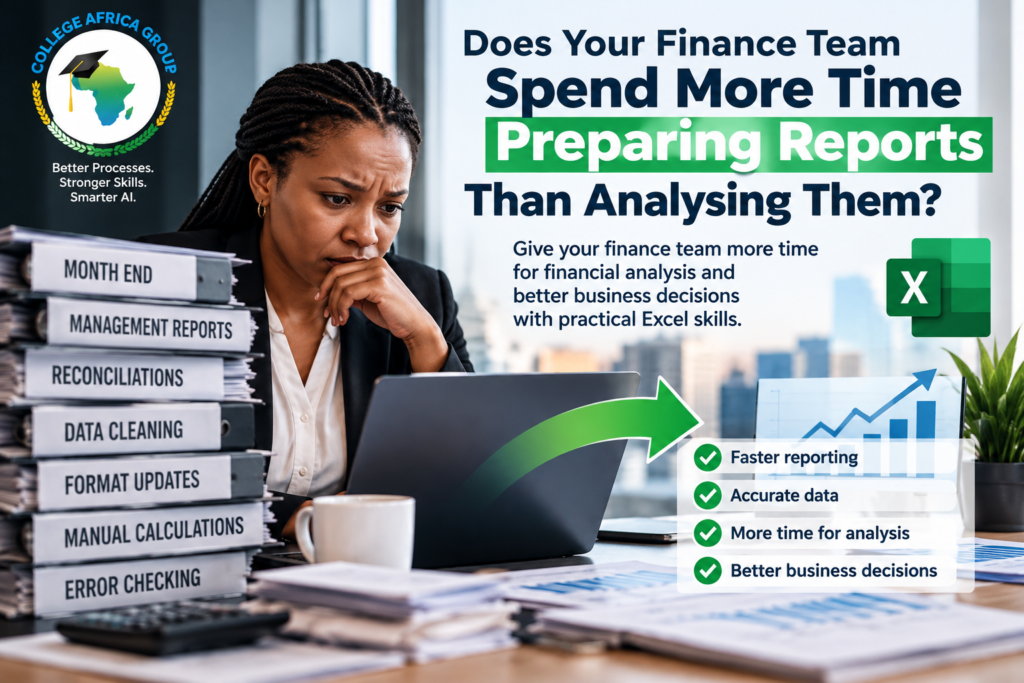
Does Your Finance Team Spend More Time Preparing Reports Than Analysing Them?
Links:
Boilerplate and Editor’s Notes.
More Info on Does Your Finance Team Spend More Time Preparing Reports Than Analysing Them? here:
X:
LinkedIn: https://www.linkedin.com/company/9491250/admin/dashboard/
Facebook: https://www.facebook.com/CollegeAfrica
Phone: +27 (0) 83 778 4903
Email sales@collegeafricagroup.com
CLICK HERE to submit your press release to MyPR.co.za.
Submit your Press Release for free to MyPR here: MyPR Free Press Release Submission.