
Do very active people really have a higher risk of heart attack – as recent headlines claimed?:

Everybody knows that exercising is good for your heart, so recent news that over-exercising can block up your arteries, may have come as a shock to many.
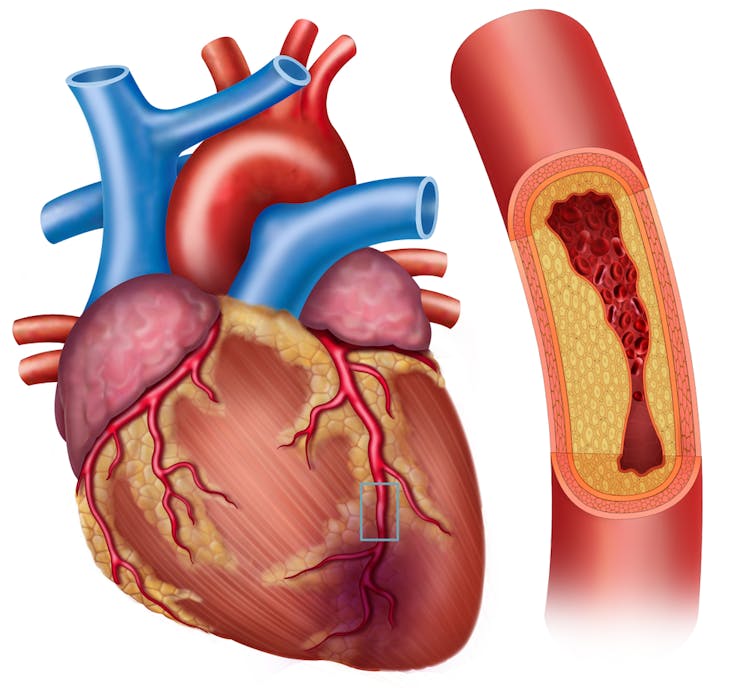
The study, which was widely reported in the media, found that very active people have higher coronary artery calcium (CAC) scores than less active people. The CAC score measures the amount of calcium in the walls of the coronary arteries – arteries that supply blood, and hence oxygen, to the heart muscle.
An increase of calcium in the coronary arteries may increase a person’s risk of having a heart attack because the presence of calcium in the coronary arteries is a sign that there may also be a buildup of plaque, known as atherosclerosis. A buildup of plaque is usually the result of an unhealthy lifestyle, such as smoking, drinking, being overweight and not getting enough exercise. So doctors often use CAC scores to identify people at risk of heart disease.
The researchers, from the University School of Medicine in South Korea, and Johns Hopkins Bloomberg School of Public Health in the US, analysed the coronary artery calcium of more than 25,000 healthy adults (mainly men) aged 30 and older between March 2011 and December 2017. The participants had two comprehensive check-ups during the study period to monitor changes in their coronary arteries.
The researchers wanted to find out if there was a link between physical activity and increased coronary artery calcification.
All the study participants completed a questionnaire to identify how much exercise they undertook each week. Nearly half the participants (47%) were categorised as inactive, 38% were categorised as being moderately active and 15% were categorised as being intensely active (the equivalent of running 6.5km a day).
Those who were more physically active tended to be older and less likely to smoke than the less physically active participants.
Scans taken at the start of the study showed an average CAC score of 9.5 in the inactive group, 10.2 in the moderately active group, and 12 in the intensely active group. At the end of the study period, those who were moderately and intensely active saw average score increases of 3 to 8. So moderate and intense exercise seems to increase the buildup of calcium deposits in the arteries.
Benefits of exercise are unquestionable
However, the researchers did not find a link between higher coronary artery calcium scores due to exercise and cardiovascular “events”, such as heart attack or stroke. So headlines which claim that exercise “raises heart attack risk” are both wrong and dangerous. Indeed, the researchers warn against this sort of interpretation. They conclude: “The cardiovascular benefits of physical activity are unquestionable.”
The health benefits of exercise are significant, with higher levels of exercise associated with a lower risk of heart disease and premature death. This suggests that while exercise may result in increased CAC scores, it lowers the risk of cardiovascular disease, such as heart attack and stroke. The benefits of exercise greatly outweigh the risks. And people should aim to do at least 150 minutes of moderate-intensity exercise or 75 minutes of vigorous-intensity exercise a week.
Interestingly, the increased density of the calcium within coronary arteries due to exercise may be protective as it decreases the likelihood of the plaque within the arteries rupturing, which can lead to a heart attack. So doctors need to be careful when interpreting the CAC scores of healthy people.

Matthew Farrow ne travaille pas, ne conseille pas, ne possède pas de parts, ne reçoit pas de fonds d'une organisation qui pourrait tirer profit de cet article, et n'a déclaré aucune autre affiliation que son organisme de recherche.
: The Conversation – Articles (UK)
Have you tried: Sailing in Africa ?