
Humanity must remove up to 660 billion tonnes of carbon dioxide (CO?) from the atmosphere by the end of the century to limit global warming to 1.5°C. That’s according to the most recent report by the Intergovernmental Panel on Climate Change (IPCC), which based its estimate on atmospheric CO? concentrations measured in 2020.
Removing this much CO? will involve more than simply planting lots of trees. Engineers and scientists are developing direct air capture technologies (DAC) which are supposed to pull vast quantities of CO? from the atmosphere while using very little land and water.
A typical DAC unit uses large fans to push air through a liquid or solid material which can bind and remove CO?, similar to how human lungs extract oxygen. The material is regenerated when heated, leaving concentrated CO?.
The concentrated CO? can either be permanently stored, usually underground in depleted oil and gas reservoirs, or used to produce useful chemicals such as synthetic fuels. These fuels would re-release CO? when burned and so are technically carbon neutral.
Advocates of the technology say this could reduce the need for fossil fuels and help industries that are difficult to decarbonise, such as aviation, reach net zero emissions. Others worry that DAC offers a distraction from the hard work of slashing carbon emissions.
These critics suggest that the high energy cost and materials used for DAC make it prohibitively expensive and so impractical on the tight timescale left to avert catastrophic climate change. The cost to remove a tonne of CO? with DAC can reach US$ 600 (£522).
DAC technology is still in its infancy. The International Energy Agency (IEA) forecasts that it will be removing 90 million tonnes a year in 2030, 620 million tonnes in 2040 and 980 million tonnes annually in 2050.
But as things stand, only 19 DAC projects have come online since 2010, which collectively remove 0.008 million tonnes of CO? each year, equivalent to about seven seconds of global emissions from energy production in 2021.
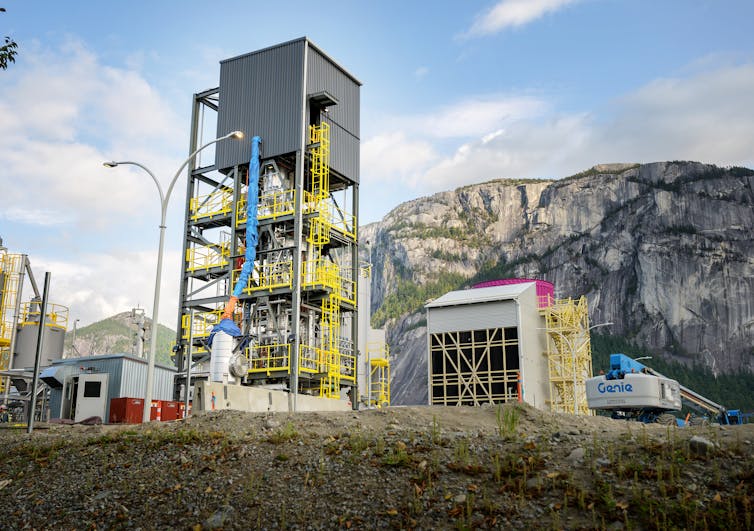
DAC developers are working on projects that will remove about 1 million tonnes of CO? a year each in the mid-2020s. But they may struggle to improve energy efficiency and reduce costs fast enough to remove CO? at the necessary scale to meet the IEA’s forecasts for the 2030s. Here’s why.
DAC deployment is gaining momentum
The largest unit currently operating is the Orca plant, which was built by the company Climeworks in Iceland in 2021. As big as two shipping containers, Orca aims to capture and permanently store up to 4,000 tonnes of CO? annually by dissolving it in water and pumping it underground where it will react to form rock.
This is how much 170,000 trees on 340 hectares of land would absorb in a year. Unfortunately, cold weather in early 2022 froze the machinery and shut down the plant.
Carbon Engineering, another DAC developer, is planning to deploy a unit in Texas in the US which it says will remove and store up to 1 million tonnes of CO? a year once it begins operating in 2024. This venture includes a multi-million dollar investment from United Airlines which is attempting to offset emissions from its flights as well as acquire synthetic fuels.
Carbon-neutral fuels might replace oil in aeroplanes and long-distance goods vehicles. But air-to-fuel technologies still need a more competitive business model than the fossil fuel industry.
This is unlikely to happen quickly, since the latter is so well-established and subsidised whereas the technology behind air-to-fuel is rudimentary and needs substantial investment to scale up.
Costs are falling too slowly
The IEA has estimated that removing up to 1 billion tonnes of CO? a year from the air with DAC plants in 2050 will consume up to 1,667 terawatt-hours of energy – equivalent to 1% of global consumption in 2019.
Costs are expected to drop to between US$ 125 and US$ 335 per tonne of CO? in the 2030s, with the prospect of reaching below US$ 100 by 2040. This will depend on DAC units being deployed and developers learning from these demonstration units, similar to how the cost of solar energy fell over time.
DAC could become financially viable in the 2030s if falling costs are met by the rising price of carbon in tax regimes. According to the International Monetary Fund, the average price of CO? in the countries where carbon taxes or pricing mechanisms exist hit US$ 6 per tonne in 2022 and is set to increase to US$ 75 by 2030.
The EU Emission Trading System priced a tonne of CO? at US$ 90 a tonne in 2022. The Inflation Reduction Act recently increased tax credits for companies removing and storing CO? in the US from US$ 50 a tonne to US$ 180.
But high carbon prices are far from the norm elsewhere. In China, the carbon price hovered between US$ 6 and US$ 9 per tonne in 2021 and 2022.
DAC could also become viable if the CO? it removes is monetised. But this is risky. One application of DAC is enhanced oil recovery, which involves pumping concentrated CO? underground to extract more oil.
Estimates suggest this method could emit 1.5 tonnes of CO? for each tonne removed. Although this strategy could reduce the net emissions of conventional oil production, it would still add carbon to the atmosphere.
Opportunity may arise in industries that need concentrated CO?, like food manufacturers. The CO? price has surged from US$ 235 a tonne in September 2021 to upwards of US$ 1,200 recently.
This is because the majority of CO? in the UK is sourced from the fertiliser industry, where soaring natural gas prices have wreaked havoc. Although current global demand is limited to about 250 million -300 million tonnes a year, DAC could soon offer a more affordable and climate-neutral supply of CO?.
New technologies may help make DAC cheaper. For example, a DAC start-up based in the UK called Mission Zero Technologies is aiming to use electricity instead of heat to regenerate the CO?-absorbing material in DAC units. This, the company claims, would cut the energy requirements of DAC fourfold.
Unfortunately, cost estimates for DAC are highly uncertain. This is partly because they often come from the developers themselves rather than independent research. There is no commonly accepted approach for quantifying the actual costs of DAC, but my research group is working to verify the removal costs claimed by DAC developers and forecast by the IEA with a global network of academics and industrialists.
Will DAC slow global warming?
The world needs to build about 30 DAC plants capable of removing more than 1 million tonnes of CO? a year every year between 2020 and 2050. With only a few such plants expected to be operational by the mid-2020s, overcoming this shortfall will be hard, especially if costs remain high and breakthrough DAC technologies are not discovered and commercialised.
I believe that DAC is still an essential tool for slowing global warming. When the predicted cost reductions are achieved, DAC will unlock the path to large-scale CO? removal with a much smaller land and water footprint than other removal technologies in the 2030s and beyond.
The role of DAC is not to compensate for rising emissions in the 2020s, but to close the emission gap and bring atmospheric CO? concentration down to limit global warming to 1.5°C during the decade and a bit approaching 2050. This is why governments and businesses should focus on ending their reliance on fossil fuels while supporting the research and development of DAC technology to drive its costs down.

Dawid Hanak's research group has received grants from UK research councils, the European Union and industrial partners.
: The Conversation – Articles (UK)
Have you tried: Farking?