
Curious Kids: why doesn’t the rainbow have black, brown and grey in it?:

Why doesn’t the rainbow have colours like black, brown and grey in it? – Ivy, aged four, Kent, UK
Many of us have seen rainbows in the sky once the sun starts shining again after a spell of rain. For us to see a rainbow, the conditions need to be just right.
We need some water droplets in the air – like rain or even fog – and we need the Sun to be behind us and quite low to the ground. This is because a rainbow is created by light passing through water droplets.

Curious Kids is a series by The Conversation that gives children the chance to have their questions about the world answered by experts. If you have a question you’d like an expert to answer, send it to curiouskids@theconversation.com and make sure you include the asker’s first name, age and town or city. We won’t be able to answer every question, but we’ll do our very best.
The light that comes from the sun seems white to us. But the white light we see in everyday life is actually made up of a mix of different colours. When the light goes through a raindrop, these colours can separate out.
Waves of light
You wouldn’t know it to look at it, but light travels in waves, like waves moving across the ocean. Each of the colours in the rainbow have what we call a different “wavelength”.
This means that the distance between the tops of the wave is a different length for each colour. The colours, from violet with the shortest wavelength to red with the longest, are called the “visible spectrum”.
Raindrops look more like little balls than the teardrop shapes we often draw. When light hits one one of these little balls of water, the light can change direction. We call this “refraction”.
Each of the different wavelengths is refracted by a slightly different amount. If the light hits the raindrop at the right angle, the refraction separates the wavelengths out into their different colours. As lots of light is refracted through lots of raindrops, we see these colours as a rainbow in the sky. The order the colours come in is set by how long their wavelength is.
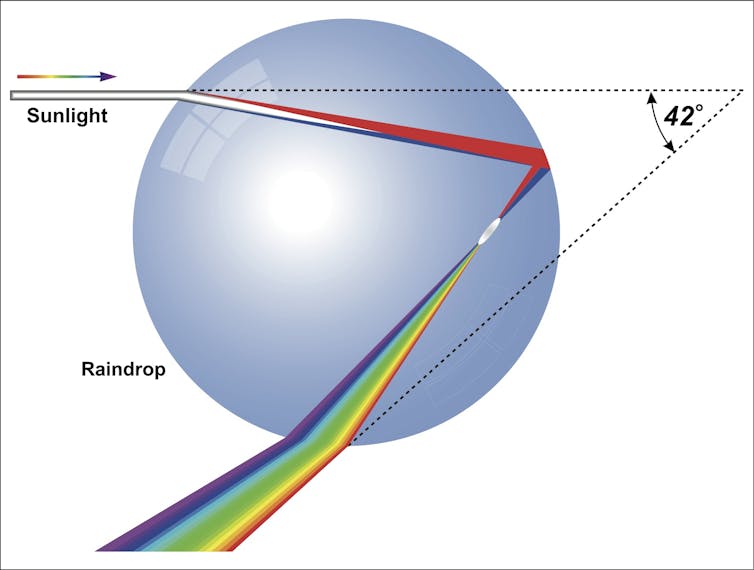
When we learn about the rainbow, we are taught that there are seven colours: red, orange, yellow, green, blue, indigo and violet. But this isn’t strictly true.
Colours in the rainbow
The different colours blend into each other, and it is difficult to tell where one colour ends and another begins. There are other colours in between them, where they mix – like turquoise between blue and green.
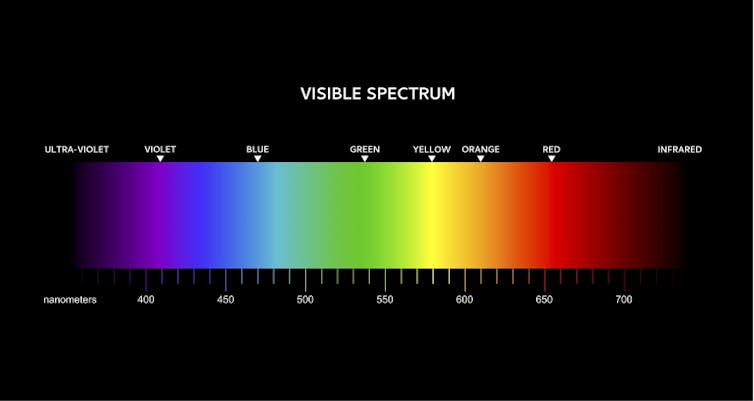
Blue and green are next to each other in the colour spectrum, which is why we can see turquoise where they blend into each other. Some colours, though, are mixes of colours that aren’t next to each other in the spectrum.
Brown, for instance, is a mix of red and green. But the red and green bands in the rainbow aren’t next to each other, so we don’t see them mix to make brown. The same is the case for many other colours that are mixtures – if the colour bands in the rainbow don’t overlap then they can’t mix.
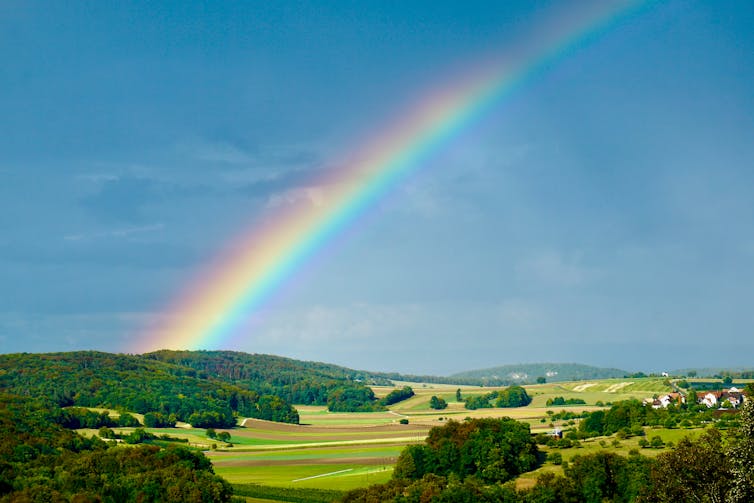
But there are two colours we would never see in a rainbow – black and white. Black is the absence of colour – it’s what’s we see when there’s no light at all.
On the other hand, white is a combination of all the colours together. When light is refracted by raindrops it separates the white light out into the visible spectrum, meaning it is no longer white. Grey is a mix of black and white, and as we can’t ever see black and white in a rainbow, we also can’t see colours made by mixing them.
Next time you see a rainbow, look out for how many colours you can spot in it – and the colours that you can’t see.

James Rawlings does not work for, consult, own shares in or receive funding from any company or organization that would benefit from this article, and has disclosed no relevant affiliations beyond their academic appointment.
: The Conversation – Articles (UK)
Have you tried: Travelling to South Africa?