
Curious Kids: is there such a thing as nothing?:
Is there such a thing as nothing? – Reggie, aged seven, Darlington
Could someone see nothing? What does nothing look like? – Maya, aged nine, Bristol
Imagine you hear a noise outside your window. You think it might be a dog barking, or maybe a child shouting. But when you get up and have a look, there’s no dog or child. “Oh,” you say, “there’s nothing there.”
We often say we’ve “got nothing”, or that there’s “nothing there”. But what we mean is that we haven’t got a particular thing. When you looked outside, lots of things were there – trees, houses, cars and bicycles maybe – but the particular thing you were looking for wasn’t there.
Even if you were looking into a completely empty room, there would still be things there. There’s always air, and air is made up of molecules, like the oxygen we need to breathe in to keep us alive.

Curious Kids is a series by The Conversation that gives children the chance to have their questions about the world answered by experts. If you have a question you’d like an expert to answer, send it to curiouskids@theconversation.com and make sure you include the asker’s first name, age and town or city. We won’t be able to answer every question, but we’ll do our very best.
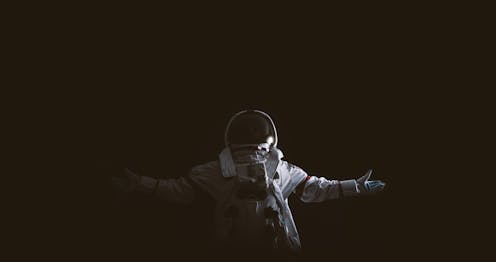
But what about space? There’s no air in space: that’s why astronauts need to wear a space suit that provides oxygen to breathe if they go on a “space walk”.
There are actually molecules in space, too, but they are so few and far between that it’s mostly empty space. This is called a vacuum. We might think that the emptiness we can see in between stars in the night sky, where there are very few molecules, will be where we find “nothing”.
It turns out, though, when you look into the dark night sky, you are not seeing “nothing”. This empty space is filled with energy, and that’s something even if you cannot hold it in your hand. Energy is what makes things happen.
Energy never goes away and it is never made out of nothing. When you run, the energy in your motion comes from the energy you got out of the food you ate. When you stop, that energy goes into heat and making a minuscule impact on the motion of the Earth as your feet rub against it when you brake.
Einstein realised that energy and particles (tiny bits of stuff) are two sides of the same coin. The tiniest things we know of – such as particles, which are more than a million billion times smaller than we are – are made from energy. About a century ago scientists realised that these tiny things act differently to bigger things in the universe. Their behaviour cannot be predicted precisely, and it can only be described with something called “quantum mechanics”.
Particles and anti-particles
This also means that the content of vacuum is not precisely zero. Tiny particles in it can meet their exact opposites, “anti-particles”. When this happens they cancel each other out and vanish, but this leaves behind the energy that had made them in the first place.
The vacuum of space is a “soup” of energy and pairs of particles and anti-particles. The Dutch scientist Hendrik Casimir suggested a way of proving this in 1948 – and half a century later, we have found out that he was right.
This energy in the vacuum also makes the universe grow bigger with time, like when you blow up a balloon.
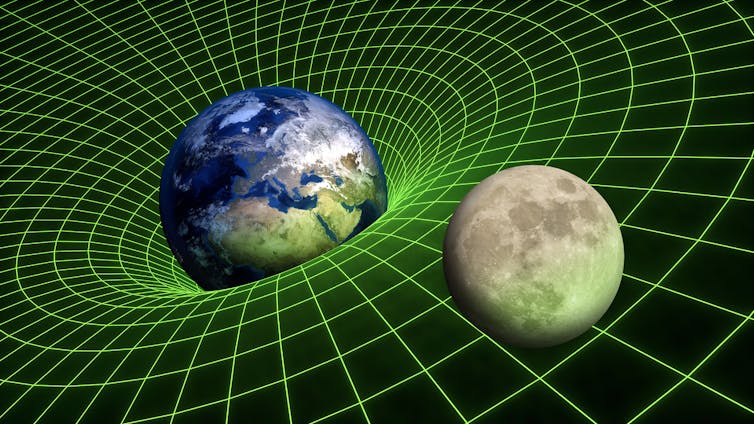
There are other things in the vacuum of space, too. Space contains “fields”, which are a way to describe the influence something can have throughout a region of space. For instance, the Earth pulls at the Moon through space by way of a field called “gravity”.
When famous physicist Albert Einstein was figuring out how gravity works, he found that space actually has shape. Something with a lot of mass, like a star or a planet, bends the space around it, like how a heavy ball held in the middle of an outstretched blanket makes the blanket change shape. If space has shape then surely space cannot be nothing.
It looks as if we won’t find “nothing” anywhere in our universe. Perhaps the place to look for nothing is beyond or outside the universe. This may be an impossible question, though. The universe is where space is, where stuff and energy are, and where time is.
Outside the universe?
Physicist Stephen Hawking explained the universe as having no boundary, either in space or in time. When you are inside a house, the walls are the boundary and you could think about what’s outside, perhaps even see it through a window. But if the universe has no boundary, then there is no such thing as “outside” (or “before”). We could call it “nothing”, but it would be better to say it’s the absence of anything.
Nothing does exist as an idea. We can use “nothing” to count with: the idea of “zero” was being used 4,000 years ago, and the oval symbol we use today was invented over 1,000 years ago.
Perhaps this is the only place where “nothing” exists: as an idea in our minds.

Jacco van Loon does not work for, consult, own shares in or receive funding from any company or organisation that would benefit from this article, and has disclosed no relevant affiliations beyond their academic appointment.
: The Conversation – Articles (UK)
Have you tried: Sailing in Africa ?