
COVID: what we know about new omicron variant BF.7:
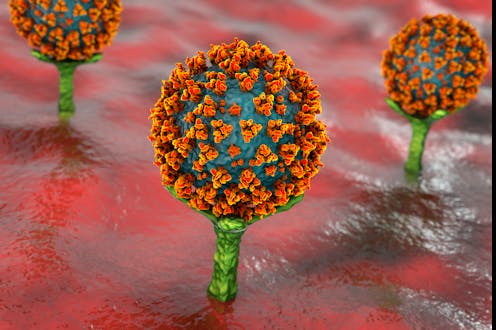
Since the COVID variant omicron emerged in late 2021, it has rapidly evolved into multiple subvariants. One subvariant, BF.7, has recently been identified as the main variant spreading in Beijing, and is contributing to a wider surge of COVID infections in China.
But what is this new variant, and should we be worried? Although reports from China about this variant’s characteristics are concerning, it doesn’t appear to be growing too much elsewhere in the world. Here’s what we know.
BF.7, short for BA.5.2.1.7, is a sub-lineage of the omicron variant BA.5.
Reports from China indicate BF.7 has the strongest infection ability out of the omicron subvariants in the country, being quicker to transmit than other variants, having a shorter incubation period, and with greater capacity to infect people who have had a previous COVID infection, or been vaccinated, or both.
To put this into context, BF.7 is believed to have an R0, or basic reproduction number, of 10 to 18.6. This means an infected person will transmit the virus to an average of 10 to 18.6 other people. Research has shown omicron has an average R0 of 5.08.
The high transmission rate of BF.7, taken with the risk of hidden spread due to the many asymptomatic carriers, is understood to be causing significant difficulty in controlling the epidemic in China.
Read more: China could face a catastrophic COVID surge as it lifts restrictions – here’s how it might play out
The symptoms of an infection with BF.7 are similar to those associated with other omicron subvariants, primarily upper respiratory symptoms. Patients may have a fever, cough, sore throat, runny nose and fatigue, among other symptoms. A minority of people can also experience gastrointestinal symptoms like vomiting and diarrhoea.
BF.7 may well cause more serious illness in people with weaker immune systems.
BF.7’s mutations
As omicron has evolved, we’ve seen the emergence of new subvariants better able to escape immunity from vaccination or prior infection. BF.7 is no different.
BF.7 carries a specific mutation, R346T, in the spike protein of SARS-CoV-2 (a protein on the surface of the virus that allows it to attach to and infect our cells). This mutation, which we also see in BF.7’s “parent” variant BA.5, has been linked with enhancing the capacity of the virus to escape neutralising antibodies generated by vaccines or previous infection.
A recent study examined the neutralisation of BF.7 in sera (a component of blood that should contain antibodies) from triple-vaccinated healthcare workers, as well as patients infected during the omicron BA.1 and BA.5 waves of the pandemic. BF.7 was resistant to neutralisation, driven partly by the R346T mutation.
BF.7 around the world
BF.7 has been detected in several other countries around the world including India, the US, the UK and several European countries such as Belgium, Germany, France and Denmark.
Despite BF.7’s immune-evasive characteristics, and worrying signs about its growth in China, the variant seems to be remaining fairly steady elsewhere. For example, in the US it was estimated to account for 5.7% of infections up to December 10, down from 6.6% the week prior.
While the UK Health Security Agency identified BF.7 as one of the most concerning variants in terms of both growth and neutralisation data in a technical briefing published in October (it accounted for over 7% of cases at that time), the most recent briefing says BF.7 has been de-escalated due to reduced incidence and low growth rates in the UK.
Read more: XBB and BQ.1: what we know about these two omicron ‘cousins’
We don’t know exactly why the situation looks different in China. BF.7’s high R0 might be due in part to a low level of immunity in the Chinese population from previous infection, and possibly vaccination too. We should, of course, be cautious about the data from China as it’s based on reports, not peer-reviewed evidence yet.
An evolving virus
Since the emergence of SARS-CoV-2 three years ago, the virus has continued to evolve, acquiring genetic mutations more rapidly than expected.
The emergence of BF.7 and other new variants is concerning. But vaccination is still the best weapon we have to fight COVID. And the recent approval by the UK drugs regulator of bivalent boosters, which target omicron alongside the original strain of SARS-CoV-2, is very promising.

Manal Mohammed does not work for, consult, own shares in or receive funding from any company or organisation that would benefit from this article, and has disclosed no relevant affiliations beyond their academic appointment.
: The Conversation – Articles (UK)
Have you tried: Visiting Port Elizabeth?