
COVID vaccines: many people have had two doses but not their boosters – here’s why that might be:
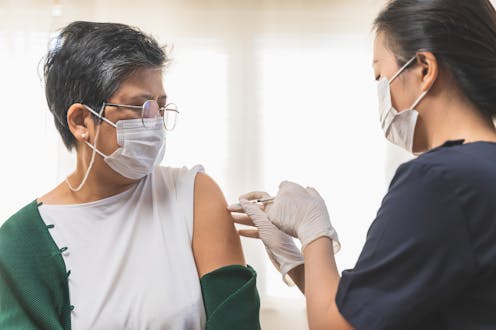
In England, the current pandemic strategy relies on vaccine protection to minimise the impacts of COVID infections. But vaccine uptake is not as good as it could be. As of October 23 2022, although 80% of adults had received two doses, only 66% had received a third.
Vaccine uptake is lower in men compared with women, and while more than 90% of people over the age of 70 have had at least three doses, uptake in younger age groups falls progressively to just one-third of 18-to-20-year-olds.
An autumn booster campaign was launched in September 2022, with a fourth dose offered to everyone aged 50 and over, people who are vulnerable due to certain medical conditions, as well as healthcare workers and carers.
As of November 6, more than 13 million people in England had received an autumn booster. But 26 million people are eligible for this additional jab, meaning only half have taken it up so far.
This lagging booster uptake, as well as the sizeable proportion of England’s population who have yet to be immunised with two doses, means millions of people may not be optimally protected ahead of winter.
So why have some people had the initial course of vaccination, but not come forward for the boosters? Before we explore the possible reasons for this, a quick recap of why COVID booster vaccines are important.
A jump-start for the immune system
It’s not clear exactly how long protection from COVID vaccines lasts, but we know it falls over time. While protection against severe illness and death is longer lasting, protection against infection gradually declines in the months after a jab.
For example, with Pfizer’s and Moderna’s mRNA shots, vaccine effectiveness against symptomatic COVID infection drops from 70% at its peak shortly after vaccination to 15% six months after the second dose.
As well as the immunity from vaccines declining over time, the continued emergence of new variants that are better able to evade immunity poses another challenge for COVID vaccines.
These factors explain why breakthrough infections occur in people who have previously been vaccinated, especially if they were jabbed some time ago.
Read more: Five reasons why young people should get a COVID booster vaccine
Booster vaccines work by giving our immune systems a reminder and a jump-start. Indeed, a booster dose tops up protection against symptomatic infection to around 60% to 75% two to four weeks afterwards.
Importantly, booster jabs offer good protection from the worst effects of infection. In those aged 65 and older who have received a booster, vaccine protection against severe disease requiring hospitalisation peaks at 90%. And protection is still around 61% ten months later.
So why are some people not getting boosted?
Vaccine hesitancy is not a new phenomenon, though today it may be more likely to be exacerbated by misinformation, such as that which spreads through social media.
Concerns over vaccine side effects and safety often drive vaccine hesitancy. Another cause is the belief that COVID vaccines are not effective as people can still become infected.
These factors can drive hesitancy to be vaccinated in the first instance, but might also see people who did receive the initial doses decline a third or fourth. It may be that some who experienced unpleasant side effects from previous jabs are avoiding further jabs for fear of repeating the experience. It may also be that contracting COVID following the initial jabs might cause people to think the vaccine was not effective.
When it comes to hesitancy specific to boosters, some may think they don’t need another dose, believing that the pandemic is over. This has not been helped by premature suggestions that this is the case.
Others may simply become less motivated, believing they’re no longer at risk of infection or not at risk of severe outcomes if they do get infected. People may underestimate the risks from a COVID infection especially if they or others they know did not get very sick with previous infections. Perspectives like these can negatively affect adherence to public health measures such as vaccination.
Uptake rates also tend to be low across ethnic minority groups. We’ve seen this both with the initial course of COVID vaccinations, and with boosters. The reasons for this are complex, but trust, particularly a lack of trust towards the government and public sector officials, is an important factor.
Encouraging people to come forward for boosters
It’s unlikely that many governments will want to impose lockdown measures again due to the disruptive effects on people and society. So the key strategy remains vaccination. Maintaining high levels of immunity in the population, especially in the most vulnerable groups, will minimise the worst effects of the pandemic.
Ensuring easy access to vaccination is essential. Often those who are “vaccine hesitant” are not necessarily “vaccine refusers”, but may have been put off by services that are difficult to access.
Vaccination appointments need to be convenient and delivered in places that people find easily accessible, such as local community pharmacies. This may be especially important for some people who find it hard to take time off work or costly to get to a vaccination centre.
Read more: COVID vaccine: how the new ‘bivalent’ booster will target omicron
Having a booster needs to be seen as “normal” and “routine” like seasonal flu jabs. For this to happen, people need confidence in the safety and effectiveness of the vaccines. In this regard, who the messenger is matters. Information about vaccines should ideally be delivered by people or organisations perceived by the public as trustworthy experts. This might be their GP, pharmacist or a local public health professional.
Intensive, targeted and local initiatives, based on community relationships, may also be useful. This could take the form of community “champions”, trusted community leaders and local healthcare workers promoting vaccination programmes delivered in community settings such as churches, mosques and community centres.

Andrew Lee has previously received research funding from the National Institute for Health Research. He is a member of the UK Faculty of Public Health and the Royal Society for Public Health.
: The Conversation – Articles (UK)
Have you tried: Farking?