
COVID breakthrough infections: what are the symptoms and who’s most at risk?:

Two weeks after your second COVID-19 vaccine dose, the protective effects of vaccination will be at their highest. At this point, you’re fully vaccinated. If you still get COVID-19 after this point, you’ve suffered a “breakthrough” infection. Broadly speaking, breakthrough infections are similar to regular COVID-19 infections in unvaccinated people – but there are some differences. Here is what to look out for if you’ve had both jabs.
According to the COVID Symptom Study, the five most common symptoms of a breakthrough infection are a headache, a runny nose, sneezing, a sore throat and loss of smell. Some of these are the same symptoms that people who haven’t had a vaccine experience. If you haven’t been vaccinated, three of the most common symptoms are also a headache, sore throat and runny nose.
However, the two other most common symptoms in the unvaccinated are fever and a persistent cough. These two “classic” COVID-19 symptoms become much less common once you’ve had your jabs. One study has found that people with breakthrough infections are 58% less likely to have a fever compared with unvaccinated people. Rather, COVID-19 after vaccination has been described as feeling like a head cold for many.
Vaccinated people are also less likely than unvaccinated people to be hospitalised if they develop COVID-19. They’re also likely to have fewer symptoms during the initial stages of the illness and are less likely to develop long COVID.
The reasons for the disease being milder in vaccinated people could be because vaccines, if they don’t block infection, seem to lead to infected people having fewer virus particles in their body. However, this has yet to be confirmed.
What raises the risk?
In the UK, research has found that 0.2% of the population – or one person in every 500 – experiences a breakthrough infection once fully vaccinated. But not everyone is at the same risk. Four things appear to contribute to how well you are protected by vaccination.
1. Vaccine type
The first is the specific vaccine type you received and the relative risk reduction that each type offers. Relative risk reduction is a measure of how much a vaccine reduces the risk of someone developing COVID-19 compared to someone who didn’t get vaccinated.
Clinical trials found that the Moderna vaccine reduced a person’s risk of developing symptomatic COVID-19 by 94%, while the Pfizer vaccine reduced this risk by 95%. The Johnson & Johnson and AstraZeneca vaccines performed less well, reducing this risk by about 66% and 70% respectively (though protection offered by the AstraZeneca vaccine appeared to rise to 81% if a longer gap was left between doses).
2. Time since vaccination
But these figures don’t paint the complete picture. It’s becoming increasingly evident that length of time since vaccination is also important and is one of the reasons why the debate over booster immunisations is growing in intensity.
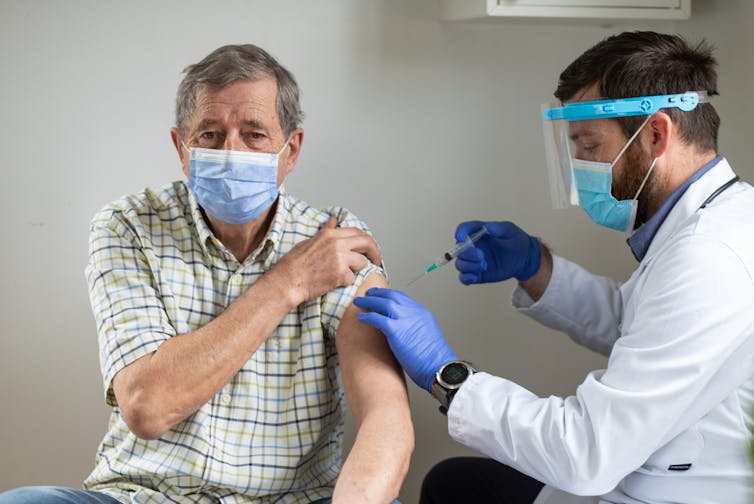
Early research, still in preprint (and so yet to be reviewed by other scientists), suggests that the Pfizer vaccine’s protection wanes over the six months following vaccination. Another preprint from Israel also suggests that this is the case. It’s too soon to know what happens to vaccine efficacy beyond six months in the double vaccinated, but it’s likely to reduce further.
3. Variants
Another important factor is the variant of the virus that you’re facing. The reductions in risk above were calculated largely by testing vaccines against the original form of the coronavirus.
But when facing the alpha variant, data from Public Health England suggests that two doses of the Pfizer vaccine is slightly less protective, reducing the risk of getting COVID-19 symptoms by 93%. Against delta, the level of protection falls even further, to 88%. The AstraZeneca vaccine is also affected this way.
The COVID Symptom Study backs all of this up. Its data suggests in the two to four weeks after receiving your second Pfizer jab, you’re around 87% less likely to get COVID-19 symptoms when facing delta. After four to five months, that figure falls to 77%.
4. Your immune system
It’s important to remember that the above figures refer to average risk reduction across a population. Your own risk will depend on your own levels of immunity and other person-specific factors (such as how exposed you are to the virus, which might be determined by your job).
Immune fitness typically reduces with age. Long-term medical conditions may also impair our response to vaccination. Older people or people with compromised immune systems may therefore have lower levels of vaccine-induced protection against COVID-19, or may see their protection wane more quickly.

It’s also worth remembering that the most clinically vulnerable received their vaccines first, possibly over eight months ago, which may heighten their risk of experiencing a breakthrough infection due to protection waning.
Do you need to worry?
Vaccines still vastly reduce your chances of getting COVID-19. They also to an even greater degree protect against hospitalisation and death.
However, it’s concerning seeing breakthrough infections, and the worry is that they might increase if vaccine protection does, as suspected, fall over time. Hence the UK government is planning to give a booster dose to those most vulnerable, and is also considering whether boosters should be given more widely. Other countries, including France and Germany, are already planning on offering boosters to groups considered to be at higher risk from COVID-19.
But even boosters end up being used, this shouldn’t be interpreted as vaccines not working. And in the meantime, it’s essential to promote vaccination to all those eligible who have not yet been vaccinated.

The authors do not work for, consult, own shares in or receive funding from any company or organisation that would benefit from this article, and have disclosed no relevant affiliations beyond their academic appointment.
: The Conversation – Articles (UK)
Have you tried: Farking?