
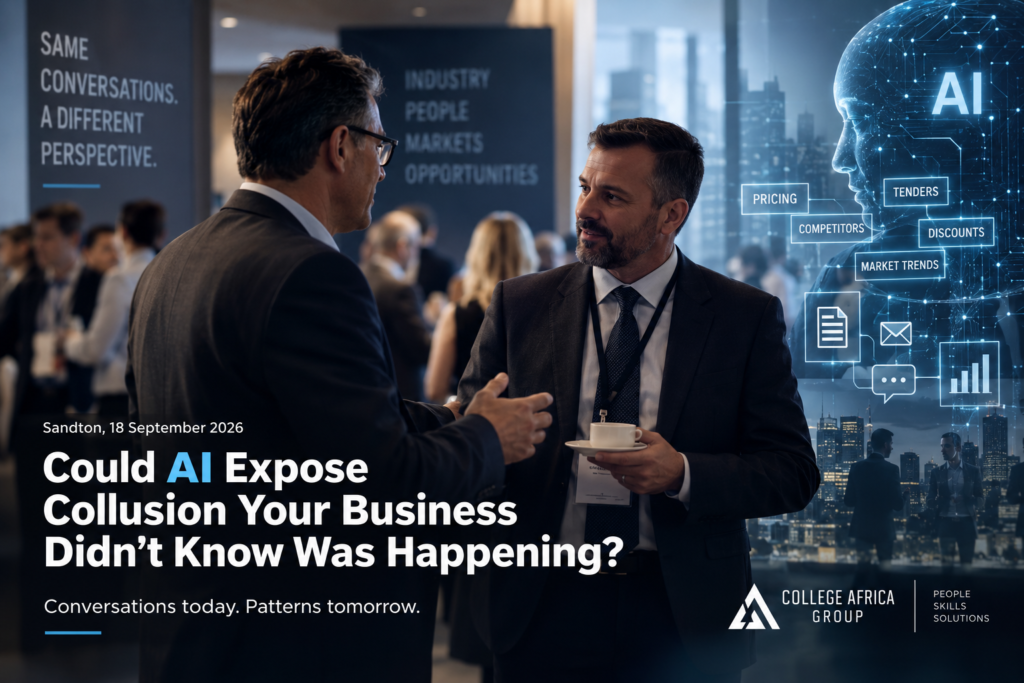
Sandton – Two sales managers from competing companies meet at an industry event. They know each other. They talk about business, difficult customers, rising costs and what is happening in the market.
Nothing unusual about that. But then the conversation moves to pricing, discounts or an upcoming tender. Perhaps someone mentions what they are planning to charge next year.
Nobody sitting around the table thinks they are involved in collusion. But could they be creating a problem for their companies without realising it?
And what happens when artificial intelligence becomes good enough to find patterns across thousands of documents, announcements, communications and pricing decisions?
That is a question South African business leaders should probably start asking.
AI Is Becoming an Investigator
A recent Moneyweb article by Amanda Visser highlighted an interesting development in Europe. Competition authorities are using artificial intelligence to scan publicly available information for patterns and phrases that could indicate possible anti-competitive behaviour.
That deserves attention. Not because AI can decide whether a company is guilty of collusion. It cannot.
What AI can do extremely well is examine enormous quantities of information. It can compare documents, find repeated phrases, analyse pricing movements and identify unusual relationships or patterns.
Things that could take people weeks or months to discover can potentially be surfaced much faster.
This is also an important reminder of how quickly AI in the workplace is changing. For many businesses, AI still means asking ChatGPT to write an email or using Microsoft Copilot to summarise a document.
That is only a small part of what is happening. AI is increasingly becoming an analytical tool capable of finding patterns across volumes of information that people simply could not review efficiently themselves.
Arnold Muscat, Director of College Africa Group, comments:
“AI in the workplace is moving far beyond writing emails and creating documents. What interests me here is its ability to analyse huge amounts of information and identify patterns that people may never see.
That creates enormous opportunities for business, but it also reinforces why governance, employee awareness and human validation are becoming so important.”
Collusion Doesn’t Have to Start in the Boardroom
Mention collusion and most people imagine senior executives secretly meeting to decide what their companies are going to charge.
The reality can be much less dramatic. Employees interact with competitors all the time through conferences, industry associations, suppliers and professional relationships built over many years.
Most of those relationships are perfectly legitimate. The danger is when normal business conversation starts drifting into commercially sensitive territory.
That could include future prices, discounts, customers, territories or tenders. It could be a discussion about who intends bidding for a particular contract or which customers a competitor is pursuing.
South Africa’s Competition Act prohibits cartel conduct between competitors, including price fixing, market division and collusive tendering.
That raises a simple management question:
Do your employees actually know where an ordinary conversation with a competitor should stop?
That may be more important than it first appears.
AI Can Connect the Dots
One email may mean very little. One conversation may mean very little. Two companies increasing their prices at roughly the same time may also mean absolutely nothing.
They may simply be reacting independently to the same increases in fuel, wages, materials or other market conditions.
But now imagine analysing thousands of pieces of information over several years. Pricing announcements, tender documents, public statements, reports, meeting records and other communications can potentially be examined together.
AI can begin connecting those dots.
A pattern may emerge that nobody noticed when each piece of information was viewed separately. That still doesn’t prove wrongdoing, but it may provide a reason for somebody to look more closely.
And this is where human judgement becomes critical.
AI can identify the pattern. People still have to determine what the pattern means.
The Moneyweb report makes this distinction particularly important. It notes that quantitative findings from AI screening still require a manual qualitative review.
What Does This Mean for South African Businesses?
This is not simply a European competition-law story. The more interesting business lesson is what AI is becoming capable of doing with information.
Companies already generate enormous amounts of digital information every day through Microsoft Outlook, Teams, Excel, Word, CRM systems, ChatGPT, Microsoft Copilot, shared drives and other business systems.
Most organisations probably don’t know everything that exists across those systems. They certainly don’t have executives reading all of it.
AI changes the scale at which information can be analysed. It gives organisations — and potentially regulators — the ability to examine information that would previously have been impractical to review manually.
That creates opportunities. It also creates risks.
The Question Is No Longer Just “Are We Using AI?”
At College Africa Group, we believe executives need to move beyond asking whether their employees are using artificial intelligence.
A better question is:
What is AI being used for in our business, what information is it analysing, and who is responsible for the decisions that follow?
That starts with understanding the business process. Organisations need to know how information moves through the business, where employees interact with customers, suppliers and competitors, and where commercially sensitive information is created and shared.
Only then should they look at where AI can genuinely improve the process.
This is one reason AI Workflow Discovery is becoming increasingly important. Before businesses automate work or deploy more AI tools, they need to understand the work itself.
The same principle applies to workplace skills. Employees still need strong business judgement and strong Microsoft 365 and Advanced Microsoft Excel skills. They also need to understand what they are doing with ChatGPT and Microsoft Copilot.
Increasingly, they need to understand the consequences of the information they create and share as well.
AI Doesn’t Carry the Responsibility
AI can analyse a million documents, identify an unusual relationship and flag a suspicious pattern. It can suggest that somebody should investigate further.
But it cannot take responsibility for what happens next. That remains a human responsibility.
This is why human validation and AI governance cannot be an afterthought. As AI becomes more powerful, organisations may discover that one of its most valuable capabilities isn’t writing something faster.
It is seeing something that people missed.
For South African executives, that leaves a challenging question:
If AI analysed the patterns inside your business today, what might it find that you don’t already know about?
Could AI Be Identifying Risks Your Management Cannot See?
College Africa Group helps organisations examine their existing workflows through AI Workflow Discovery, identify where AI can create practical business value, and strengthen the Microsoft 365, ChatGPT and Microsoft Copilot skills employees need to use these tools responsibly.
Speak to College Africa Group about an AI Workflow Discovery session. Start by understanding your business processes, information flows and opportunities before simply adding more AI tools.
Better Business Processes. Stronger Workplace Skills. Smarter AI. Greater Business Productivity.
Images:
Video:
https://www.youtube.com/@collegeafricaexcelvideotip1434
Could AI Expose Collusion Your Business Didn’t Know Was Happening?
Links:
Boilerplate and Editor’s Notes.
More Info on Could AI Expose Collusion Your Business Didn’t Know Was Happening? here:
LinkedIn: https://www.linkedin.com/company/9491250/admin/dashboard/
Facebook: https://www.facebook.com/CollegeAfrica
Phone: +27 (0) 83 778 4903
Email sales@collegeafricagroup.com
CLICK HERE to submit your press release to MyPR.co.za.
Submit your Press Release for free to MyPR here: MyPR Free Press Release Submission.