
Could ageing immune systems be a better predictor of cancer than genetic mutations?:

It has long been known that cancer arises when genes mutate and start producing abnormal proteins, or no protein at all. However, our latest research, published in PNAS, suggests that there is another, equally important mechanism by which cancer arises: an ageing immune system.
We were interested in why the incidence of cancer rises so steeply with age. The conventional wisdom is that it’s due to a single cell in the body accumulating just the right sequence of genetic mutations that transform it into a cancer cell, seeding a tumour.
It takes a long time for six or seven key mutations to randomly occur in the same cell, so the chance of cancer arising in this way would be very small when a person is young, but would rise dramatically into middle and old age. This model has been the foundation of cancer research for decades and fits well with the molecular evidence that cancer cells have scrambled genomes.
Shrinking thymus gland
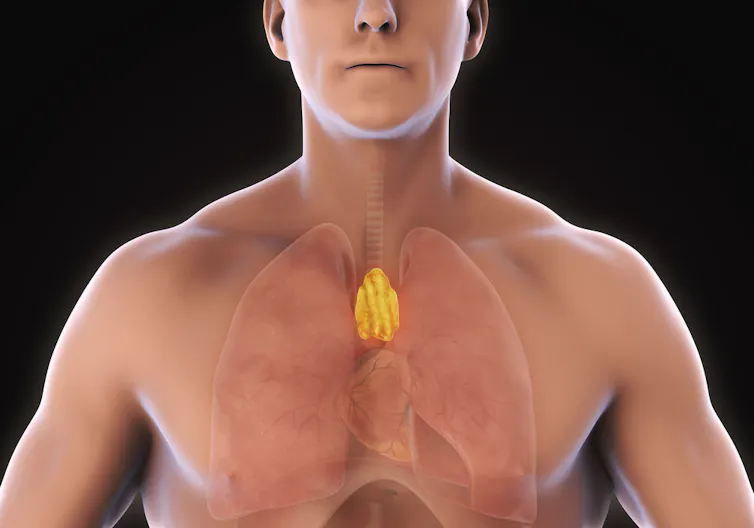
But, what about the fact that the body is itself ageing? Do our increasingly frail bodies become intrinsically more susceptible to cancer over the years? We looked at a key aspect of ageing: the declining immune system. In particular, we looked at the dramatic shrinkage of the thymus gland, which halves in size every 16 years from birth.
The thymus produces new T cells – white blood cells that scan the body for invaders. If the immune system is helping keep cancer at bay, it stands to reason that cancer will become more likely as a person ages.
To test our idea we created a mathematical model. The model is not meant to describe in detail what is going on – after all, the immune system itself is an extraordinarily complex biological system. Our aim was to capture the essence of the problem in the model, make predictions, and then test them rigorously against data.
We assumed that cancer cells are arising in the body at a constant rate throughout life, but that the immune system is highly effective at identifying and destroying them. However, no system is perfect. One can imagine that a cancer cell, trying to grow a new tumour, may through sheer luck evade the immune system.
Such rare events would become less rare as we age due to the natural decline of the immune system. From this logic, we derived a mathematical prediction for cancer incidence.
We used data on cancer incidence – collected from over 2m patients and covering over 100 different types of cancer – from the US National Cancer Institute to test our predictions. We compared how well our model fitted the data to the traditional mutation model.
Our model fitted better, overall, than the mutation model. This was initially quite shocking, given the enormous status of the mutation model and the simplified approach we took in constructing our immune-decline model.
A striking observation from the data was that for some cancers, and also some infectious diseases, rising incidence with age exactly mirrors the exponential decline of the immune system – a natural prediction from our model, but very hard to explain from the mutation model.
Why men are more susceptible to cancer
To test our model more stringently, we decided to look at a curious feature of cancer incidence that is not well understood: for most cancers there is a significantly higher incidence in men than in women. This is not easily explained from a purely genetic viewpoint, as men and women share the same basic genome, apart from the different sex chromosomes. So researchers have wondered whether environmental or hormonal factors are responsible.
It turns out that our model is able to give a direct explanation; immune system decline occurs more slowly in women than in men. We were able to fit male and female cancer incidence data separately with our model, just using the fact that the immune decline occurs at different rates between the two.
For those cancers that our model fitted particularly well, the pivot age is between 50 and 60 years. This has direct clinical relevance and may become a useful diagnostic indicator to give doctors an idea on when to improve screening for various cancers.
What next? We are the first to stress that it is early days, and that our model needs to be rigorously examined and tested by cancer biologists and medical doctors. It is unlikely to survive unchanged, but we hope that it contains the seed of a new approach to cancer.
Another cause of cautious optimism is the following observation. Nearly all vertebrates have a shrinking thymus gland, the exception being some species of shark; and sharks are known to have extremely low rates of cancer.

Thea Newman owns Solaravus, a research consultancy. Thea's research was funded by the Scottish government and the NIH.
Sam Palmer does not work for, consult, own shares in or receive funding from any company or organisation that would benefit from this article, and has disclosed no relevant affiliations beyond their academic appointment.
: The Conversation – Articles (UK)
Have you tried: Farking?