
Check out this South African City image:
Metakomatiite (Diamond Springs Formation, Mesoarchean; South Pass, Wind River Range, Wyoming, USA) 6
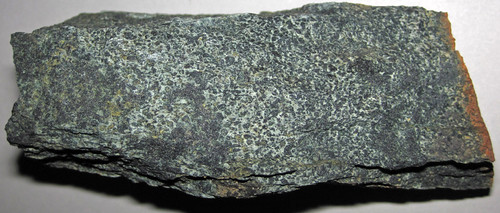
Image by James St. John
Metakomatiite (serpentinite) from the Precambrian of Wyoming, USA. (8.5 centimeters across at its widest)
Komatiites are very rare, magnesium-rich, extrusive, ultramafic igneous rocks. They are named after the Komati River Valley in South Africa, the type locality. Komatiite is an exceedingly rare type of lava. No volcano on Earth erupts this material today. Komatiites are essentially restricted to the Archean (4.55 to 2.5 billion years ago). Experimental evidence has shown that komatiite lavas, when originally erupted, were considerably hotter (~1600º C) than any modern lava type on Earth. This indicates that Earth’s mantle was much hotter than now. Other geologic evidence also indicates that early Earth’s heat flux was much higher than today’s.
Komatiite lava had a very low viscosity – it could flow like an ultradense gas. This property permitted the solidification of some individual lava flows that are only 1 cm thick.
The classic texture of komatiites is spinifex texture, named after clumps of long, spiky (& painful!) grasses. Komatiites with spinifex texture have short to long blades or plates of olivine mixed with smaller-scale blades of pyroxene.
All Archean komatiites are metamorphosed – the original igneous mineralogy (olivine, pyroxene, minor chromite, etc.) is gone to mostly gone. Such rocks are best termed metakomatiites, but the prefix “meta-” is usually not specified.
Komatiites have economic significance, as many are closely associated with copper-nickel minerals (chalcopyrite & pentlandite), plus minor platinum-group elements, arsenides, bismuthides, and maybe a little gold and silver. Komatiites are a world-class source of nickel in Canada and Western Australia.
The rock shown above is an unusual komatiite – it is not spinifex-textured and it is not extrusive. This is a metamorphosed (serpentinized), cumulate-textured, intrusive komatiite. It’s MgO content is 26.6% to 38.1%.
Stratigraphy: Diamond Springs Formation, Mesoarchean, >2.87 Ga
Locality: low roadcut along old dirt road west of & uphill from power substation (Rocky Mountain Power, Atlantic City Switching Station), just west of Crest Road, northwestern side of Rt. 28, southwestern side of South Pass, Wind River Range, west-central Wyoming, USA (42° 31′ 29.45" North latitude, 108° 45′ 52.36" West longitude)
Image automatically curated and published by www.free-mail.co.za – CLICK HERE to learn more about WP Robot for WordPress.
Have you tried: Sailing in Africa ?