
Check out this Paternoster image:
Image from page 790 of “The animal kingdom : arranged after its organization, forming a natural history of animals, and an introduction to comparative anatomy” (1849)
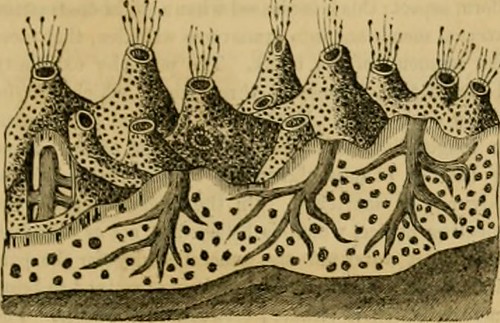
Image by Internet Archive Book Images
Identifier: animalkingdomar00cuvi
Title: The animal kingdom : arranged after its organization, forming a natural history of animals, and an introduction to comparative anatomy
Year: 1849 (1840s)
Authors: Cuvier, Georges, baron, 1769-1832 Metcalf Collection (North Carolina State University) NCRS Blyth, Edward, 1810-1873 Mudie, Robert, 1777-1842 Johnston, George, 1797-1855 Westwood, J. O. (John Obadiah), 1805-1893 Carpenter, William Benjamin, 1813-1885
Subjects: Animals
Publisher: London : Wm. S. Orr and Co., Amen Corner, Paternoster Row
Contributing Library: NCSU Libraries
Digitizing Sponsor: NCSU Libraries
View Book Page: Book Viewer
About This Book: Catalog Entry
View All Images: All Images From Book
Click here to view book online to see this illustration in context in a browseable online version of this book.
Text Appearing Before Image:
canals into their cavities; and at last become altogether detached, and arecarried forth by the current. The substance of the Sponge is chiefly composed of tubular fibres of a homy character, which forma network that possesses considerable elasticity ; this network forms, as it were, a skeleton, which isclothed with a gelatinous flesh. In the greater proportion of Sponges, it is strengthened by spicules, orneedle-shaped crystals of earthy matter; these, which are sometimes composed o( silex, in other casesof carbonate of lime, are disposed at intervals throughout the mass ; but are especially abundant inthe neighbourhood of the canals, and around the external orifices both of these and of the pores, eachof which is strengthened by a regular framework of spicules. No classification of Sponges that has yet been proposed is likely to have a permanent value; solittle being yet known of their real nature, and of the characters which should serve as the guide intheir systematic arrangement.
Text Appearing After Image:
CLASS INFUSORIA. The improvements recently made in the Microscope, and the large amount of attention that has beendevoted of late to the natural history of this class, has vastly added to our knowledge of it. One result,however, of this increase of knowledge, which is mainly due to the researches of Professor Ehrenberg,has been to show that the two groups of which the Cuvierian class consists are really very distinctfrom one another, resembling each other in nothing but their minuteness of size, and the softness and 706 RADIATA. transparency of their textures ; and that the order Rotifera ought to constitute a separate class, andto have a place in the Articulated series. Rotifera. The animals of this class have usually an elongated form, and are perfectly symmetrical on the twosides. At the anterior extremity, we observe one or more rows of vibratile cilia; these are frequentlyarranged (as in the common Wheel Animatcule^ Fig. 21, b), in a circular manner, and when they arein motion, a
Note About Images
Please note that these images are extracted from scanned page images that may have been digitally enhanced for readability – coloration and appearance of these illustrations may not perfectly resemble the original work.
Image automatically curated and published by www.free-mail.co.za – CLICK HERE to learn more about WP Robot for WordPress.
Have you tried: Travelling to South Africa?