
A cool Paternoster image:
Image from page 265 of “The animal kingdom : arranged after its organization, forming a natural history of animals, and an introduction to comparative anatomy” (1849)
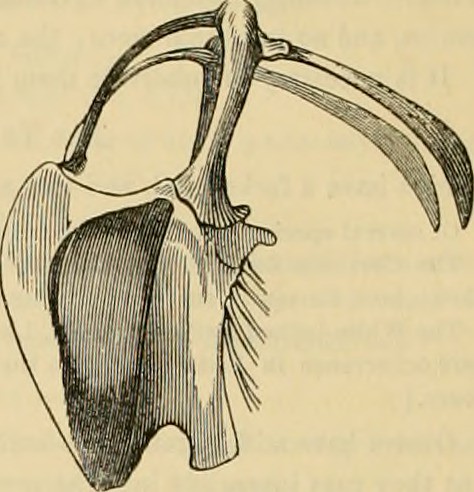
Image by Internet Archive Book Images
Identifier: animalkingdomar00cuvi
Title: The animal kingdom : arranged after its organization, forming a natural history of animals, and an introduction to comparative anatomy
Year: 1849 (1840s)
Authors: Cuvier, Georges, baron, 1769-1832 Metcalf Collection (North Carolina State University) NCRS Blyth, Edward, 1810-1873 Mudie, Robert, 1777-1842 Johnston, George, 1797-1855 Westwood, J. O. (John Obadiah), 1805-1893 Carpenter, William Benjamin, 1813-1885
Subjects: Animals
Publisher: London : Wm. S. Orr and Co., Amen Corner, Paternoster Row
Contributing Library: NCSU Libraries
Digitizing Sponsor: NCSU Libraries
View Book Page: Book Viewer
About This Book: Catalog Entry
View All Images: All Images From Book
Click here to view book online to see this illustration in context in a browseable online version of this book.
Text Appearing Before Image:
China have ren-dered them an important article of traffic in that country. [It is interestingto note that the Purple Swallow (i/. purpurea) of America, which has a stouter beak than theothers, feeds much on berries, at least while in its winter quarters, as observed by j\I. Audubon. The relation ofthis genus to the Phibalures has been already remarked]. The Moth-hunters {Caprimulgiis, Lin.)—Have the same light, soft plumage, minutely mottled with grey and brown, that characterizes othernight-birds. Their eyes are large ; the beak, still more deeply cleft than in the Swallows, and[generally] armed with strong vibrissse, is capable of engulphing the largest insects, which are retainedby means of a glutinous saliva, [as in the Swifts] ; the nostrils, placed at its base, are like smalltubes; their wings are lengthened ; the feet short, with plumed tarsi, and a membrane connecting thebasal portion of the toes; the thumb itself is thus connected with the internal toe, and is directed o 2
Text Appearing After Image:
196 AVES. inward. Tlie claw of the middle toe is commonly pectinated on its inner edge ; and tlie outer toe hasonly four phalanges, a conformation extremely rare among Birds. They live solitarily [or rather per-manently in pairs] and are crepuscular in their time of action, pursuing Moths and other nocturnalinserts: deposit few eggs [we believe always two in number] on the bare ground, and have gene-rally singular voices. [The Moth-hunters bear the same relationship to the Swifts (not to the Swallows) that the Owls doto the Hawks, and have similar great ca;ca ; also a simple vocal organ, and general anatomy verynmch resembling that of the Cuckoos, as will be partly seen bycomparison of the figures we have given of the sternal apparatusof both. They have only ten tail-feathers; and the young arecovered with down when first excluded.] The common European species (C Europieus, Lin.) [is remarkable forthe loud sound it emits, like the burr of a spinning-wheel. Another,C. ruftcollls, Teni.
Note About Images
Please note that these images are extracted from scanned page images that may have been digitally enhanced for readability – coloration and appearance of these illustrations may not perfectly resemble the original work.
Image automatically curated and published by www.free-mail.co.za – CLICK HERE to learn more about WP Robot for WordPress.
Have you tried: Farking?