
Check out this Paternoster image:
Image from page 127 of “The animal kingdom : arranged after its organization, forming a natural history of animals, and an introduction to comparative anatomy” (1849)
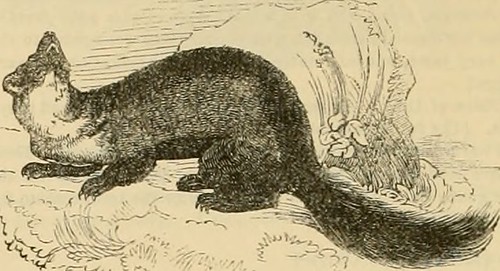
Image by Internet Archive Book Images
Identifier: animalkingdomar00cuvi
Title: The animal kingdom : arranged after its organization, forming a natural history of animals, and an introduction to comparative anatomy
Year: 1849 (1840s)
Authors: Cuvier, Georges, baron, 1769-1832 Metcalf Collection (North Carolina State University) NCRS Blyth, Edward, 1810-1873 Mudie, Robert, 1777-1842 Johnston, George, 1797-1855 Westwood, J. O. (John Obadiah), 1805-1893 Carpenter, William Benjamin, 1813-1885
Subjects: Animals
Publisher: London : Wm. S. Orr and Co., Amen Corner, Paternoster Row
Contributing Library: NCSU Libraries
Digitizing Sponsor: NCSU Libraries
View Book Page: Book Viewer
About This Book: Catalog Entry
View All Images: All Images From Book
Click here to view book online to see this illustration in context in a browseable online version of this book.
Text Appearing Before Image:
onger and more bushy, is the Zonlla capensis of some recent authors: there would appear, indeed, to be severalspecies of these Zorilles.] The Martens {Mustela, Cuv. \_Marte8, Kay] )—Differ from the true Weasels by having [commonly] an additional false molar above and below, aud a small tubercle on the inner side of their car-nivorous tooth ; two characters which some-what diminish the ferocity of theh- nature.[They are liandsorae, aud remarkably litheactive animals, with larger ears than tlieWeasels, and fine bushy tails; are alsomore arboreal iu their habits. The scentthey diffuse when irritated is not disagree-able, f] There are two species in Europe, very closelyallied together. The Yellow-breasted or PineMarten (Mustela martes, Lin.), inhabiting wilddistricts, and the Wiite-breasted or BeechMarten (.1/. fuina, IJn.), which frequents woodsnear human habitations. [Many consider these tonia, I have noticed that the former are constantlythe other. The American species usually deemed
Text Appearing After Image:
-^XJi< be vaiieties merely of the same ; but on exaniininjr several ( smaller, with the zygomatic arch fully twice as strong as identical with M. foma, is intermediate. There are numerous others, as the Pekan or Fishing Marten of Canada, &c.; and the Sable of commerce (3/. zibellina^ Auct.), celebrated for its beautiful fur, is a member of this division. In the Sable and several others, the soles are coiHpletely covered with close fur; but in M. fiavigula of the Hiramalayas, the under surface of the foot is naked, and the toes joined to their e.xtremities, as in the Badgers, &c.] The Skunks {Mephitis, Cuv.)— Possess, like the Weasels, two false molars above and three below; but their superior tuberculousgrinder is very large, and as long as broad, and tbeir inferior carniTorous tooth has two tubercles onits inner side, thus approximating these animals to tiie Badgers, in the same way as the Weasels arerelated to the Grisons and Wolverine. In addition to this, the
Note About Images
Please note that these images are extracted from scanned page images that may have been digitally enhanced for readability – coloration and appearance of these illustrations may not perfectly resemble the original work.
Image automatically curated and published by www.free-mail.co.za – CLICK HERE to learn more about WP Robot for WordPress.
Have you tried: Travelling to South Africa?