
Check out this South African City image:
African safari, Aug 2014 – 002
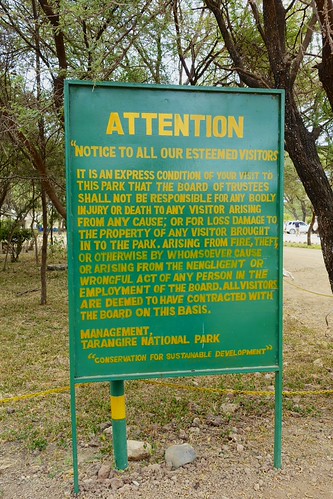
Image by Ed Yourdon
This prominent sign greeted us upon entry to the Tarangire National Park, on our first full day in Tanzania. After reading it, I was determined not to engage in any "negligent" act, whatever that might mean …
Unsurprisingly, we got our first exposure to wild animals in this park: elephants, baboons, zebra, antelope, giraffes, ostriches, and much much more …
The park is the sixth largest in the country, and is located in the Manyara Region of Tanzania. It gets its name from the Tarangire River, which crosses through the park. For more details, take a look at this Wikipedia article.
**************************
As I wrote in the notes for my October 2012 safari in South Africa, I have lived most of my adult life without ever venturing into the African jungle, and without participating in the mysterious activity known as “safari.” Thus, my impressions were based on a variety of movies — ranging from Meryl Streep’s glorious Out of Africa (filmed near the starting point of this current trip, at the base of Mt. Kilimanjaro) to The African Queen to the silliness of childhood Tarzan movies — as well as photographs and visits to local zoos to see mangy animals who have no more first-hand experience with the continent than I had.
Actually, I have made a few visits to Africa over the years — even before that first safari trip a couple years ago. I’m not sure that my two visits to Egypt count in this regard — but I did travel to South Africa in the early 1990s, to speak at computer conferences in Johannesburg and Cape Town. The last visit was made shortly before the release of Nelson Mandela, when the entire country waited for a fundamental transition, even though no one was sure what kind of future lay ahead of them. Hectic travel schedules, the demands of business, and the desire not to leave my family stranded at home any longer than necessary, eliminated the casual thought of spending a week on safari on those early trips … and so, like several other potential trips (Easter Island, Machu Picchu, Patagonia, Antarctica, a river trip on the Amazon, etc.), it was simply added to my “bucket list.”
But in 2012, I had another opportunity to return to South Africa, for an abortive computer conference that took place in Cape Town. After 20 years, our children are grown and gone, and most of the hectic pressures of business have diminished; so my wife and I were able to set aside a week, and we visited two different safari lodges in the Kruger National Park of northern South Africa, just a few miles from the Mozambique border. If you’re interested, you can see the photos in this Flickr album; suffice it to say that it was impressive enough that we decided to come back for another safari, if we ever had the chance.
The “chance,” as it turns out, occurred in a quiet two-week period of August 2014; and this second safari involved brief stays in five small camps located in northern Tanzania and southern Kenya. As I noted after our first safari, we could have gone to Botswana or Zaire or Zimbabwe or a dozen other countries; even without South Africa or Tanzania, there were dozens of different parks, game reserves, lodges, and camps that we could have chosen. (A brief bit of history, in case you’re interested: Tanzania used to be Tanganyika, and before that it was German East Africa; in 1964, it combined with the island-state of Zanzibar to become the Republic of Tanzania. You can read more details in this Wikipedia article).
As with our previous trip, we saw such an amazing variety of animals that I can scarcely remember them all. People at each new camp that we visited kept asking if we had seen the “big five”: lions, leopards, cheetahs, rhinos, and elephants. To which the answer, after the first one or two camps, was simply yes, yes, yes, yes, and yes. We also saw zebras (millions, or so it seemed), giraffes, ostriches, wildebeest (gazillions of the shaggy beasts), warthogs, crocodiles, hyenas,jackals, babboons, monkeys, and vast herds of antelopes (which included kudu and impalas and topi and Thompson gazelles and dic-dic antelopes, and goodness knows what else). I didn’t even try to keep track of all the birds we saw; vultures, eagles, and hawks were everywhere, but there were many others that I had never seen or heard of before, and which I’ll probably never see again back in the urban jungle of New York City.
As we had seen on our earlier 2012 trip, some of these species were quite compatible and nonchalant about being in each others’ presence; but there was no question that predators were everywhere, and that there was a constant struggle between the hunters and the hunted. Indeed, it was somewhat surprising to see how many thousands of antelope and wildebeest and zebras managed to evade the constant danger of lions, leopards, and cheetahs (which turn out to be at the bottom of the “pecking order” of predators); but it gradually became clear that hackneyed phrases like “survival of the fittest” actually do mean something out here. Yes, the older animals, and the weak and lame and very young, are quite vulnerable — and they generally don’t survive very long. But lots more do survive by being constantly alert, constantly sniffing the breeze, and constantly listening for warning sounds from nearby birds, monkeys, and members of their own herd.
We saw a few indications of a “kill” that had recently taken place: a pride of lions ripping away at the flesh of a recently-killed wildebeest; a jaguar that had dragged a recently-killed warthog up into a tree for safekeeping, while hyenas and jackals frantically leapt and jumped in a vain attempt to get up the tree themselves — along with the occasional skeletons and bleached-white bones of animals killed a season or two ago.
We had several hours each day to observe all of this, and I took roughly three thousand photos by the end of the trip. I’ve uploaded a relatively small number of “keepers" to this Flickr album, which will convey at least a little of what it’s like to actually be in the presence of so many animals. But to truly appreciate it, you’ve got to be there, in person.
The only caution I’ll add is that your return trip should avoid Nairobi if at all possible. The chaos and confusion in the Nairobi airport, on the day of our return, is a story unto itself … but I took no photos there, so you’ll just have to use your imagination.
Image automatically curated and published by www.free-mail.co.za – CLICK HERE to learn more about WP Robot for WordPress.
Have you tried: Sailing in Africa ?