
It is generally assumed that the best candidates for the job of prime minister are people who have considerable experience of top-level politics. Ideally, this experience would involve having served in the cabinet and in particular, having occupied one of the “great offices of state” – chancellor of the exchequer, foreign secretary or home secretary.
Of the remaining candidates in the contest to replace Boris Johnson as prime minister, two have held great offices of state and two are significantly less experienced, instead seeking to present themselves as clean-slate candidates who have not been so closely associated with Johnson’s government. Conservative party members will shortly be asked to decide which of these options is preferable as they vote for their new leader.
How does their respective experience compare with previous prime ministers? And does it matter?
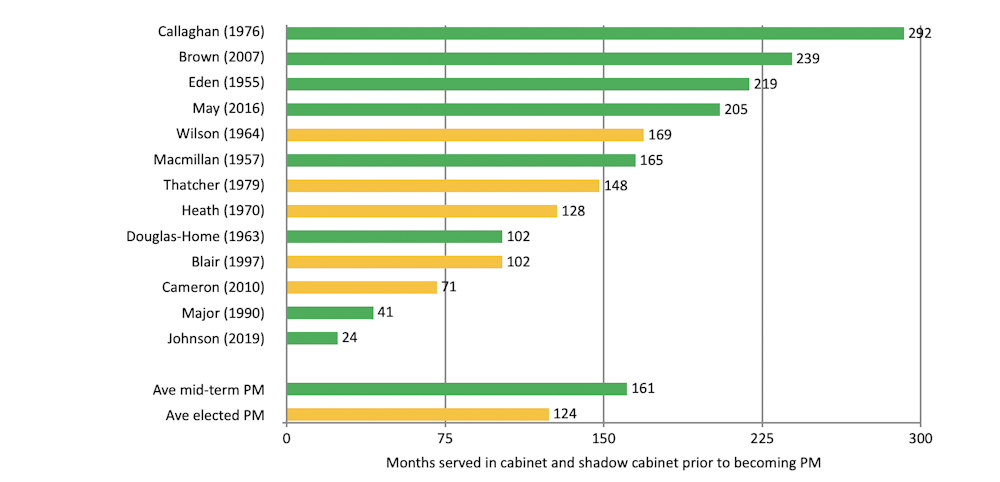
On average, the 13 prime ministers who have governed the UK since 1955 had spent 147 months (over 12 years) working in either the shadow cabinet or cabinet when they came to power.
Of these, eight had spent ten years at the top level. Labour prime minister James Callaghan had served for nearly 25 years at the highest levels of opposition and government before becoming prime minister in 1976.
The least experienced was Boris Johnson, with just 24 months as foreign secretary. However, he had previously served eight years as London mayor, a post that might be roughly analogous to a (non-great-office) cabinet position. John Major enjoyed a meteoric rise in the Thatcher governments, serving only 41 months in the cabinet before becoming prime minister. Most of the more experienced prime ministers came to the role when their parties were already in government (i.e. mid-term) rather than through winning a general election.
Combined cabinet and shadow cabinet experience of UK prime ministers since 1955
The great offices of state
Of the 13 prime ministers since 1955, eight came to power in the middle of a term of government after being selected by their parties. Their experiences are therefore particularly pertinent for hopefuls competing to become the next mid-term Conservative prime minister in September.
Anthony Eden and Gordon Brown had more than ten years’ experience of the great offices, Callaghan more than seven and Theresa May six. Alec Douglas-Home and Harold Macmillan had some great-office experience but more in other departments.
The other two mid-term prime ministers, Major and Johnson, were considerably less experienced, although both had occupied great offices.
On average, mid-term prime ministers had more than seven years’ cabinet experience – and five of those in the great offices. All eight mid-term prime ministers had previously held at least one great office, with Major holding two and Callaghan all three.
Cabinet experience of new prime ministers since 1955
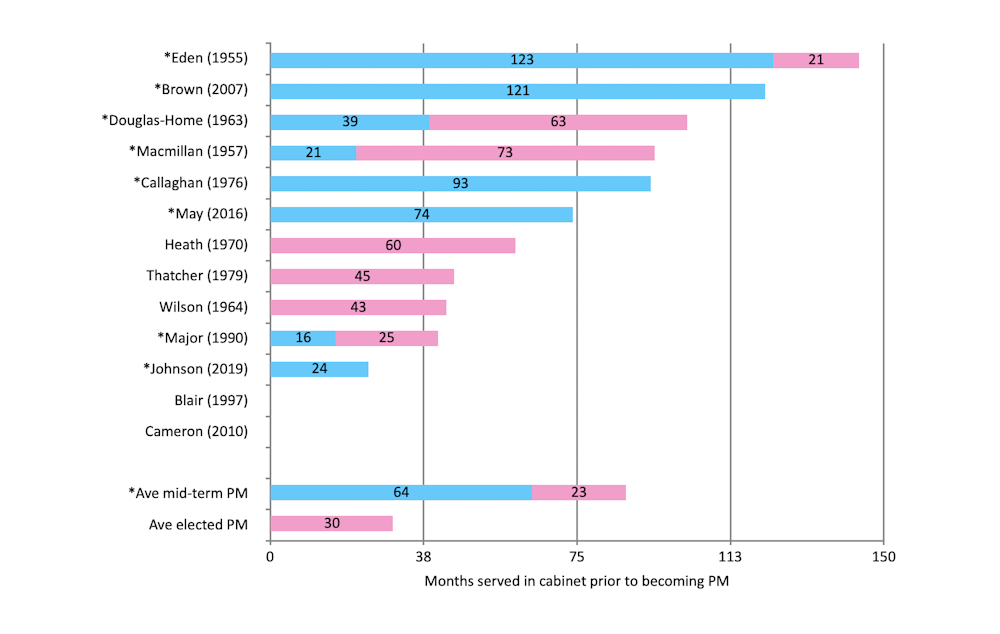
Edward Heath, Margaret Thatcher and Harold Wilson came to power by winning general elections from opposition, although all three had cabinet experience. Only Tony Blair and David Cameron had no prior cabinet experience, as their respective parties had just ended long spells in opposition when they won general elections. They had both, however, served several years as leader of the opposition.
What this means for the leadership hopefuls
Some of the most experienced candidates – Jeremy Hunt, Sajid Javid and Grant Shapps – are already out of the current race to become Conservative leader. Liz Truss is by far the most experienced of the remaining candidates, with eight years in the cabinet, most recently as foreign secretary. Rishi Sunak has three years’ experience, mostly in the great-office role of chancellor. Truss’s experience profile resembles Macmillan’s, while Sunak’s is similar to Major’s.
Cabinet experience of 2022 Conservative leadership contestants
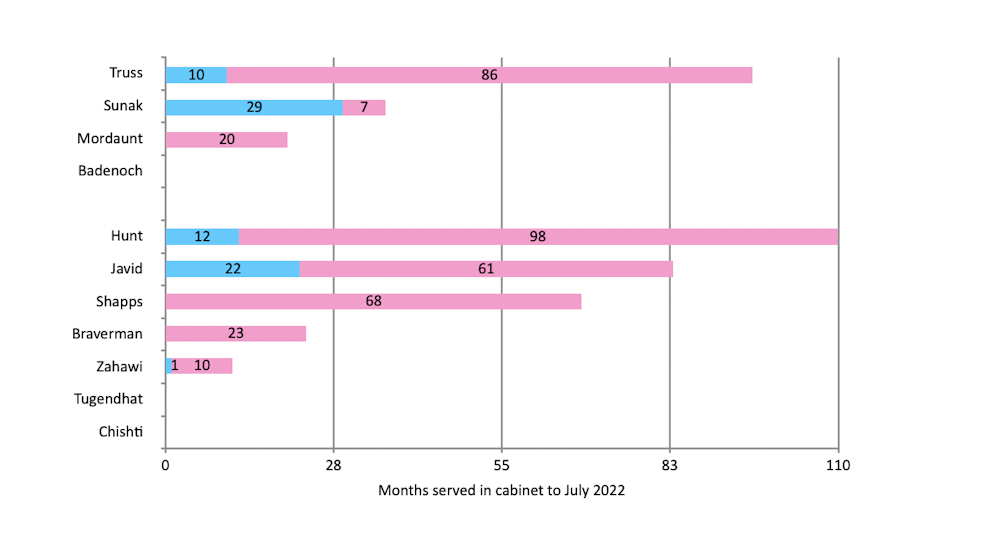
The other candidates are less experienced. Penny Mordaunt has never served in a great office, a brief spell at the Ministry of Defence being her highest-ranked job. She is currently a junior minister. Kemi Badenoch has never served in the cabinet.
Governing parties tend to prioritise competence over electability when choosing a new leader. Mid-term prime ministers have little time to become acquainted with the job. They must take quick decisions over which policies to change and who to appoint to the cabinet. Experience can help with these decisions. But the Conservatives in 2022 have already declined some of the most experienced candidates on offer. Truss fits the usual profile of a mid-term prime minister, Sunak partially and the other candidates not at all.
However, some of the most experienced post-war prime ministers were also among the least successful and short-lived. Eden had more experience than any but saw his premiership destroyed by the Suez crisis. Douglas-Home lasted 364 days before losing an election. Brown spent ten years as chancellor while he waited for the top job but when it finally came, he had few innovative policies left. Callaghan is indelibly associated with the winter of discontent, while May’s premiership was defined by her failure to secure Brexit.
Past experience does not, therefore, necessarily equate to governing success. The highest-achieving prime ministers since 1955 are Thatcher and Blair – both of whom represented breaks with the past in their own parties and both of whom were elected from opposition before going on to win multiple elections.
The dilemma for the Conservatives is that Truss and Sunak are known quantities but may represent continuity at a time when the Tories are behind in the polls. Mordaunt and Badenoch are breaks with the past, but how would they perform running a government?
If the past is anything to go by, the Conservatives may eventually opt for one of the more experienced candidates.

Tom Quinn does not work for, consult, own shares in or receive funding from any company or organisation that would benefit from this article, and has disclosed no relevant affiliations beyond their academic appointment.
: The Conversation – Articles (UK)
Have you tried: Visiting Port Elizabeth?