
Clearing alien trees can help reduce climate change impact on Cape Town’s water supply:

Droughts in water scarce regions are being aggravated by human-driven climate change. While rainfall reduction is the main driver, increased temperature and evaporation can also play a role.
Another influence on drought severity is the condition of the catchment area where rain falls and drains into rivers. Important factors here include the amount and type of vegetation covering the catchment and soil characteristics.
One way of offsetting the impacts of climate change on water resources is catchment restoration, which can involve revegetation, wetland restoration, gully rehabilitation, and alien tree clearing. This is one of several types of nature-based solutions, which focus on reducing climate change impacts through working with nature.
But it’s not easy to tell what difference restoration makes on the impacts of human-aggravated changes in climate on water availability during droughts.
In a recently published analysis, we took a closer look at the role of climate change and catchment conditions during the 2015-2017 Cape Town “Day Zero” drought. This drought led to one of the most serious water crises experienced by any city in the world in recent times. The drought arose from a prolonged shortage of rainfall and, consequently, river flows, which progressively depleted reservoir storage in the area.
We wanted to see whether clearing alien trees from mountain catchments where the city’s water comes from would have lessened the impacts of climate change on the drought. This is the first study that has looked at the potential for nature-based solutions to buffer society from extreme event impacts directly linked to human-driven changes in the climate.
We found that clearing alien trees before the drought hit could have reduced the impact of climate change on water supply during the “Day Zero” drought. But it could not have removed all of the human-driven climate change impact on water availability.
Alien trees and water supply
In South Africa, invasive alien tree clearing is a well-known form of catchment restoration. These trees have spread across many mountain catchments critical for water supply. Alien trees use substantially more water than native vegetation because they are taller, have greater leaf areas, and have deeper root systems. These characteristics increase the amount of water lost due to transpiration from the tree, compared to native plants, leaving less water for river flow and groundwater recharge. Impacts from alien trees on water are felt especially during drought periods when water is most needed.
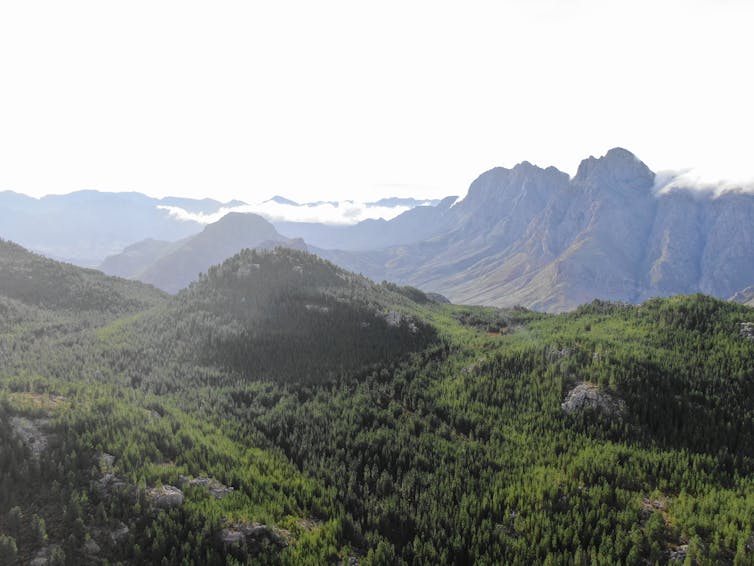
This situation is not unique to South Africa. Studies across the globe confirm a decrease in water yields in response to afforestation (planting trees).
Human influence on the rainfall shortages and reduced river flows
Between 2015 and 2017, a very rare drought event – the worst since 1904 – pushed Cape Town into a water crisis. Researchers have previously found that climate change made the reduction in rainfall that triggered the crisis three to six times more likely.
The focus of these studies was on the rainfall shortage. But Cape Town’s water is dependent on river flows from distant mountainous catchments. Water flowing from these catchments is captured and stored in six large dams. During the drought, dam levels dropped to less than 20% of their capacity.
Our analysis aimed to see whether clearing alien trees from these mountain catchments would have lessened the impacts of lower rainfall from climate change on river flows.
Using climate models and a hydrological model we simulated worlds with and without human-driven climate change and with and without catchment restoration and maintenance. We did this for two mountain catchments typical of those that supply the Western Cape Water Supply System which feeds Cape Town’s water delivery.
Our results suggest that climate change reduced river flows during the drought by 12-29% relative to a world with no human influence on the climate. This was larger than the 7-15% reduction in rainfall falling on these catchments that we could attribute to climate change. So the catchments amplified the climate change impact as water moved from rainfall to river flows.
Similarly to previous work, we found some, but not a very large, influence of climate change on evaporation.
Our analysis showed that clearing alien trees before the drought hit could have reduced the impact of climate change on river flow during the drought. For example, clearing catchments with moderate invasions (40% coverage of alien trees) could have ameliorated river flow reductions attributed to climate change by 3-16%. Preventing the spread of alien trees to fully cover the catchments avoided 10-27% additional reductions in stream flow due to climate change.
Going forward
An important insight from our analysis is that fully clearing the catchments could not have completely offset the climate change impact.
So, while catchment restoration can make a difference for managing changing drought risk, it is not the complete solution for addressing climate change impacts on water resources, even at current levels of climate change. Catchment restoration needs to be combined with other adaptation options in water scarce regions facing a warmer and drier world.
Also, in many cases, climate change is not the only driver of water scarcity. Poor management, services, and infrastructure can easily override the benefits that nature-based solutions could offer.
While our results suggest nature-based solutions can be important, it is critical to realise that nature-based solutions should be context specific. An understanding of the local conditions is important in the design of any response.

Petra Holden receives funding from the AXA Research Fund, through the AXA Research Chair in African Climate Risk, the Danish Ministry of Foreign Affairs (MFA) – grant number 17-M07-KU, the BNP Paribas Foundation Climate Initiative, and the International Development Research Centre.
Alanna Rebelo receives funding from the South African Water Research Commission and the Danish Ministry of Foreign Affairs (MFA) – grant number 17-M07-KU.
Joyce Kimutai receives funding from AXA Research Chair in African Climate Risk.
Kamoru Abiodun Lawal receives funding from the South African Water Research Commission (WRC), AXA Research Fund, BNP-Paribas Foundation Climate Initiative, the GCRF African-SWIFT and the the European Union funded six-year Intra-ACP (African, Caribbean, Pacific Group of States) Climate Services and Related Applications (ClimSA) project.
Mark New receives funding from a number of national and international research funders, including the South African National Research Foundation, the International Development Research Centre, UK Research and Innovation, the AXA Research Fund and the BNP-Paribas Foundation.
Piotr Wolski receives funding from a number of national and international funders including RSA Department of Water and Sanitation, UNDP, UNEP, World Bank, NIH, SADC and EU.
Romaric C. Odoulami receives funding from the AXA Research Fund, the Solar Radiation Management Governance Initiative (SRMGI), the DAAD ClimapAfrica, the Carnegie Developing Emerging Academic Leaders (DEAL) programme, and the BNP-Paribas Foundation Climate Initiative.
Tiro Nkemelang receives funding from AXA Research Chair in African Climate Risk.
: The Conversation – Articles (AFRICA)
Have you tried: Sailing in Africa ?