
It’s one of the greatest puzzles in physics. All the particles that make up the matter around us, such electrons and protons, have antimatter versions which are nearly identical, but with mirrored properties such as the opposite electric charge. When an antimatter and a matter particle meet, they annihilate in a flash of energy.
If antimatter and matter are truly identical but mirrored copies of each other, they should have been produced in equal amounts in the Big Bang. The problem is that would have made it all annihilate. But today, there’s nearly no antimatter left in the universe – it appears only in some radioactive decays and in a small fraction of cosmic rays. So what happened to it? Using the LHCb experiment at CERN to study the difference between matter and antimatter, we have discovered a new way that this difference can appear.
The existence of antimatter was predicted by physicist Paul Dirac’s equation describing the motion of electrons in 1928. At first, it was not clear if this was just a mathematical quirk or a description of a real particle. But in 1932 Carl Anderson discovered an antimatter partner to the electron – the positron – while studying cosmic rays that rain down on Earth from space. Over the next few decades physicists found that all matter particles have antimatter partners.
Scientists believe that in the very hot and dense state shortly after the Big Bang, there must have been processes that gave preference to matter over antimatter. This created a small surplus of matter, and as the universe cooled, all the antimatter was destroyed, or annihilated, by an equal amount of matter, leaving a tiny surplus of matter. And it is this surplus that makes up everything we see in the universe today.
Exactly what processes caused the surplus is unclear, and physicists have been on the lookout for decades.
Known asymmetry
The behaviour of quarks, which are the fundamental building blocks of matter along with leptons, can shed light on the difference between matter and antimatter. Quarks come in many different kinds, or “flavours”, known as up, down, charm, strange, bottom and top plus six corresponding anti-quarks.
The up and down quarks are what make up the protons and neutrons in the nuclei of ordinary matter, and the other quarks can be produced by high-energy processes – for instance by colliding particles in accelerators such as the Large Hadron Collider at CERN.
Particles consisting of a quark and an anti-quark are called mesons, and there are four neutral mesons (B0, B0, D0 and K0) that exhibit a fascinating behaviour. They can spontaneously turn into their antiparticle partner and then back again, a phenomenon that was observed for the first time in the 1960. Since they are unstable, they will “decay” – fall apart – into other more stable particles at some point during their oscillation. This decay happens slightly differently for mesons compared with anti-mesons, which combined with the oscillation means that the rate of the decay varies over time.
The rules for the oscillations and decays are given by a theoretical framework called the Cabibbo-Kobayashi-Maskawa (CKM) mechanism. It predicts that there is a difference in the behaviour of matter and antimatter, but one that is too small to generate the surplus of matter in the early universe required to explain the abundance we see today.
This indicates that there is something we don’t understand and that studying this topic may challenge some of our most fundamental theories in physics.
New physics?
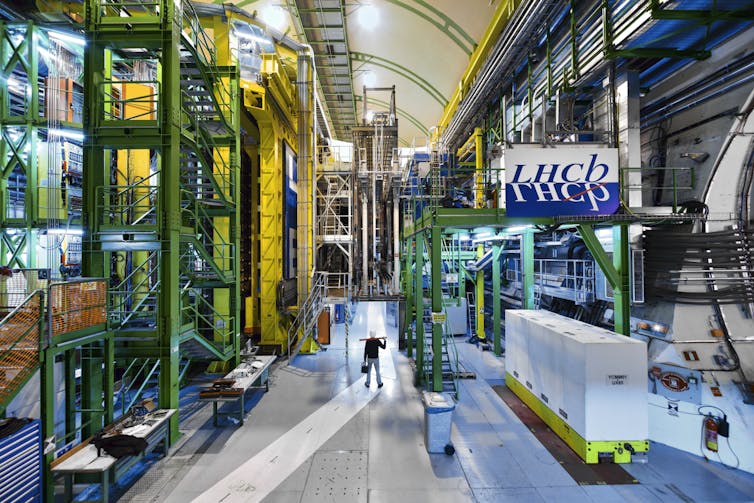
Our recent result from the LHCb experiment is a study of neutral B0 mesons, looking at their decays into pairs of charged K mesons. The B0 mesons were created by colliding protons with other protons in the Large Hadron Collider where they oscillated into their anti-meson and back three trillion times per second. The collisions also created anti-B0 mesons that oscillate in the same way, giving us samples of mesons and anti-mesons that could be compared.
We counted the number of decays from the two samples and compared the two numbers, to see how this difference varied as the oscillation progressed. There was a slight difference – with more decays happening for one of the B0 mesons. And for the first time for B0mesons, we observed that the difference in decay, or asymmetry, varied according to the oscillation between the B0 meson and the anti-meson.
In addition to being a milestone in the study of matter-antimatter differences, we were also able to measure the size of the asymmetries. This can be translated into measurements of several parameters of the underlying theory. Comparing the results with other measurements provides a consistency check, to see if the currently accepted theory is a correct description of nature. Since the small preference of matter over antimatter that we observe on the microscopic scale cannot explain the overwhelming abundance of matter that we observe in the universe, it is likely that our current understanding is an approximation of a more fundamental theory.
Investigating this mechanism that we know can generate matter-antimatter asymmetries, probing it from different angles, may tell us where the problem lies. Studying the world on the smallest scale is our best chance to be able to understand what we see on the largest scale.

Lars Eklund works for Uppsala University and is affiliated with the University of Glasgow, which would both benefit from any publicity generated by this article. He has received funding from STFC in the UK .
: The Conversation – Articles (UK)
Have you tried: Travelling to South Africa?