
Cats: a box office bomb, but has anyone noticed the ethnic stereotyping?:
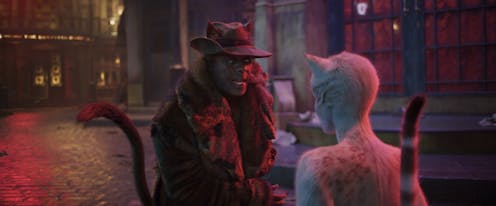
The US$ 100 million film version of Andrew Lloyd Webber’s smash-hit musical Cats, currently in cinemas, has bombed at the box office, been savaged by critics and withdrawn from Oscar consideration.
Part of this failure relates to problems in adaptation. How should creators transpose animal characters from stage to screen? How do we view bodies differently in real and recorded formats? What kind of criteria should be used to judge a hybrid production? But one thing the media has hardly mentioned, that is a problem, is the racial bias that is embodied in the representation of the cats on screen.
Adapting a text or play for the screen can be a tricky business. We inherit certain expectations from source materials, and ask questions about “fidelity” and what’s been added and cut when a narrative is translated into film.
TS Eliot’s original poems for children were adapted to a stage show by Andrew Lloyd Webber in 1981. The musical was hugely successful and went on to run for more than 20 years, grossing several billion dollars and winning seven Tony awards.
Nearly four decades later, Universal Pictures adapted the show for the big screen and the resulting film was released in December 2019. The audience for this film is made up of musical theatre fans as well as other moviegoers who may not have the same expectations – and the film must make sense for both groups.
Much of the controversy over the Cats adaptation has focused on how bodies are represented and viewed. Cats as a stage show, with its 1980s unitards, was heavy on sex appeal – particularly Rum Tum Tugger, whose hip-thrusting choreography conjured up animalistic hedonism.
Criticism of the movie has fixated on CGI choices, the grafting of moving ears, tails and “digital fur”, and removal of human parts in pursuit of the “U” rating. In a moment that may be an in-joke, the character Jennyanydots wonders if Rum Tum Tugger has been neutered.
Uncanny valley
In digital film, an effect recently described as “uncanny valley” – the slightly creepy effect created by use of technology to alter images – means that we find hybrid bodies disconcerting, as our expectations are confused. Are these human-like cats, or cat-like humans? Is the feline characterisation erotic or innocent? Is this a movie for adults or children?
Read more: Uncanny valley: why we find human-like robots and dolls so creepy
There’s also a big difference between the way music works on stage and on screen – and if you saw the musical, your expectations for the film might leave you disappointed. The director, Tom Hooper, chose quiet, up-close delivery, similar to the effect he chose for his 2012 musical film version of Les Misérables, prioritising intimate vocals over the projection needed in a stage show. An exception is made for Jennifer Hudson’s powerful voice (as Grizabella), which we are primed for by her fame as a singer and a preview of her big moment in the trailer.
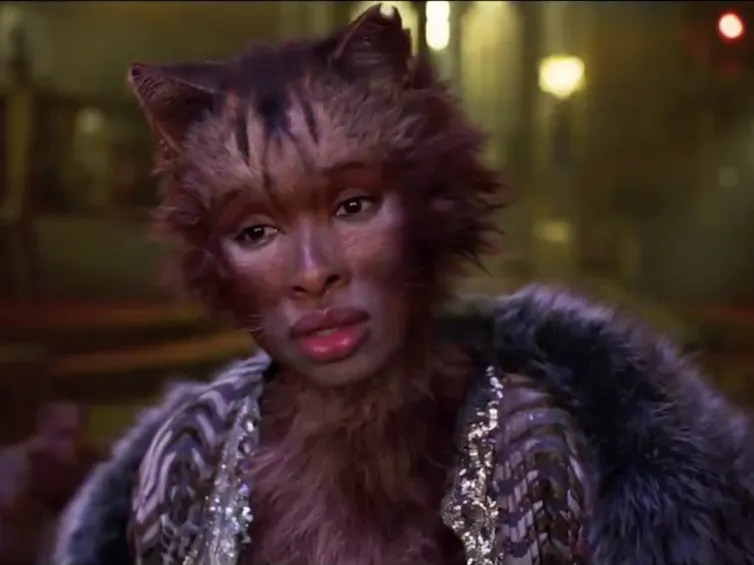
In fact, most of her big number, Memory, is almost spoken. Hushed vocals, made for film, contrast with large-scale, theatrical choreography (much borrowed from the stage show). This confuses our expectations of the screen versus the stage even further.
But none of these issues prepare us for the central problem with the 2019 Cats – the racial bias evident in characterisation.
Racial bias
Since black-face minstrelsy, musical theatre has had a fraught history with race. It could be argued that anthropomorphised animal characters have the potential to express racial bias at its most troubling. For example, American academic and theatre-maker Jessica Brater and her co-authors have noted (in Theatre Journal – not available online) how the character of Donkey in Shrek The Musical – an adaptation from Eddie Murphy’s voicing of the character from the animated film – embodies the lineage of minstrelsy in operation on the Broadway stage.
In the Cats movie, black actors portray marginalised characters. Macavity, the criminal – originally a ginger cat – is now Idris Elba, clad in rich brown digital fur. Grizabella the outcast is also a character of colour, played, as we have heard, by Jennifer Hudson. Grizabella’s saviour, Old Deuteronomy, comes in the distinctly white form of Judi Dench. This is doubly unfortunate given the history of the character on stage – played by several black actors including Ken Page on Broadway and Quentin Earl Darrington in the 2016 revival.
Jason Derulo recreates the oversexed Rum Tum Tugger bedecked in hip-hop apparel.
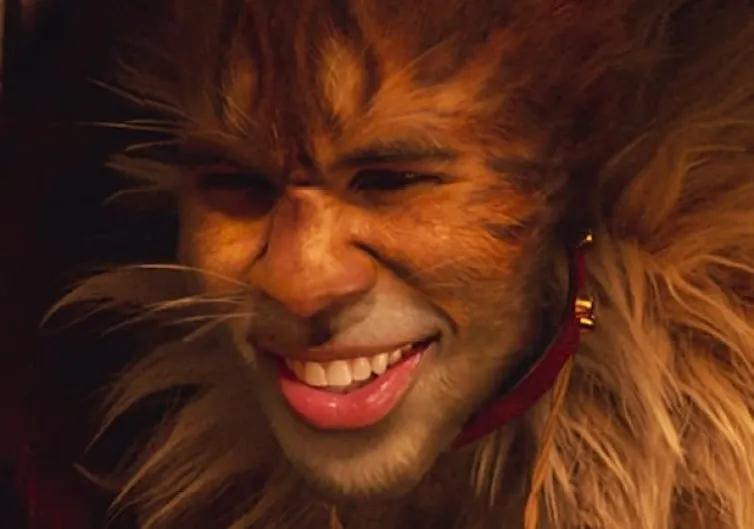
The central character, Victoria – the white cat, ballerina and ingenue – is played by a dancer of dual heritage, Francesca Hayward. But it has been noted in the press and by many commentators on Twitter, that only in her case is her original skin tone concealed, by digital whitewashing.
Overall, elements of casting, costume, cultural appropriation and aesthetics become more problematic on a cumulative basis, where actors who are visibly black are cast and costumed as the criminal, the Lothario and the outcast, while saviour and ingenue characters are made explicitly white.
But, apart from the apparent whitening of Hayward, this appears to have largely escaped the notice of the press.
The film seeks family appeal – and there is potentially a great deal of appeal in a tale of singing, dancing, CGI-enhanced cats to engage youngsters. But this huge budget spectacle frees itself from the obligation to take on the social responsibility that is assumed, for example, by BBC television productions and other content created explicitly for children.
If there is a cult afterlife for Cats, as some predict, it is not raciness but racial bias embedded in the film that will frame it markedly within our current age – a time that really ought to know better.

Jennifer Daniel has previously received funding from the AHRC, the Royal Musical Association and the Fund for Women Graduates. She is currently affiliated with the Labour Party.
: The Conversation – Articles (UK)
Have you tried: Travelling to South Africa?